StellaVLA:利用上下文中的结构化示范
构建可泛化的视觉—语言—动作模型
StellaVLA: In-Context Structured Demonstration for Generalizable Vision-Language-Action Models
StellarEdge AI Technical Team
Siyu Xu, Yunke Wang, Zijian Wang, Dihao Zhu, Chenghao Xia,
Chengbin Du, Daochang Liu, Tao Huang, Chang Xu
arXiv:2608.11671v1 [cs.RO],2026 年 8 月 12 日提交
技术报告封面日期:2026 年 8 月 1 日
中文逐段翻译与解释
整理日期:2026 年 11 月 1 日
构建可泛化的视觉—语言—动作模型
StellaVLA: In-Context Structured Demonstration for Generalizable Vision-Language-Action Models
StellarEdge AI Technical Team
Siyu Xu, Yunke Wang, Zijian Wang, Dihao Zhu, Chenghao Xia,
Chengbin Du, Daochang Liu, Tao Huang, Chang Xu
arXiv:2608.11671v1 [cs.RO],2026 年 8 月 12 日提交
技术报告封面日期:2026 年 8 月 1 日
中文逐段翻译与解释
整理日期:2026 年 11 月 1 日
解释
阅读方式。沿用本工作区已完成译文的三联框:灰色框保留英文原文,蓝色框给出中文译文,橙色框解释概念、方法和结论边界。图表采用原论文源码中的矢量图或完整重排表格,附原注、译注及绿色解读框。保留原章节、公式和图表编号;参考文献列表从略,编号对应原文。附录 A–D 全部覆盖。解释框是本译稿的分析,不属于作者原文。
来源与许可。原论文:https://arxiv.org/abs/2608.11671v1;PDF:https://arxiv.org/pdf/2608.11671v1;项目页:https://stelledge.com/blog/stellavla。论文以 CC BY 4.0 发布,许可见 https://creativecommons.org/licenses/by/4.0/。本文件在原作基础上增加中文翻译、解释并调整排版;原作者不因此为译稿背书。英文内容以下载的 v1 源码及 PDF 为依据。
来源与许可。原论文:https://arxiv.org/abs/2608.11671v1;PDF:https://arxiv.org/pdf/2608.11671v1;项目页:https://stelledge.com/blog/stellavla。论文以 CC BY 4.0 发布,许可见 https://creativecommons.org/licenses/by/4.0/。本文件在原作基础上增加中文翻译、解释并调整排版;原作者不因此为译稿背书。英文内容以下载的 v1 源码及 PDF 为依据。
目录
导读摘要(Abstract)1 引言(Introduction)2 相关工作(Related Work)2.1 作为动作表示的语言2.2 测试时适应与上下文条件化 VLA2.3 人类与跨本体示范3 方法(Methodology)3.1 离线结构化上下文提取3.2 并行双重训练范式3.3 非对称推理与缓存4 实验(Experiments)4.1 实验设置4.2 仿真中的泛化4.2.1 LIBERO 分布内验证4.2.2 VLA-Arena 任务级泛化4.2.3 LIBERO-Plus 零样本鲁棒性4.3 真机与跨本体评估4.4 理解结构化示范4.5 空间语言监督与部署5 结论(Conclusion)6 作者名单(Author List)A 实现细节(Implementation Details)B 真机设置(Real-World Setup)C 补充分析(Additional Analysis)C.1 示范结构D 讨论与局限(Discussion and Limitations)导读
本文解决的问题。VLA 在训练分布之外经常失效。作者希望部署时只需给模型看一条相关示范,就能改变行为,而不用针对新情况再次微调。难点是模型可能忽略原始演示视频与动作数值,仍按训练时学到的习惯行动。方法的完整链条。先离线把演示分成子目标,用视觉语言模型标注“当前在做什么”,再把真实运动转换成统一的 2D/3D 文字描述。训练时检索一条示范作为上下文,并让共享主干同时完成连续动作预测与空间语言预测;部署时保留示范输入、缓存其前缀,只运行连续动作分支。| 概念 | 本文中的具体含义 |
| VLM / VLA | 视觉语言模型理解图文;VLA 进一步输出机器人动作。 |
| ICL / ICIL | 上下文学习 / 上下文模仿学习:部署时改变输入示范,模型权重保持不变。 |
| 结构化示范 | 有顺序的子目标,加关键帧、机器人状态、2D 轨迹及 3D 运动描述。 |
| 动作块(chunk) | 一次预测未来 H 步连续动作,而非一次只预测一个动作。 |
| 空间语言专家 | 训练时预测子任务及该动作块的文字化运动;推理时不生成这段文字。 |
| 跨本体(cross-embodiment) | 示范可来自真人手或另一种机器人;可执行动作仍在目标机器人动作空间内学习。 |
| KV 缓存 | 重用固定示范前缀的注意力键值,减少后续控制步的重复编码。 |
摘要(Abstract)
原文
Vision-Language-Action (VLA) models can follow instructions and manipulate objects, but their performance often collapses out of distribution (OOD), when the scene, viewpoint, or object differs from training. Adapting to each new situation typically requires collecting more data and fine-tuning. We present StellaVLA, a framework that instead adapts at test time by conditioning on a single retrieved demonstration. The key idea is to move beyond imitating what an expert did and instead convey why: an automated offline pipeline converts each raw trajectory into a structured demonstration, e.g., a task plan, sub-goal descriptions, and verbalized 3D motion, at zero human-annotation cost. Provided as in-context guidance, this structured demonstration lets the policy reason about the task rather than mimic a pixel trajectory, which also makes it transferable across embodiments (real-robot, human-hand, or XR demonstrations). A parallel dual-training design internalizes this reasoning during training through a joint action-and-language objective, while inference uses the action expert alone, preserving real-time, high-frequency control with no added latency. On the VLA-Arena leaderboard(注:https://vla-arena.github.io/#leaderboard) (Aug 1, 2026), StellaVLA ranks first with an overall score of 0.63, versus 0.44 and 0.22 for the strong prior models (\pi_{0.5} and LingBot-VLA), and it further leads on LIBERO with 98.8% average success rate and LIBERO-Plus with 85.1% success rate. Our real-robot benchmark demonstrates that StellaVLA can use both human/robot demos and human-to-robot (XR) demos as in-context structured demonstration to help VLA model adapt to OOD tasks.
译文
视觉—语言—动作(Vision-Language-Action,VLA)模型能够遵循指令并操作物体,但当场景、视角或物体与训练时不同时,它们在分布外(out of distribution,OOD)的表现常常会崩溃。适应每一种新情况通常需要收集更多数据并微调。我们提出 StellaVLA:一个通过以单条检索到的示范为条件,在测试时完成适应的框架。核心思想是不仅模仿专家做了什么,还要传达为什么这样做:自动化离线流水线以零人工标注成本,把每条原始轨迹转换成结构化示范,例如任务计划、子目标描述及文字化的三维运动。作为上下文指导,这种结构化示范使策略能够对任务进行推理,而不只是模仿像素轨迹,也因此能够跨本体迁移,包括真实机器人、真人手或 XR 示范。并行双重训练设计通过动作与语言的联合目标,在训练期间将这种推理内化;推理时则只使用动作专家,从而保持实时、高频控制而不增加延迟。在 VLA-Arena 排行榜(2026 年 8 月 1 日)上,StellaVLA 以 0.63 的总体得分位列第一,此前强模型 \pi_{0.5} 和 LingBot-VLA 分别为 0.44 和 0.22;它还在 LIBERO 上以 98.8% 的平均成功率、在 LIBERO-Plus 上以 85.1% 的成功率取得领先。我们的真机基准表明,StellaVLA 可以把人类/机器人示范以及人到机器人的 XR 示范用作上下文中的结构化示范,帮助 VLA 模型适应 OOD 任务。
解释
摘要把三件事串在一起:把示范变得可理解、训练模型利用示范、部署时省去文字生成。XR 是扩展现实(extended reality),在本文中用于记录人手操作并重定向到机器人。这里的“为什么”主要是可观察的子目标与运动结构,并非测量到了专家真实心理活动。“零人工标注”不等于零数据采集或零计算成本。“无额外延迟”也需要结合表 8 理解:去掉的是在线自回归解释的开销,示范注意力和编码仍有成本。排行榜名次是作者所述日期的快照。
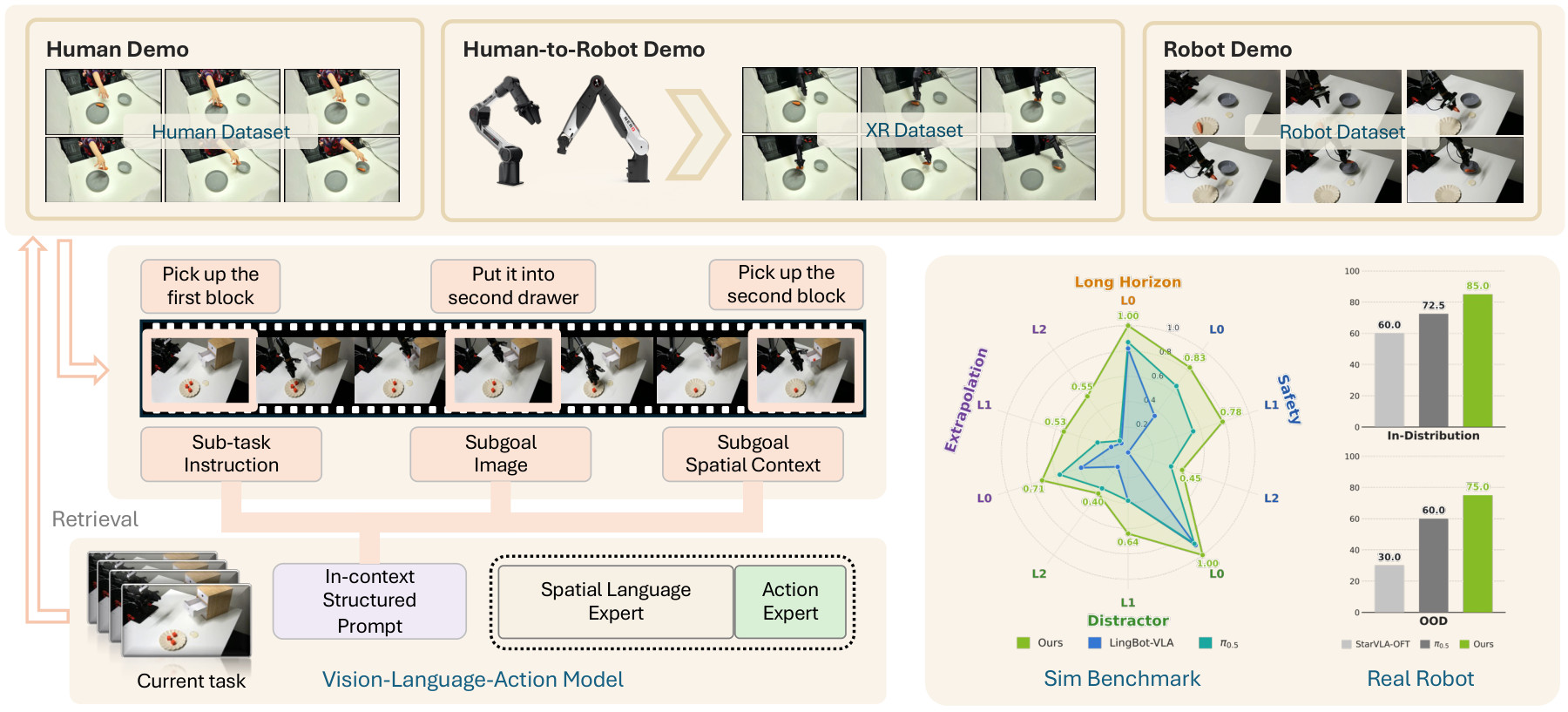
图 1:StellaVLA 总览:VLA 策略以上下文中的结构化示范为条件。我们把不同的人类和机器人演示转成结构化样例,每例包含高层语义理由(子目标)和细粒度运动学理由(运动),检索后用于提示 VLA 完成操作任务。训练时,辅助空间语言专家对这些理由提供监督,使策略依据底层推理而不只是模仿观测运动来锚定动作。推理时移除该专家,只使用动作专家,以保持实时控制。最终模型在仿真和真机中对未见任务与环境展现出更稳健的泛化。
原图注:Overview of StellaVLA, which conditions a VLA policy on in-context structured demonstrations. We convert diverse human and robot demonstrations into structured examples. Each example comprises high-level semantic rationales (sub-goals) and fine-grained kinematic rationales (movements), which are retrieved to prompt a vision-language-action model for manipulation tasks. During training, an auxiliary spatial-language expert supervises these rationales so the policy grounds its actions in the underlying reasoning rather than only imitating the observed motions. At inference this expert is removed and only the action expert is used, preserving real-time control. The resulting model generalizes more robustly to unseen tasks and environments in both simulation and real-world experiments.
图 1 解读
从左向右看:左边是人手、XR 人到机器人、真实机器人三类数据,经统一处理后进入检索;中间把当前任务与子目标序列、关键帧、空间上下文拼成结构化提示;右边是共享 VLA 及动作和空间语言两分支,再用于仿真或真机。 图中的“解释”具体是什么:例如“拿起第一块积木—放进第二层抽屉—拿起第二块”,每一步附空间状态。它表达程序与运动,而非直接读取人的心理活动。 图的作用:给出数据到部署的全链条。两种训练输出不构成先语言后动作的串行控制;推理时删语言分支后,示范前缀仍然存在。
1引言(Introduction)
原文
Vision-Language-Action (VLA) models have become a prominent paradigm for robotic manipulation [4, 23]. Built on pretrained Vision-Language Models (VLMs), they translate visual and textual inputs into physical actions. In practice, however, their performance degrades sharply out of distribution (OOD), when the scene, viewpoint, or object differs from training [9, 49, 61], and recovering typically requires collecting new data and fine-tuning. In-Context Imitation Learning (ICIL) offers a way to adapt at test time without weight updates [13, 57]. By appending retrieved expert trajectories, e.g., sequences of observations and low-level actions, as a contextual prefix, ICIL gives the policy a non-parametric memory it can imitate on the fly. But existing frameworks use these trajectories only as raw observations and continuous actions, which encourages surface-level imitation: the policy sees what the expert did without the why. Lacking that structure, it often treats the demonstration as noise and falls back on its pretrained priors [49], which is a behavioral inertia that keeps it from generalizing to out-of-distribution tasks.
译文
视觉—语言—动作(VLA)模型已经成为机器人操作的重要范式。它们建立在预训练视觉—语言模型(VLM)之上,把视觉和文字输入转换成物理动作。然而在实践中,一旦场景、视角或物体与训练时不同,其分布外表现便会急剧下降;恢复性能通常需要收集新数据并微调。上下文模仿学习(In-Context Imitation Learning,ICIL)提供了一种测试时不更新权重的适应方式。通过把检索到的专家轨迹——例如观测与底层动作的序列——追加为上下文前缀,ICIL 为策略提供了可以即时模仿的非参数记忆。但是现有框架只把这些轨迹当作原始观测和连续动作,容易促成表层模仿:策略看到了专家做了什么,却不知道为什么。缺少这种结构时,它经常把示范视为噪声,转而依赖预训练先验;这种行为惯性阻碍了它向分布外任务泛化。
解释
参数适应与输入适应是不同的。微调把新经验写入权重;ICIL 把经验作为本次输入,类似先看例题再做新题。“非参数记忆”指示范存放在外部库中,而不是要求模型没有参数。作者指出一个训练与使用之间的障碍:把长视频或动作数组放进输入,并不保证模型会利用它。行为惯性(behavioral inertia)在这里指模型继续执行熟悉套路,即使上下文给了新的操作程序。
原文
Reasoning provides the missing structure. Foundation models generalize better when the intermediate reasoning is made explicit rather than left implicit [17, 51, 59, 60]: decomposing a task into logical steps exposes the why behind each action. The question we address is how to surface this reasoning inside retrieved demonstrations, so that a VLA policy imitates the expert's reasoning rather than only its motions. Motivated by this idea, we propose StellaVLA (Figure 1), which advances ICIL by turning demonstrations into structured, reasoning-augmented context. An automated offline pipeline converts raw expert trajectories into this form at zero human-annotation cost: following the “language-as-action” paradigm [8, 29], a VLM segments long-horizon trajectories and generates hierarchical rationales, high-level semantic rationales (sub-goals) and fine-grained kinematic rationales (movements), which augment each demonstration alongside its original observations and actions. Applied across sources, this yields a unified cross-embodiment demonstration pool.
译文
推理提供了缺失的结构。当中间推理被明确呈现而不是保持隐含时,基础模型往往能更好地泛化:把任务分解成逻辑步骤,能够揭示每个动作背后的原因。我们研究的问题是如何在检索到的示范中显式呈现这种推理,使 VLA 策略模仿专家的推理,而不只是模仿运动。受此启发,我们提出 StellaVLA(图 1),通过把示范转换成结构化、推理增强的上下文来推进 ICIL。自动化离线流水线以零人工标注成本将原始专家轨迹转换成这种形式:遵循“语言即动作”(language-as-action)范式,由 VLM 对长时程轨迹进行分段并生成分层理由,包括高层语义理由(子目标)和细粒度运动学理由(运动),把这些内容连同原始观测和动作一起加入每条示范。对不同来源进行同样处理,就得到统一的跨本体示范池。
解释
结构化的例子可以是:“先打开抽屉,再把积木放进去,最后关抽屉”,每一步再附上末端移动方向和图像中的路径。高层子目标解决任务顺序,低层运动描述解决如何落到空间中。离线流水线只需对演示处理一次,因此可以使用较昂贵的 VLM 标注,而不把它放进实时控制回路。人手和机器人的关节结构不同,但可以共享“打开抽屉”及空间位移的描述。关于“推理”的机制性解释仍是作者的建模动机,需要结合后文消融判断支持程度。
原文
Unlike prior ICIL methods that rely on prompting alone [21, 58], StellaVLA couples in-context prompting with explicit supervision through a parallel dual-training design. During training, the model conditions on the retrieved rationale-augmented demonstrations and is jointly optimized to predict low-level actions and to articulate the corresponding rationales, internalizing both what to do and why. The language supervision grounds actions in their semantic intent, while the retrieved rationales act as a reusable template for how to plan in similar situations. At inference, the spatial-language expert is removed entirely: the policy uses only the action expert, guided by the KV-cached demonstration prefix, giving real-time high-frequency control with no added latency while still benefiting from the task structure learned during training.
译文
与仅依靠提示的既有 ICIL 方法不同,StellaVLA 通过并行双重训练设计,把上下文提示与显式监督结合起来。训练时,模型以检索到的、理由增强的示范为条件,同时优化底层动作预测与对应理由的表达,使其内化做什么和为什么。语言监督把动作与其语义意图联系起来,检索到的理由则提供一种可复用的模板,用于规划相似情形。推理时,空间语言专家被完全移除:策略只使用动作专家,由经过 KV 缓存的示范前缀引导,既受益于训练期间学到的任务结构,又能在不增加延迟的情况下实现实时高频控制。
解释
这里有两个不同的信息通道:示范是输入条件,语言目标是训练信号。二者同时作用于共享主干,却不能视为同一个模块。动作头与语言头并行,动作不需要等解释文本逐词生成后才能得到,所以可以在部署时关掉语言头。删掉语言头也没有删掉示范输入。文中的“内化推理”可以理解为辅助任务改变了表征;论文并没有直接观察到某种内部思维过程。
原文
Our main contributions are:
- We propose StellaVLA, a retrieval-augmented VLA framework that shifts ICIL from imitating actions to imitating the reasoning behind them, reducing behavioral inertia under OOD conditions.
- A parallel dual-training design, fed by a zero-human-cost offline extraction pipeline, that internalizes expert reasoning during training and strips the spatial-language expert at inference, leaving the control loop free of autoregressive decoding overhead.
- Extensive simulation and real-robot manipulation experiments show that StellaVLA ranks first on the VLA-Arena leaderboard (Aug 1, 2026) with an overall score of 0.63, while achieving 98.8% average success in LIBERO and leading in LIBERO-Plus and our real-robot benchmark.
译文
我们的主要贡献如下:
- 提出 StellaVLA,一个检索增强 VLA 框架,使 ICIL 从模仿动作转向模仿动作背后的推理,从而减轻 OOD 条件下的行为惯性。
- 提出由零人工成本离线提取流水线提供数据的并行双重训练设计,在训练时内化专家推理,并在推理时移除空间语言专家,使控制回路不承担自回归解码开销。
- 广泛的仿真和真机操作实验表明,StellaVLA 在 VLA-Arena 排行榜(2026 年 8 月 1 日)以 0.63 的总体得分排名第一,在 LIBERO 上达到 98.8% 的平均成功率,并在 LIBERO-Plus 及作者的真机基准上取得领先。
解释
三项贡献分别对应示范表示、训练与部署架构、实验验证。本文使用现成的 Qwen3-VL 主干与 MLP 动作头,重点是如何组织及利用示范。比较结果时需注意:部分基线直接引用各自论文或排行榜;真机 StarVLA-OFT 才是同主干、同数据的匹配对照。测试阶段不更新参数不代表没有目标任务示范,这一点在 VLA-Arena 上尤其重要。
2相关工作(Related Work)
原文
Vision-language-action (VLA) models adapt pretrained vision-language backbones for robotic control. Actions can be generated as discretized tokens [23], or predicted through regression, flow-matching, and frequency-domain action heads [4, 16, 24, 35, 37]. Recent work has further improved computational efficiency [11, 34, 47, 48] or augmented policy representations with geometric, depth, and world-model priors [19, 26, 27, 32, 40, 42, 56]. In contrast, StellaVLA retains a standard VLM backbone with a continuous-action expert and focuses on a complementary question: how expert demonstrations should be represented and exploited as in-context supervision.
译文
视觉—语言—动作(VLA)模型将预训练视觉语言主干适配到机器人控制。动作既可以生成为离散 token,也可以通过回归、流匹配以及频域动作头预测。近期工作进一步提高了计算效率,或者借助几何、深度及世界模型先验增强策略表征。相比之下,StellaVLA 保留标准 VLM 主干和连续动作专家,关注一个互补的问题:应如何表示专家示范,并将其用作上下文中的监督信息。
解释
动作输出方式与示范输入方式是两个设计维度。离散 token 方法把动作量化成符号序列;回归直接输出连续数值;流匹配从噪声逐步得到动作;频域头则在变换域表示动作序列。本文选择直接回归,并没有提出新的世界模型。这里所谓“上下文监督”是示范在输入中提供参照,不意味着推理时计算梯度或更新权重。
2.1作为动作表示的语言
原文
Language-as-action methods represent robot behavior using the vocabulary of pretrained VLMs, providing a semantic interface between high-level reasoning and continuous control. Prior work verbalizes low-level actions, jointly models language and action tokens, or represents action hierarchies and subtasks in language [2, 15, 28, 52]. By expressing behavior in the VLM's semantic space, these approaches retain an interpretable correspondence between task intent and robot motion.
译文
“语言即动作”方法使用预训练 VLM 的词汇来表示机器人行为,为高层推理与连续控制提供语义接口。已有工作把底层动作文字化、联合建模语言与动作 token,或者用语言表示动作层级和子任务。通过在 VLM 的语义空间中表达行为,这些方法保留了任务意图与机器人运动之间可解释的对应关系。
解释
机器人命令中的浮点数对语言模型未必天然有意义,而“向右移动、靠近把手、闭合夹爪”与其预训练语义知识更接近。“词汇”也可以包含数字和结构化字段,因此并不等于把运动描述成随意的日常文字。可解释性来自任务和运动之间有可读对应关系,不代表文字形式一定比连续动作更精确。
原文
StellaVLA uses language as a shared representation for both retrieved context and training supervision. Each demonstration is organized into subgoals that pair semantic descriptions and keyframes with language-rendered robot states and 2D/3D motions, yielding a structured semantic state-action sequence. During training, a language expert predicts the current subtask and a language rendering of the same action chunk predicted by the continuous action expert. This shared interface connects demonstration-level procedural structure with step-level control, while the language expert is removed at inference. This differs from latent-action approaches, which encode behavior into learned latent variables outside the VLM's native semantic space [5, 50].
译文
StellaVLA 将语言用作检索上下文与训练监督的共享表示。每条示范按子目标组织,将语义描述和关键帧与语言化的机器人状态、2D/3D 运动配对,形成结构化的语义状态—动作序列。训练时,语言专家预测当前子任务,以及连续动作专家所预测的同一个动作块的语言表示。这种共享接口把示范层面的程序结构与逐步控制联系起来,而语言专家在推理时被移除。这不同于潜在动作方法:后者把行为编码成 VLM 原生语义空间之外的、学习得到的潜变量。
解释
关键是两端使用同一种描述规范:示范中的“这一段怎么运动”和训练目标中的“未来这个动作块怎么运动”由同一个规则转换器生成。这样模型看到的示范与自己要预测的动作之间有共同接口。潜在动作(latent action)则是学习出来的压缩编码,不一定能直接读懂;本文采用的文字表示更可读,但也会受到量化精度和词元长度的约束。
2.2测试时适应与上下文条件化 VLA
原文
Robot policies can adapt at deployment either by updating model parameters or by conditioning a fixed policy on additional experience. Test-time training methods update fast weights, latent prompts, or memory using deployment data [12, 22, 43, 55]. In contrast, context-conditioned approaches leave the policy parameters unchanged and adapt behavior through demonstrations, retrieved experience, or execution history [31, 33, 39, 57]. Recent work has further explored in-context imitation and retrieval-based adaptation for VLAs [13, 20, 41].
译文
机器人策略可以在部署时通过更新模型参数来适应,也可以让固定策略以额外经验为条件。测试时训练方法使用部署数据来更新快权重、潜在提示或记忆。相比之下,上下文条件化方法保持策略参数不变,通过示范、检索经验或执行历史来调整行为。近期工作进一步探索了 VLA 的上下文模仿与基于检索的适应。
解释
本文属于固定参数、改变上下文这一路线。需要区分“训练这个能够读示范的模型”与“部署时学习一个新任务”:前者仍然需要完整微调,后者不再进行参数更新。执行历史是当前机器人已经经历的片段,检索示范则来自另一个成功回合;二者的信息来源和用途不同。
原文
The supplied context, however, can play substantially different roles. \pi_{0.7} conditions on subtask instructions, subgoal images, episode metadata, and control modes to specify an execution strategy [36], while Qwen-RobotManip uses recent observation–state–action chunks to adapt to the dynamics of the current episode [38]. StellaVLA instead retrieves a prior demonstration and converts it into a structured procedural context composed of segment-level subtasks and grounded 2D/3D motion. The retrieved episode therefore serves as an explicit task demonstration rather than merely additional execution history, enabling adaptation without parameter updates.
译文
不过,所提供的上下文可以扮演非常不同的角色。\pi_{0.7} 以子任务指令、子目标图像、回合元数据及控制模式为条件来指定执行策略;Qwen-RobotManip 使用近期的观测—状态—动作块,适应当前回合的动力学。StellaVLA 则检索过去的示范,将其转换成由分段子任务以及具有空间落点的 2D/3D 运动组成的结构化程序上下文。因此,被检索的回合充当的是明确的任务示范,而不只是额外的执行历史,从而能够在不更新参数的情况下完成适应。
解释
一段上下文可能告诉模型“当前机械臂反应有多快”,也可能告诉它“这个任务应先做哪一步”。前者更接近动力学适应,后者是本文的程序性指导。这里的 grounded 指运动能对应到图像位置或真实工作空间;可译为“空间锚定”或“具有空间落点”,不只是抽象文字。
2.3人类与跨本体示范
原文
Human videos and heterogeneous robot data provide broader behavioral coverage than single-platform demonstrations, but differ in both embodiment and action space. Prior work addresses this mismatch through shared latent actions, cross-embodiment motion representations, world models, video conditioning, retargeting, or canonicalized action spaces [3, 6, 7, 14, 18, 38, 44].
译文
人类视频和异构机器人数据提供了比单平台示范更广的行为覆盖,但其本体和动作空间不同。既有工作通过共享潜在动作、跨本体运动表示、世界模型、视频条件化、重定向或者规范化动作空间等方式来解决这种不匹配。
解释
人有手指和腕关节,机械臂可能只有六个关节及平行夹爪,因而不能直接把人手的控制向量送给机器人。重定向(retargeting)是把一种身体上的运动转换到另一种身体上;规范化动作空间则预先定义统一动作表示。本文的选择是在“作为参考的示范”这一侧统一表示。
原文
StellaVLA instead addresses cross-embodiment demonstrations at the representation level. Real-robot, human-hand, and XR-retargeted demonstrations are converted into a common structured representation of semantic subtasks and grounded motion before retrieval. Crucially, off-embodiment demonstrations are used only as context, and executable actions are always predicted and supervised in the target robot's native control space. This separation allows heterogeneous demonstrations to provide procedural guidance without requiring their source action spaces to be directly aligned with the target policy.
译文
StellaVLA 在表示层面处理跨本体示范。真实机器人、真人手和 XR 重定向示范在检索前,被转换为共同的结构化表示:语义子任务以及具有空间锚定的运动。关键在于,异本体示范只作为上下文使用;可执行动作始终在目标机器人的原生控制空间中预测并接受监督。这种分离使异构示范能够提供程序指导,而无需将其来源动作空间与目标策略直接对齐。
解释
人手数据教的是程序,真机数据教的是如何驱动这台机器人。所以“跨本体”并不意味着本文仅凭人类视频就学会了机械臂控制。动作标签全部来自目标真机,异本体数据只进入检索池。统一表示仍需要相机标定、坐标约定和追踪等基础条件,这些细节在附录 B 进一步说明。
3方法(Methodology)
原文
In this section, we detail the StellaVLA framework, illustrated in Figure 2, which advances ICIL with structured contextual rationales to improve VLA generalization. We first present an automated offline pipeline that converts raw trajectories into rationale-augmented segments (Sec. 3.1), then introduce a parallel dual-training paradigm that uses these trajectories as both explicit supervision and in-context prompts (Sec. 3.2), and finally describe an asymmetric inference strategy that leaves the control loop free of autoregressive decoding overhead (Sec. 3.3).
译文
本节详细介绍图 2 所示的 StellaVLA 框架,它通过结构化上下文理由推进 ICIL,以提高 VLA 的泛化能力。我们首先介绍自动化离线流水线,将原始轨迹转换为理由增强的片段(3.1 节);然后介绍并行双重训练范式,使这些轨迹同时用作显式监督与上下文提示(3.2 节);最后介绍非对称推理策略,使控制回路不承担自回归解码开销(3.3 节)。
解释
阅读方法时可依次问三个问题:示范怎么制成、模型怎么训练、部署时保留什么。离线阶段可以做耗时的分段与标注,在线阶段则依靠已经训练好的主干和缓存快速预测动作。图 2 是连接这三个阶段的总图。
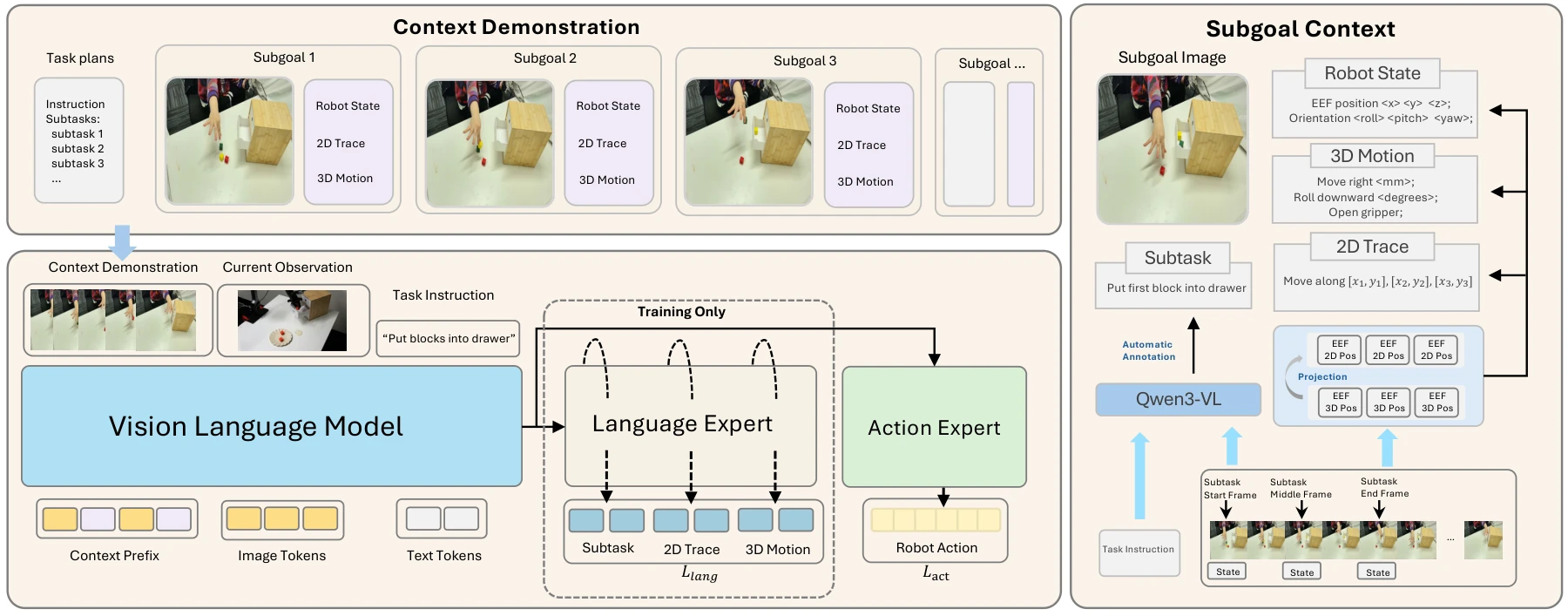
图 2:StellaVLA 框架总览。左上:检索到的上下文示范表示为任务计划与一系列子目标,每个子目标包含关键帧、机器人状态、二维轨迹和三维运动。右侧:这些标注由 VLM 推断和机器人轨迹自动离线生成,无需人工标注。左下:视觉语言模型将示范、当前观测和指令编码成共享表示,由动作专家用于动作预测,由空间语言专家仅在训练时提供辅助监督。推理时移除空间语言专家,只需一次前向传播。
原图注:Overview of StellaVLA. Top left: a retrieved context demonstration is represented as a task plan and a sequence of subgoals, each containing a keyframe, robot state, 2D trace, and 3D motion. Right: these annotations are generated automatically offline from VLM reasoning and robot trajectories, without human labeling. Bottom left: the vision-language model encodes the demonstration together with the current observation and instruction into a shared representation, which is consumed by an action expert for action prediction and a spatial-language expert for auxiliary supervision during training only. The spatial-language expert is removed at inference, requiring only a single forward pass.
图 2 解读
右侧是制作示范:Qwen3-VL 根据视频和任务标注子任务;轨迹中的末端三维位置通过相机投影得到二维点;状态、运动及子目标被整理成统一字段。图中 EEF 指末端执行器,roll/pitch/yaw 指滚转/俯仰/偏航。 左上是模型读到的参考:任务计划后按顺序展开子目标,每个子目标都配图像、状态、2D Trace 与 3D Motion;这是固定前缀。 左下是训练计算:图像 token、文本 token 及示范前缀进入主干,两个分支分别接受 \mathcal L_{\mathrm{act}} 与 \mathcal L_{\mathrm{lang}}。虚线 Training Only 框圈出语言专家,说明它不位于部署动作生成的必经路径。 关键区别:检索示范中的运动描述按整段生成,当前训练语言目标则按同一个短动作块生成;两者使用同一文字化算子 \Phi,但时间跨度不同。
3.1离线结构化上下文提取
原文
Raw trajectory formulation. An expert demonstration is recorded as \tau = \{(o_t, a_t)\}_{t=1}^T, where o_t denotes sensory input (e.g., multi-view RGB and proprioception) and a_t \in \mathbb{R}^{d_a} is the continuous control command (e.g., end-effector pose and gripper state). Such trajectories may come from diverse embodiments and collection paradigms, including real-robot teleoperation, human hand tracking, or XR-retargeted demonstrations [44]. Although they encapsulate successful executions, the raw numerical actions lack explicit semantic rationale, which hinders cross-embodiment reasoning.
译文
原始轨迹的形式化。一条专家示范记录为 \tau=\{(o_t,a_t)\}_{t=1}^{T},其中 o_t 表示传感输入,例如多视角 RGB 和本体感知;a_t\in\mathbb{R}^{d_a} 是连续控制命令,例如末端执行器位姿和夹爪状态。这些轨迹可以来自不同本体和采集方式,包括真实机器人遥操作、人手追踪或 XR 重定向示范。虽然它们包含成功执行的过程,但原始数值动作缺少明确的语义理由,这阻碍了跨本体推理。
解释
t 是时间步,T 是示范长度,d_a 是动作维数。本体感知(proprioception)指关节角、末端状态等机器人自身传感信息。\tau 是一串观测—动作对,不是单张图片。“末端位姿与夹爪”是一般性例子,本文真机实际预测的是六个关节目标量与夹爪宽度,不能把例子误当成所有平台统一的动作格式。
原文
Semantic segmentation via causal deduction. To bridge the semantic gap without incurring prohibitive human annotation costs, we introduce an automated offline pipeline (Figure 2, right) that deduces the expert's underlying thought process. The core motivation is to infer the “cause” (the expert's underlying structured rationale) from the “effect” (the observed physical execution). Given a raw trajectory \tau and its corresponding high-level task instruction \mathcal{I}, we utilize a powerful off-the-shelf Vision-Language Model (e.g., Qwen3-VL) to explicitly decompose the continuous trajectory into K discrete, semantically meaningful segments. For each segment k \in \{1, \dots, K\} spanning from time step t_{\mathrm{start}}^{(k)} to t_{\mathrm{end}}^{(k)}, the VLM analyzes the visual changes to identify the high-level sub-goal achieved. This process captures the true decision-making process that governs the expert's behavior.
译文
通过因果推断进行语义分段。为在不付出高昂人工标注成本的情况下弥合语义鸿沟,我们引入自动化离线流水线(图 2 右侧),推断专家潜在的思考过程。核心动机是从“结果”(观察到的物理执行)推断“原因”(专家潜在的结构化理由)。给定原始轨迹 \tau 及对应的高层任务指令 \mathcal{I},我们利用强大的现成视觉语言模型,例如 Qwen3-VL,将连续轨迹显式分解为 K 个离散且语义明确的片段。对每个 k\in\{1,\ldots,K\}、覆盖时间步 t_{\mathrm{start}}^{(k)} 到 t_{\mathrm{end}}^{(k)} 的片段,VLM 分析视觉变化,识别已实现的高层子目标。该过程捕捉支配专家行为的真实决策过程。
解释
K 是子任务段数,每段由起止时间界定。例如把“把积木放进抽屉并关上”分为打开、逐个放入、关闭。最后一句是作者的强表述。仅从视频反推意图属于对观测行为的事后解释,并不能证明恢复了专家真实的心理因果过程,也不是带干预的因果识别实验。实际可验证的产物是分段边界与子目标标签,其误标可能传递给后续训练。
原文
Kinematic verbalization via language-as-action. Once the trajectory is segmented, we adopt a “language-as-action” paradigm that deterministically translates physical actions within each segment into structured text. Because VLAs are built upon VLMs with a strong affinity for semantic language[15, 54], these rationales can be processed with the original text vocabulary, without introducing specialized action tokens.
译文
通过“语言即动作”将运动学文字化。完成轨迹分段后,我们采用“语言即动作”范式,以确定性的方式把每一段中的物理动作转换为结构化文字。由于 VLA 建立在对语义语言有很强亲和性的 VLM 之上,这些理由可以用原有文本词汇处理,无需引入专门的动作 token。
解释
这里要区分VLM 标注语义和规则转换运动:子目标由 VLM 推断,运动描述则根据真实运动确定性生成。确定性意味着同样的运动输入按同样规则得到同样文字,减少任意编造数值的风险。无需新增专用动作 token,指的是这些文字描述;连续动作仍由 MLP 输出。
原文
Ultimately, this two-tier process generates a Structured Context l_k for each segment that explicitly articulates the underlying logic through a hierarchical representation:
- Semantic Rationale (Sub-goal Description): Captures the high-level semantic objective achieved in this segment (e.g., “Reach for the handle of the blue mug”), automatically identified by the VLM based on visual observations.
- Kinematic Rationale (Movement Description): Verbalizes fine-grained motion as a 3D movement in the workspace (e.g., “Move the end-effector by \Delta x=+0.05, \Delta y=-0.02, \Delta z=+0.10 and close gripper”) and a 2D movement obtained by projecting the 3D trajectory onto the camera plane with known intrinsics/extrinsics. This dual form encourages the VLM to reason about spatial logic and visual grounding via text tokens, rather than emitting raw floating-point actions.
译文
最终,这个两层过程为每个片段生成结构化上下文 l_k,用分层表示显式表达底层逻辑:
- 语义理由(子目标描述):捕捉这一段所实现的高层语义目标,例如“伸向蓝色马克杯的把手”,由 VLM 根据视觉观测自动识别。
- 运动学理由(运动描述):把细粒度运动表述为工作空间中的三维运动,例如“让末端执行器移动 \Delta x=+0.05,\Delta y=-0.02,\Delta z=+0.10,并闭合夹爪”,以及利用已知相机内外参把三维轨迹投影到相机平面后得到的二维运动。这种双重形式鼓励 VLM 通过文本 token 进行空间逻辑与视觉锚定推理,而不是输出原始浮点动作。
解释
l_k 是第 k 段的上下文描述。语义回答“做什么”,三维运动回答“在工作空间怎样动”,二维轨迹回答“在图像中经过哪里”。同一个物理运动在不同相机中有不同像素轨迹,因此二维路径有助于把语言与图像对应起来。数值例子在原段没有标明单位,不能直接解释成毫米;如果约定为米,则三个位移分别是 +5,-2,+10 cm。二维投影依赖相机标定,并非无标定就能自动得到。
原文
Both kinematic fields are produced by a single deterministic verbaliser \Phi, which maps any contiguous span of actions to its 3D displacement in the workspace and to the 2D projection of that displacement onto the image plane. Applying \Phi over a whole segment yields the movement description carried inside l_k; we reuse the same operator at the much shorter scale of an action chunk in Sec. 3.2, which is what places the retrieved demonstration and the policy's own prediction in one common vocabulary. The sub-goal description, by contrast, is attached to every frame: each step t carries the subtask s_t that the expert is executing in the observation o_t.
译文
两个运动学字段都由同一个确定性文字化算子 \Phi 产生,它把任意连续动作区间映射为工作空间的三维位移,以及该位移在图像平面上的二维投影。把 \Phi 应用于整个片段,就得到 l_k 中的运动描述;在 3.2 节,我们将同一个算子复用于时间尺度短得多的动作块,从而把检索示范与策略自身的预测放进共同词汇体系。相比之下,子目标描述附着在每一帧上:每个时间步 t 都携带专家在观测 o_t 中正在执行的子任务 s_t。
解释
这里有两个时间尺度:片段可能覆盖“拿起一个积木”的完整过程;动作块只覆盖未来几个控制步。\Phi 在这两个尺度上使用统一的描述规则。s_t 是当前帧对应的子任务标签,通常由该帧所在片段的标签赋值得到;l_k 则描述整个片段。二者不能混成每个控制步都要生成完整任务计划。
原文
Rationale-augmented demonstration pool. Through this process, the original raw trajectory \tau is transformed into a rationale-augmented trajectory \tau_{\mathrm{rat}} = \{(o_t, a_t, s_t, l_k)\}_{t=1}^T, where each time step t is now grounded not only by its corresponding observation and action, but also by its own subtask label s_t and by the explicit segment-level structured rationale l_k of the segment it belongs to. By processing all available expert demonstrations through this pipeline, we construct a comprehensive demonstration pool \mathcal{D}_{\mathrm{pool}} = \{\tau_{\mathrm{rat}}^{(i)}\}_{i=1}^N.
译文
理由增强的示范池。经过上述过程,原始轨迹 \tau 被转换为理由增强轨迹 \tau_{\mathrm{rat}}=\{(o_t,a_t,s_t,l_k)\}_{t=1}^{T}。每个时间步不仅对应观测与动作,还关联其自身的子任务标签 s_t,以及所属片段明确的片段级结构化理由 l_k。将所有可用专家示范都通过这条流水线处理后,我们得到完整示范池 \mathcal{D}_{\mathrm{pool}}=\{\tau_{\mathrm{rat}}^{(i)}\}_{i=1}^{N}。
解释
N 是示范回合数,上标 (i) 表示第 i 条示范。严格地说,k 随时间步变化,应理解为“时间 t 所在的第 k(t) 段”;同一段里的多帧共享该段的 l_k。示范池保存这些增强后的回合,供训练和部署检索使用。这一步主要是数据表示与存储的变化,还没有训练控制策略。
3.2并行双重训练范式
原文
Retrieval-augmented prompt formulation. During training, the learning process is formulated as a leave-one-out retrieval task. To train the policy to imitate a specific target trajectory \tau_{\mathrm{tgt}} sampled from \mathcal{D}_{\mathrm{pool}}, the system queries the remaining pool \mathcal{D}_{\mathrm{pool}} \setminus \{\tau_{\mathrm{tgt}}\} and retrieves the top-1 rationale-augmented expert trajectory, ranked by cosine similarity between the language embeddings of the task instructions. Retrieval is therefore purely linguistic, which is what lets a demonstration recorded on another embodiment be retrieved for a robot episode. The retrieved trajectory is formatted into a contextual prefix prompt \mathcal{P}_{\mathrm{demo}}. The final input to the VLA model at time step t is constructed by concatenating the retrieved demonstration, the current task instruction \mathcal{I}, and the current observation o_t:
x_t = \bigl[ \mathcal{P}_{\mathrm{demo}} \oplus \mathcal{I} \oplus o_t \bigr](1)
Crucially, because \mathcal{P}_{\mathrm{demo}} contains the rich l_k descriptions from the experts, it acts as an implicit in-context learning (ICL) signal, providing the model with a cognitive template of how to “think” and plan in similar scenarios. 译文
检索增强提示的形式化。训练时,学习过程被表述为留一检索任务。为训练策略模仿从 \mathcal{D}_{\mathrm{pool}} 中采样的某条目标轨迹 \tau_{\mathrm{tgt}},系统查询剩余示范池 \mathcal{D}_{\mathrm{pool}}\setminus\{\tau_{\mathrm{tgt}}\},按任务指令语言嵌入之间的余弦相似度排序,检索最相近的一条理由增强专家轨迹。因此,检索完全基于语言,这使记录在另一种本体上的示范也能被检索来服务机器人回合。检索到的轨迹被格式化为上下文前缀提示 \mathcal{P}_{\mathrm{demo}}。时间步 t 的最终 VLA 输入由检索示范、当前任务指令 \mathcal{I} 和当前观测 o_t 拼接得到:
x_t=[\mathcal{P}_{\mathrm{demo}}\oplus\mathcal{I}\oplus o_t].\tag{1}
关键在于,\mathcal{P}_{\mathrm{demo}} 包含专家丰富的 l_k 描述,因此充当隐式上下文学习(ICL)信号,为模型提供在相似场景中如何“思考”和规划的认知模板。 解释
\setminus 表示从池中排除目标回合;这样避免把当前监督目标本身完整作为示范输入。top-1 表示每次只取一条示范,\oplus 是序列拼接而非数值相加。余弦相似度衡量两个任务文字向量的方向是否接近。留一不是留出整个任务:同一任务的其他示范仍可检索。附录明确指出,仿真任务指令集合封闭,检索实际退化为精确任务匹配,因此不能把该设置视为已经验证了开放世界的可靠检索。
原文
Parallel experts architecture. The core of our VLA policy is a unified Vision-Language Model backbone f_\theta equipped with two parallel experts (Figure 2, bottom left). Given the input x_t, the backbone processes the multimodal sequence into a shared latent representation h_t = f_\theta(x_t). This single latent vector is then simultaneously fed into:
- An action expert, a lightweight MLP head that regresses the continuous action chunk \hat{A}_t = (\hat{a}_t, \dots, \hat{a}_{t+H-1}) spanning the next H control steps.
- A spatial-language expert, the native autoregressive LM head, that emits the rationale \hat{c}_t = (\hat{s}_t, \hat{m}_t) of the current step: the subtask \hat{s}_t being executed in o_t, and the verbalised 3D and 2D movement \hat{m}_t of that very same action chunk.
译文
并行专家架构。VLA 策略的核心是统一视觉语言主干 f_\theta,配有两个并行专家(图 2 左下)。给定输入 x_t,主干把多模态序列处理为共享潜在表示 h_t=f_\theta(x_t),再将这一共享潜在向量同时送入:
- 动作专家:轻量 MLP 头,回归覆盖未来 H 个控制步的连续动作块 \hat A_t=(\hat a_t,\ldots,\hat a_{t+H-1})。
- 空间语言专家:原生自回归语言模型头,输出当前步的理由 \hat c_t=(\hat s_t,\hat m_t),即在 o_t 中正在执行的子任务 \hat s_t,以及同一个动作块的文字化三维和二维运动 \hat m_t。
解释
\theta 是主干参数,帽子 \hat{\ } 表示预测量,H 是动作块长度。核心依赖关系是 x_t\to h_t\to\{\hat A_t,\hat c_t\},而不是先生成解释再决定动作。附录把实现描述得更具体:动作占位 token 的隐藏状态送入 MLP,这些 token 在因果顺序上位于解释文本之前,无法读取后面的解释。正文的“单个向量”是概念化表示,不应据此断定实现只使用一个 token。
原文
Spatial language supervision. While the retrieved demonstration provides segment-level context, spatial-language supervision is defined at each time step as
c_t = \bigl(s_t,\; \Phi(A_t)\bigr),(1)
where s_t is the subtask label for o_t, A_t = (a_t, \dots, a_{t+H-1}) is the ground-truth action chunk, and \Phi(A_t) verbalises its 3D and 2D movement. The subtask label provides semantic supervision for the current task stage; the 2D movement grounds the prediction in o_t, while the 3D movement provides kinematic supervision in the workspace. 译文
空间语言监督。检索示范提供片段级上下文,而空间语言监督在每个时间步定义为
c_t=(s_t,\Phi(A_t)),\tag{2}
其中 s_t 是观测 o_t 的子任务标签,A_t=(a_t,\ldots,a_{t+H-1}) 是真实动作块,\Phi(A_t) 将其三维和二维运动文字化。子任务标签提供当前任务阶段的语义监督;二维运动把预测锚定到 o_t 中,三维运动则提供工作空间内的运动学监督。 解释
c_t 是训练标签,不是检索示范本身。它由“当前属于哪个子任务”和“接下来这 H 步如何运动”两部分组成。\Phi 输入的是真实动作块 A_t,不是预测动作 \hat A_t;因此动作回归与语言分支接受相互一致的真值监督。区分这一点可避免误认为语言分支只是给模型已经做出的错误动作写解释。
原文
Dual rationale objective. During training, the model is optimized to minimize a joint objective:
\mathcal{L} = \mathcal{L}_{\mathrm{act}}(\hat{A}_t, A_t) + \lambda \mathcal{L}_{\mathrm{lang}}(\hat{c}_t, c_t)(1)
where \mathcal{L}_{\mathrm{act}} is the regression loss for the continuous control commands (e.g., L_1 loss), \mathcal{L}_{\mathrm{lang}} is the standard autoregressive cross-entropy loss for the structured rationale text generation, and \lambda is a balancing coefficient. 译文
双重理由目标。训练期间,模型被优化以最小化联合目标:
\mathcal L=\mathcal L_{\mathrm{act}}(\hat A_t,A_t)+\lambda\mathcal L_{\mathrm{lang}}(\hat c_t,c_t).\tag{3}
其中 \mathcal L_{\mathrm{act}} 是连续控制命令的回归损失,例如 L_1 损失;\mathcal L_{\mathrm{lang}} 是用于结构化理由文本生成的标准自回归交叉熵损失;\lambda 是平衡系数。 解释
第一项惩罚动作数值错误,第二项惩罚目标文字 token 的预测错误,两者共同更新共享主干。以 L_1 为例,其直觉是把各维各步的绝对误差相加或平均;原式没有规定具体归约方式。\lambda 决定语言任务对训练的相对影响。默认 \lambda=0.3 并不表示“语言占总学习的 30%”,因为两种损失的量纲和尺度不同。\lambda=0 关闭语言监督,但仍然保留检索示范输入。
原文
The two experts provide complementary supervision for the shared representation h_t. Since \Phi is deterministic, A_t and \Phi(A_t) describe the same motion in continuous and linguistic forms. Together, the explicit semantic, grounding, and kinematic supervision in c_t and the contextual guidance from \mathcal{P}_{\mathrm{demo}} encourage h_t to connect the demonstrated task structure and current observation with the robot motion required at time t.
译文
两个专家为共享表示 h_t 提供互补监督。由于 \Phi 是确定性的,A_t 与 \Phi(A_t) 分别以连续形式和语言形式描述同一段运动。c_t 中明确的语义、空间锚定和运动学监督,加上 \mathcal{P}_{\mathrm{demo}} 提供的上下文指导,共同促使 h_t 将示范中的任务结构、当前观测与时间 t 所需的机器人运动联系起来。
解释
这相当于要求共享表征同时支持“准确做”和“按统一格式说清当前动作”。它可能减少仅依赖外观的捷径,并提供多任务正则化。但“互补”的机制解释并不能替代消融:后文显示适量语言监督有利于分布内精度,增加其权重却没有带来持续的 OOD 收益。
3.3非对称推理与缓存
原文
Action-only execution. A fundamental limitation of standard Embodied CoT paradigms is the severe latency introduced by autoregressive text generation during inference[17, 25, 51, 59], which often breaks the strict timing requirements of high-frequency robotic control. Our parallel architecture elegantly resolves this bottleneck. Because the action expert and the spatial-language expert read from h_t independently, and the profound physical “mental model” has already been forged into the backbone weights during training via \mathcal{L}_{\mathrm{lang}}, the language read-out becomes strictly optional at deployment.
译文
仅执行动作。标准具身思维链(Embodied CoT)范式的一项根本限制,是推理时自回归文本生成引入的严重延迟,常常破坏高频机器人控制的严格时序要求。我们的并行架构解决了这一瓶颈。由于动作专家与空间语言专家独立读取 h_t,而深层物理“心智模型”已在训练期间通过 \mathcal L_{\mathrm{lang}} 融入主干权重,部署时语言读出就成为完全可选的部分。
解释
自回归生成需要一个 token 接一个 token 地运行,延迟随输出长度增长。本文允许动作头先取出连续动作,不必把隐含表征再翻译成完整文字。“物理心智模型”是作者的解释性措辞;实证上可以确认的是联合训练后关掉文字生成仍能控制,并没有直接证明主干内部建立了何种物理推理机制。
原文
During inference, the autoregressive spatial-language expert is entirely stripped away. The policy executes a single forward pass through the backbone and the lightweight MLP action expert to output the action chunk \hat{A}_t. This asymmetric strategy decouples the acquisition of reasoning (paid for during training) from its execution, so continuous control incurs no autoregressive decoding overhead.
译文
推理时,自回归空间语言专家被完全移除。策略仅通过主干和轻量 MLP 动作专家做一次前向传播,就输出动作块 \hat A_t。这种非对称策略把推理能力的习得(在训练时支付成本)与执行解耦,使连续控制不承担自回归解码开销。
解释
“非对称”指训练有两种输出监督,部署只运行动作输出路径。一次前向预测多个动作步,还能把大模型计算成本分摊到控制序列上。它仍需在后续时刻根据新观测再次前向,并不是整场任务只运行一次模型。
原文
Demonstration prefix caching. To further optimize inference efficiency, we exploit the static nature of the retrieved context[48]. For a given novel task, the retrieved rationale-rich demonstration prefix \mathcal{P}_{\mathrm{demo}} is pinned at the beginning of the rollout and remains immutable for the duration of the episode. Consequently, the key-value (KV) cache for the entire prefix is computed exactly once at t=1. For all subsequent time steps, the policy only needs to forward the live suffix (the current observation o_t), drastically reducing the computational footprint. This caching mechanism ensures that carrying a rich, multi-step rationale demonstration incurs virtually zero marginal cost during the high-frequency control loop.
译文
示范前缀缓存。为进一步优化推理效率,我们利用检索上下文的静态性质。对给定的新任务,包含丰富理由的示范前缀 \mathcal{P}_{\mathrm{demo}} 在 rollout 开始时固定下来,并在整个回合保持不变。因此,整个前缀的键值(KV)缓存只在 t=1 计算一次。之后每个时间步,策略只需对实时后缀——当前观测 o_t——进行前向计算,显著降低计算负担。这种缓存机制使携带丰富、多步骤理由示范在高频控制回路中的边际成本几乎为零。
解释
KV 缓存保存 Transformer 中固定前缀的 key 和 value。后续新观测可以读取这些缓存,无需反复编码所有旧示范 token。“几乎为零”是原文措辞,不能按字面理解为没有任何成本:后缀仍需对缓存做注意力,缓存占用显存,首步还需预填充。表 8 中缓存后为 91 ms,无示范为 64 ms,仍相差 27 ms。固定前缀还带来适应性限制:执行偏离计划时,没有在线更新示范或重新规划的机制。
4实验(Experiments)
原文
We evaluate four questions: (i) whether structured demonstrations improve in-distribution performance and generalization under task and visual shifts, (ii) whether the policy uses the retrieved demonstration and which parts of it carry transferable information, (iii) how spatial-language supervision affects the learned representation, and (iv) whether the resulting policy can use cross-embodiment context without sacrificing deployment efficiency.
译文
我们评估四个问题:(i)结构化示范是否提高分布内表现,以及任务与视觉变化下的泛化能力;(ii)策略是否使用检索示范,其中哪些部分承载了可迁移信息;(iii)空间语言监督如何影响学到的表征;(iv)得到的策略能否在不牺牲部署效率的情况下利用跨本体上下文。
解释
四个问题对应不同证据:主基准说明系统效果,正确/缺失/错误示范干预说明上下文是否影响行为,字段及模态消融说明信息来源,权重与延迟实验说明辅助监督的作用和部署代价。需要分别回答,不能用一个总成功率替代所有机制验证。
4.1实验设置
原文
Model and Training. StellaVLA couples a Qwen3-VL-4B backbone [1] with an OpenVLA-OFT-style MLP action expert [24]. At each step, the model receives third-person and wrist RGB observations, a language rendering of the robot state, the task instruction, and one retrieved same-task structured demonstration. The action expert regresses an action chunk under an L_1 objective. In parallel, the spatial-language expert is trained by cross-entropy (weight \lambda=0.3) to predict the current subtask and the 2D/3D description of the same action chunk. The subtask, 2D movement, and 3D movement provide semantic, visual-grounding, and kinematic supervision, respectively. The spatial-language expert is not decoded at inference.
译文
模型与训练。StellaVLA 将 Qwen3-VL-4B 主干与 OpenVLA-OFT 风格的 MLP 动作专家结合。每一步模型接收第三人称与腕部 RGB 观测、语言化的机器人状态、任务指令以及一条检索到的同任务结构化示范。动作专家在 L_1 目标下回归动作块。与此同时,空间语言专家通过交叉熵训练,权重 \lambda=0.3,预测当前子任务以及同一动作块的 2D/3D 描述。子任务、二维运动和三维运动分别提供语义、视觉锚定及运动学监督。推理时不解码空间语言专家。
解释
4B 表示约 40 亿参数规模。双相机提供场景整体与夹爪附近的互补视野;机器人状态以文字而非单独数值编码器输入。同任务示范是明确的条件,并非任取一个相似机器人视频。语言分支有训练损失,但没有在线文字输出;这里再次说明部署时直接回归动作。
原文
All models are fully fine-tuned from Qwen3-VL-4B-Instruct for 30k steps with a global batch size of 128. Context-demonstration dropout is 0.0 when a same-task demonstration is always available and 0.5 otherwise. Appendix A gives optimization, retrieval, and platform-specific details.
译文
所有模型都从 Qwen3-VL-4B-Instruct 开始全参数微调,训练 30k 步,全局批量大小为 128。始终有同任务示范可用时,上下文示范丢弃率为 0.0;否则为 0.5。附录 A 给出优化、检索与各平台的具体细节。
解释
全参数微调意味着不只是训练动作头,主干也更新。“测试时不更新”与“从不训练”是完全不同的。30k 即 30,000 个优化步,全局 batch 为所有设备合计 128 个样本。示范 dropout 在训练时有概率去掉输入示范,让模型学会缺少示范时的行为;仿真 LIBERO 默认没有这种丢弃,所以测试时突然移除示范也造成了输入分布变化。
原文
Protocol and Matched Control. We report task success rate under each benchmark's official protocol. StarVLA-OFT [42] is trained with the same backbone, action expert, and data as StellaVLA, but receives neither a retrieved demonstration nor spatial-language supervision. It therefore measures the gain from the complete StellaVLA design rather than either component alone. To isolate the role of context, Table 5 instead intervenes on a fixed StellaVLA checkpoint by supplying the correct, no, or a wrong-task demonstration at evaluation.
译文
协议与匹配对照。我们按各基准的官方协议报告任务成功率。StarVLA-OFT 与 StellaVLA 使用相同主干、动作专家和数据训练,但既不接收检索示范,也没有空间语言监督。因此,它衡量的是完整 StellaVLA 设计的收益,而非其中任一组件单独的收益。为隔离上下文的作用,表 5 改为在同一个固定 StellaVLA 检查点上干预:评估时分别提供正确示范、无示范或错误任务示范。
解释
这是理解论文因果归因的关键。两种方法各自训练后比较,包含训练方案和输入方式的组合差异;同一模型只替换示范,则更直接检验它是否响应上下文。表 5 能说明示范内容改变行为,但不能单独证明这种行为一定来自“真实推理”,也不能把无示范时的跌幅当成所有模型加示范都会获得的收益。
4.2仿真中的泛化
原文
We first evaluate StellaVLA on three simulation benchmarks, as shown in Figure 3, probing in-distribution competence, task-level generalization, and zero-shot robustness.
译文
我们首先在图 3 所示的三个仿真基准上评估 StellaVLA,考察分布内能力、任务级泛化与零样本鲁棒性。
解释
三种测试各有侧重:LIBERO 测试熟悉任务,VLA-Arena 改变任务约束和组合,LIBERO-Plus 改变视觉、状态或语言条件。“零样本鲁棒性”在此指不针对扰动重新训练,不等于没有训练过原任务或没有提供示范。
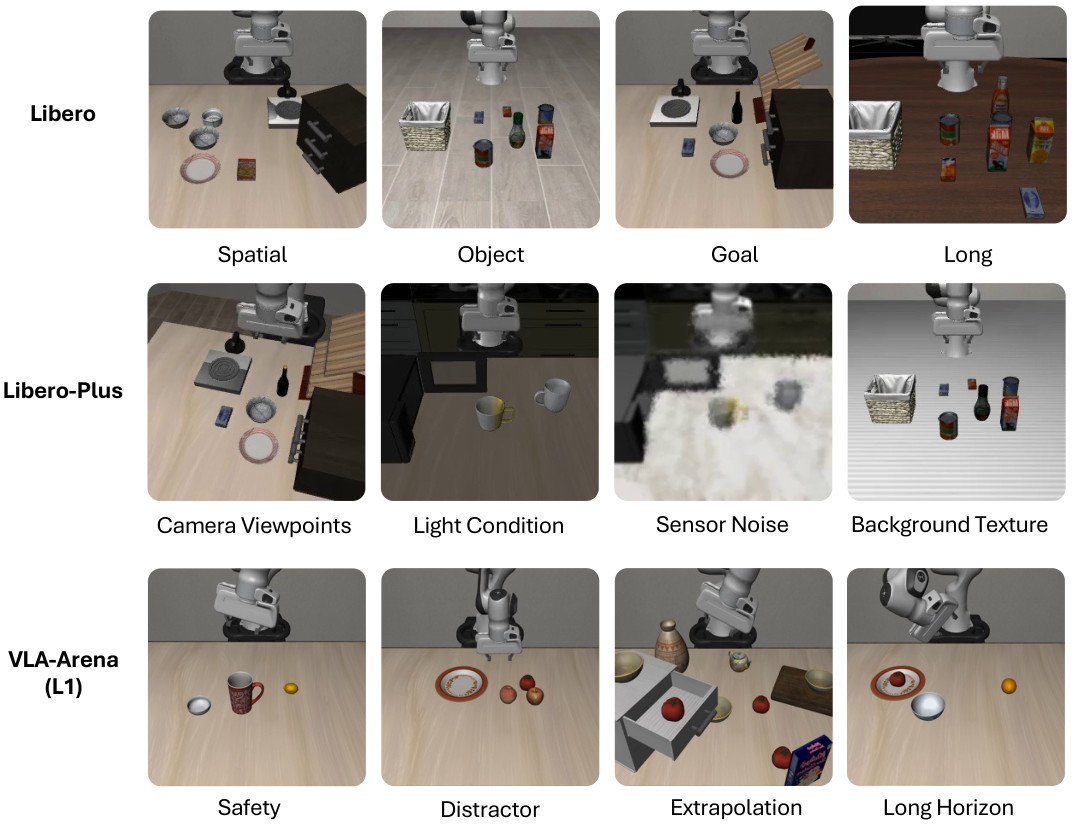
图 3:三个仿真基准。上:四个标准 LIBERO 套件。中:LIBERO-Plus 的扰动轴,例如相机视角、光照、传感器噪声和背景纹理。下:VLA-Arena 改变任务,加入安全约束、干扰物、对未见物体的外推以及长时程组合。
原图注:The three simulation benchmarks. Top: the four standard LIBERO suites. Middle: LIBERO-Plus perturbation axes, e.g., camera viewpoint, lighting, sensor noise and background texture. Bottom: VLA-Arena, which changes the task, adding safety constraints, distractors, extrapolation to unseen objects, and long-horizon composition.
图 3 解读
上排 LIBERO:Spatial、Object、Goal、Long 分别侧重空间关系、目标物体、目标条件及较长任务序列。中排 LIBERO-Plus:展示视觉扰动的代表例子,完整测试还包括机器人初始状态、物体布局和语言,共七类。下排 VLA-Arena:Safety 关注约束,Distractor 关注无关物体,Extrapolation 关注训练范围之外的组合或物体,Long Horizon 关注多步程序。该图是任务示意,没有数值坐标轴;作用是区分“熟悉任务成功”“观测扰动鲁棒”与“任务变化适应”,避免把三个成绩当成同一种泛化。
表 1:标准 LIBERO 基准上的分布内成功率(%)。每个套件评估 500 个 rollout;除作者匹配的无示范对照 StarVLA-OFT 外,基线数字引用各自原论文。每列最佳值以粗体标出。
| Method | Spatial | Object | Goal | Long | Avg. |
| MemoryVLA [39] | 98.4 | 98.4 | 96.4 | 93.4 | 96.7 |
| ACoT-VLA [60] | 99.4 | 99.6 | 98.8 | 96.0 | 98.5 |
| AVA-VLA [46] | 99.2 | 99.6 | 97.9 | 96.2 | 98.2 |
| StarVLA-OFT | 97.8 | 98.6 | 96.2 | 93.8 | 96.6 |
| CogVLA [26] | 98.6 | 98.8 | 96.6 | 95.4 | 97.4 |
| Retrieval-VLA [57] | 97.4 | 98.8 | 96.3 | 89.5 | 95.5 |
| DreamVLA [56] | 97.5 | 94.0 | 89.5 | 89.5 | 92.6 |
| StellaVLA (Ours) | 99.6 | 99.0 | 99.6 | 96.8 | 98.8 |
原表注:In-distribution success rate (%) on the standard LIBERO benchmark [30]. Each suite is evaluated over 500 rollouts; baseline numbers are as reported in the original papers, except our matched demonstration-free control StarVLA-OFT [42]. Best per column in bold.
表 1 解读
行是不同 VLA 方法;列依次为 Spatial(空间)、Object(物体)、Goal(目标)、Long(长程)及四套件平均。StellaVLA 在空间、目标、长程和平均列最高,Object 的 99.0 低于 ACoT-VLA 与 AVA-VLA 的 99.6,因此不是每列都第一。对匹配对照,四项收益为 1.8、0.4、3.4、3.0 个百分点,平均从 96.6 到 98.8。其他基线来自不同原论文,不能据此认定所有训练和评估细节完全相同。
4.2.1LIBERO 分布内验证
原文
StellaVLA reaches 98.8\% average success on LIBERO (Table 1), showing that structured context does not compromise in-distribution performance. Relative to StarVLA-OFT, the gain is small on Object (+0.4) but larger on Goal (+3.4) and Long (+3.0), where the current observation alone may not determine the intended outcome or subgoal order. The same pattern becomes more pronounced when the demonstration is removed or replaced at evaluation (Table 5).
译文
StellaVLA 在 LIBERO 上达到 98.8% 的平均成功率(表 1),说明结构化上下文没有损害分布内表现。相对 StarVLA-OFT,Object 上提升较小(+0.4),而 Goal(+3.4)和 Long(+3.0)上提升更大,因为仅凭当前观测可能无法确定预期结果或子目标顺序。在评估时移除或替换示范后,这种模式更加明显(表 5)。
解释
这些增量单位为百分点。例如 Goal 从 96.2% 到 99.6%,提高 3.4 个百分点。Object 主要区分目标物体,而 Goal 与 Long 更依赖结果和顺序,理论上更能受益于程序示范。四套件的均值为 (99.6+99.0+99.6+96.8)/4=98.75,四舍五入为 98.8。接近满分时小差异也可能受随机评估影响,文中未给多训练种子的置信区间。
表 2:VLA-Arena 三种难度上的成功率:L0 为分布内,L1 为中等泛化难度,L2 最难。行是 11 个任务套件,归为安全、干扰物、外推和长时程四类;分数范围为 [0,1]。基线来自 VLA-Arena 排行榜。最佳结果以粗体标出。为方便阅读,译稿将原来并排的三个等级拆成三张连续子表,保留全部数值。
表 2(续分栏):L0
| Task Suite | OpenVLA-OFT | LingBot-VLA | Motus | GR00T-N1.6 | Evo-Depth | \pi_{0.5} | StellaVLA |
| Static Obst. | 0.89 | 0.47 | 0.82 | 0.72 | 0.88 | 0.90 | 1.00 |
| Cautious Grasp | 0.67 | 0.21 | 0.76 | 0.16 | 0.78 | 0.38 | 0.80 |
| Hazard Avoid. | 0.42 | 0.16 | 0.43 | 0.64 | 0.40 | 0.62 | 0.62 |
| State Pres. | 0.99 | 0.54 | 0.85 | 0.66 | 0.88 | 0.80 | 0.92 |
| Dynamic Obst. | 0.75 | 0.40 | 0.43 | 0.74 | 0.82 | 0.54 | 0.80 |
| Static Distr. | 0.99 | 0.93 | 0.75 | 0.46 | 0.94 | 0.90 | 1.00 |
| Dynamic Distr. | 0.90 | 0.88 | 0.73 | 0.70 | 0.86 | 0.88 | 1.00 |
| Prep. Comb. | 0.54 | 0.46 | 0.13 | 0.48 | 0.66 | 0.54 | 0.70 |
| Task Workflows | 0.53 | 0.37 | 0.32 | 0.42 | 0.32 | 0.52 | 0.64 |
| Unseen Obj. | 0.61 | 0.34 | 0.59 | 0.26 | 0.78 | 0.64 | 0.80 |
| Long Horizon | 0.80 | 0.82 | 0.64 | 0.29 | 0.93 | 0.87 | 1.00 |
| Mean | 0.74 | 0.51 | 0.59 | 0.50 | 0.75 | 0.69 | 0.84 |
表 2(续分栏):L1
| Task Suite | OpenVLA-OFT | LingBot-VLA | Motus | GR00T-N1.6 | Evo-Depth | \pi_{0.5} | StellaVLA |
| Static Obst. | 0.25 | 0.00 | 0.56 | 0.30 | 0.66 | 0.64 | 1.00 |
| Cautious Grasp | 0.32 | 0.00 | 0.07 | 0.02 | 0.24 | 0.16 | 0.50 |
| Hazard Avoid. | 0.00 | 0.00 | 0.24 | 0.04 | 0.00 | 0.40 | 0.92 |
| State Pres. | 0.75 | 0.00 | 0.47 | 0.50 | 0.66 | 0.80 | 0.90 |
| Dynamic Obst. | 0.55 | 0.00 | 0.35 | 0.50 | 0.60 | 0.70 | 0.60 |
| Static Distr. | 0.13 | 0.15 | 0.19 | 0.32 | 0.20 | 0.04 | 0.56 |
| Dynamic Distr. | 0.56 | 0.61 | 0.60 | 0.72 | 0.60 | 0.72 | 0.72 |
| Prep. Comb. | 0.09 | 0.05 | 0.00 | 0.00 | 0.00 | 0.04 | 0.14 |
| Task Workflows | 0.03 | 0.05 | 0.00 | 0.00 | 0.00 | 0.22 | 0.66 |
| Unseen Obj. | 0.39 | 0.32 | 0.55 | 0.18 | 0.52 | 0.50 | 0.80 |
| Long Horizon | 0.00 | 0.03 | 0.05 | 0.02 | 0.00 | 0.00 | 0.02 |
| Mean | 0.28 | 0.11 | 0.28 | 0.24 | 0.32 | 0.38 | 0.62 |
表 2(续分栏):L2
| Task Suite | OpenVLA-OFT | LingBot-VLA | Motus | GR00T-N1.6 | Evo-Depth | \pi_{0.5} | StellaVLA |
| Static Obst. | 0.21 | 0.00 | 0.19 | 0.14 | 0.48 | 0.50 | 0.80 |
| Cautious Grasp | 0.00 | 0.00 | 0.19 | 0.00 | 0.00 | 0.00 | 0.10 |
| Hazard Avoid. | 0.09 | 0.00 | 0.16 | 0.10 | 0.14 | 0.28 | 0.70 |
| State Pres. | 0.38 | 0.00 | 0.49 | 0.38 | 0.56 | 0.74 | 0.62 |
| Dynamic Obst. | 0.05 | 0.00 | 0.26 | 0.02 | 0.06 | 0.26 | 0.02 |
| Static Distr. | 0.15 | 0.11 | 0.03 | 0.06 | 0.24 | 0.14 | 0.20 |
| Dynamic Distr. | 0.39 | 0.17 | 0.33 | 0.18 | 0.32 | 0.56 | 0.60 |
| Prep. Comb. | 0.00 | 0.01 | 0.00 | 0.00 | 0.00 | 0.00 | 0.00 |
| Task Workflows | 0.13 | 0.11 | 0.02 | 0.00 | 0.00 | 0.26 | 0.84 |
| Unseen Obj. | 0.19 | 0.15 | 0.13 | 0.16 | 0.04 | 0.08 | 0.80 |
| Long Horizon | 0.00 | 0.00 | 0.03 | 0.00 | 0.00 | 0.00 | 0.00 |
| Mean | 0.14 | 0.05 | 0.17 | 0.09 | 0.17 | 0.26 | 0.43 |
| Method | Overall |
| OpenVLA-OFT | 0.39 |
| LingBot-VLA | 0.22 |
| Motus | 0.34 |
| GR00T-N1.6 | 0.28 |
| Evo-Depth | 0.41 |
| \pi_{0.5} | 0.44 |
| StellaVLA | 0.63 |
原表注:Success rate on VLA-Arena across 3 difficulty levels: L0 (in-distribution), L1 (intermediate generalization), and L2 (hardest). Rows are the 11 task suites grouped into four categories (Safety, Distractor, Extrapolation, Long Horizon). Scores are fractions in [0,1]. Baseline results are from the VLA-Arena leaderboard [53]. Best per column in bold.
表 2 解读
每个子表的列为七种方法,行含义如下:安全类 Static Obst. 为静态障碍、Cautious Grasp 为谨慎抓取、Hazard Avoid. 为危险规避、State Pres. 为状态保持、Dynamic Obst. 为动态障碍;干扰类 Static/Dynamic Distr. 为静态/动态干扰物;外推类 Prep. Comb. 为原文缩写所指的组合套件(保留缩写以避免误扩展)、Task Workflows 为任务流程、Unseen Obj. 为未见物体;最后是 Long Horizon 长时程。Mean 是逐等级均值,Overall 是全等级总分。 StellaVLA 的等级均值 0.84/0.62/0.43 和总分 0.63 都最高,但不是所有格子都最好:动态障碍 L2 仅 0.02,低于 Motus 的 0.26;长时程 L1/L2 为 0.02/0.00,仍几乎失败。未见物体三个等级均为 0.80,任务流程从 0.64 到 0.84 是突出收益。测试时本文模型额外接收目标任务示范,因此该成绩应连同输入协议一起理解。
4.2.2VLA-Arena 任务级泛化
原文
VLA-Arena [53] evaluates task-level generalization across 11 suites in four categories: Safety, Distractor, Extrapolation, and Long Horizon. Each suite contains three difficulty levels, from L0 (in-distribution) to L2 (hardest), while training uses L0 data only. We follow the official protocol and compare against OpenVLA-OFT [24], LingBot-VLA [45], Motus [3], GR00T-N1.6 [32], Evo-Depth [27], and \pi_{0.5} [37]. At test time, StellaVLA receives one structured demonstration of the target task without any parameter update. As shown in Table 2, StellaVLA achieves the best mean success rate at all three levels: 0.84, 0.62, and 0.43 on L0, L1, and L2, respectively. Its overall score is 0.63, compared with 0.44 for the strongest baseline, \pi_{0.5}. The margin over \pi_{0.5} grows from 0.15 at L0 to 0.24 at L1 and remains 0.17 at L2, where no parameter update is performed and only the target-task demonstration is supplied.
译文
VLA-Arena 在安全、干扰物、外推和长时程四类的 11 个套件上评估任务级泛化。每个套件包含从 L0(分布内)到 L2(最难)的三个难度等级,训练仅使用 L0 数据。我们遵循官方协议,对比 OpenVLA-OFT、LingBot-VLA、Motus、GR00T-N1.6、Evo-Depth 与 \pi_{0.5}。测试时,StellaVLA 接收一条目标任务的结构化示范,不进行任何参数更新。如表 2 所示,它在三个等级均取得最佳平均成功率:L0 为 0.84、L1 为 0.62、L2 为 0.43。总体得分为 0.63,而最强基线 \pi_{0.5} 为 0.44。相对 \pi_{0.5},优势从 L0 的 0.15 扩大到 L1 的 0.24,并在 L2 保持 0.17;整个过程中不更新参数,仅提供目标任务示范。
解释
训练只见 L0,测试可见目标任务示范,这是本文的适应协议。L1/L2 的新任务信息通过上下文进入模型,而非通过梯度。0.63 是 0–1 尺度上的总分,可读作约 63%,但不应混同于每一套件都成功 63%。0.63-0.44=0.19,即总分提高 0.19;各等级差值为 0.84-0.69=0.15、0.62-0.38=0.24、0.43-0.26=0.17。基线数字来自排行榜,输入信息预算是否完全一致需要另行核查,因此这里主要是协议下的系统比较。
原文
The per-suite results further delimit this gain. StellaVLA maintains 0.80 on Unseen Objects across all three levels, consistent with transferring a procedure when the object referent changes. Task Workflows rises from 0.64 at L0 to 0.84 at L2, suggesting that context can become more useful as the test workflow departs from training. Long Horizon remains near zero at L1/L2 for every method, including ours: a fixed prefix specifies the procedure but cannot re-plan after execution drift.
译文
逐套件结果进一步限定了这种收益。StellaVLA 在三个等级的 Unseen Objects 上均保持 0.80,与物体指代改变时程序仍能迁移的解释一致。Task Workflows 从 L0 的 0.64 上升到 L2 的 0.84,表明当测试工作流程偏离训练时,上下文可能更有用。包括本文方法在内,所有方法在 Long Horizon 的 L1/L2 上仍接近零:固定前缀指定了程序,却无法在执行偏移后重新规划。
解释
整体领先不意味着所有困难都解决。Task Workflows 的 L2 更高,不能直接推出“越难越容易”:等级改变了具体任务分布,示范在其中的作用也可能不同。长时程失败说明知道步骤与稳定执行步骤是两回事,固定任务说明不能消除感知和控制误差的累积。作者把无法在线重规划作为解释,但这里未通过单独加入重规划模块来验证该瓶颈。
4.2.3LIBERO-Plus 零样本鲁棒性
原文
LIBERO-Plus [10] perturbs LIBERO tasks along seven axes: viewpoint, robot state, sensor noise, object layout, background, lighting, and language. We evaluate the LIBERO-trained checkpoint without retraining and compare with the zero-shot baselines reported in [10]. StellaVLA reaches 85.1\% on average (Table 3), outperforming StarVLA-OFT by 10.1 points. The largest gains occur under camera viewpoint (+23.5), sensor noise (+19.7), robot initial state (+14.7), and language perturbations (+8.3), where the observation or instruction changes while the task procedure remains intact.
译文
LIBERO-Plus 沿七个轴扰动 LIBERO 任务:视角、机器人状态、传感器噪声、物体布局、背景、光照和语言。我们不重新训练,直接评估在 LIBERO 上训练的检查点,并与 LIBERO-Plus 原文报告的零样本基线比较。StellaVLA 平均达到 85.1%(表 3),比 StarVLA-OFT 高 10.1 个百分点。最大收益出现在相机视角(+23.5)、传感器噪声(+19.7)、机器人初始状态(+14.7)和语言扰动(+8.3)下;这些条件改变了观测或指令,而任务程序保持不变。
解释
这是程序不变、观测条件变化的迁移测试。例如同样把物体放进抽屉,换了相机位置或指令措辞。结构化子目标较少依赖原图外观,可能提供更稳定的参照。表 3 的平均值按任务数加权,排除 Orig. 列,不能拿七个类别的简单算术均值核验 85.1。相机列 70.5-47.0=23.5,是百分点提升而非相对增长 23.5%。
原文
The smaller gains are also informative. Background and lighting are already near saturation for both models, leaving little room for improvement. Under object-layout changes, StellaVLA gains only 0.1 point because the demonstration's scene-specific spatial relation no longer matches the current scene. Structured context therefore transfers task procedure more reliably than a fixed spatial trajectory.
译文
较小的收益同样具有信息量。两种模型的背景和光照表现都已接近饱和,提升空间不大。在物体布局变化下,StellaVLA 只提高 0.1 个百分点,因为示范中特定场景的空间关系已不再匹配当前场景。因此,结构化上下文对任务程序的迁移比对固定空间轨迹的迁移更可靠。
解释
背景与光照并不是本文全面优于对照的项目:StellaVLA 分别为 95.2、95.7,对照为 95.3、96.3。布局列 79.3 对 79.2 几乎持平,提示静态空间提示也可能失配。“因为空间关系不再匹配”是作者对现象的解释,文中没有独立消融把这一个原因与其他感知或控制困难完全区分。
表 3:LIBERO-Plus 上的零样本鲁棒性;所有模型在标准 LIBERO 上训练,然后不重新训练,直接测试扰动任务。Avg. 为七类扰动按任务数加权的均值,不包括 Orig.。各列最佳值以粗体标出。
| Method | Orig. | Cam. | Robot | Noise | Layout | Backg. | Light | Lang. | Avg. |
| OpenVLA | 76.5 | 1.1 | 4.1 | 19.3 | 31.6 | 25.3 | 4.4 | 26.8 | 16.0 |
| OpenVLA-OFT | 97.1 | 59.7 | 37.2 | 76.7 | 77.1 | 92.4 | 85.8 | 81.5 | 71.4 |
| \pi_0 | 94.2 | 15.8 | 6.6 | 79.4 | 70.4 | 78.5 | 79.6 | 61.0 | 53.8 |
| \pi_0-FAST | 85.5 | 66.4 | 24.8 | 75.8 | 70.3 | 67.7 | 73.0 | 63.3 | 62.5 |
| Nora | 87.9 | 4.0 | 41.1 | 17.6 | 63.9 | 50.5 | 31.0 | 67.0 | 38.7 |
| WorldVLA | 79.1 | 0.3 | 30.2 | 12.2 | 39.4 | 14.5 | 29.4 | 44.2 | 24.3 |
| UniVLA | 95.2 | 4.3 | 50.3 | 25.3 | 34.3 | 80.0 | 59.1 | 71.8 | 44.0 |
| RIPT-VLA | 97.5 | 58.3 | 36.7 | 73.8 | 76.5 | 90.4 | 87.9 | 80.1 | 70.4 |
| StarVLA-OFT | 96.6 | 47.0 | 60.1 | 73.1 | 79.2 | 95.3 | 96.3 | 87.0 | 75.0 |
| StellaVLA | 98.8 | 70.5 | 74.8 | 92.8 | 79.3 | 95.2 | 95.7 | 95.3 | 85.1 |
原表注:Zero-shot robustness on LIBERO-Plus [10]; all models are trained on standard LIBERO and tested on the perturbed tasks without retraining. Avg. is the task-count-weighted mean over the seven perturbation categories, excluding Orig. Best per column in bold.
表 3 解读
行是方法;Orig. 为原始任务,Cam. 为相机视角,Robot 为机器人初始状态,Noise 为传感器噪声,Layout 为物体布局,Backg. 为背景,Light 为光照,Lang. 为语言,Avg. 为扰动平均。StellaVLA 的 85.1 高于 StarVLA-OFT 的 75.0;最明显是相机 70.5 对 47.0、噪声 92.8 对 73.1。背景和光照略低于对照,布局几乎持平。因此收益集中在部分扰动上,并非所有视觉变化都获益。平均值是加权指标,不能用表中七个类别数字直接等权求平均来复算。
4.3真机与跨本体评估
原文
Platform, Tasks, and Data. We evaluate on a 6-DOF AgileX Piper arm with third-person and wrist-mounted RGB cameras. The benchmark contains four tabletop tasks: precision pen-to-cup placement, carrot-to-bowl pick-and-place, placing blocks in a drawer and closing it, and stacking three bowls. We collect 125 teleoperated robot episodes (71{,}702 frames), covering precision, articulated-object, and multi-stage manipulation.
译文
平台、任务与数据。我们在配有第三人称和腕部 RGB 相机的六自由度 AgileX Piper 机械臂上进行评估。基准包含四个桌面任务:将笔精确放入杯中、将胡萝卜抓放到碗中、把积木放进抽屉并关闭抽屉,以及叠放三个碗。我们收集 125 个遥操作机器人回合,共 71,702 帧,覆盖精密操作、有关节物体的操作及多阶段操作。
解释
六自由度指机械臂有六个可控关节自由度,夹爪宽度另占一个输出维度。四个任务分别考察精确对齐、普通抓放、抽屉这种可动结构及多物体叠放。125 个回合是目标真机的控制训练来源,因此跨本体演示的加入不能被理解为不需要真机动作数据。
原文
Cross-Source Demonstration Pool. The retrieval pool combines the robot episodes with 26 human-hand takes recorded in XR and 26 frame-aligned trajectories retargeted to the Piper. All three sources are converted into the same structured representation. The 2D grounding point is aligned across the human wrist and robot flange, and off-embodiment frames are used only as retrieved context: all executable action targets remain from the real robot.
译文
跨来源示范池。检索池把机器人回合与在 XR 中记录的 26 条真人手示范,以及 26 条逐帧对齐、重定向到 Piper 的轨迹合并。三种来源都转换为相同的结构化表示。二维空间锚定点在人手腕与机器人法兰之间保持一致;异本体帧只作为被检索的上下文使用,所有可执行动作目标仍来自真实机器人。
解释
同一人类操作被保留为人手外观与重定向机器人外观两种版本,用于减少动作程序不同带来的混杂。“法兰”是机械臂末端用于连接夹爪的机械接口;统一参考点能避免人手坐标表示手腕、机器人坐标却表示夹爪尖端这种定义差异。这里并非把人手关节标签直接混进控制监督。
原文
Protocol and Baselines. We evaluate four in-distribution tasks, two OOD-L1 object-attribute perturbations, and one unseen OOD-L2 drawer task, with 10 rollouts per cell. Object placements are re-randomized and matched across methods. StarVLA-OFT is the matched control for the complete StellaVLA design, while the separately pretrained \pi_{0.5} [37], fine-tuned on the same episodes, provides an external reference. Appendix B specifies the control stack, perturbations, success criteria, and progress metric.
译文
协议与基线。我们评估四个分布内任务、两个 OOD-L1 物体属性扰动条件,以及一个未见过的 OOD-L2 抽屉任务,每个结果单元运行 10 个回合。物体位置重新随机化,并在不同方法之间匹配。StarVLA-OFT 是完整 StellaVLA 设计的匹配对照;另外在相同回合上微调、但具有独立预训练过程的 \pi_{0.5} 提供外部参照。附录 B 规定控制栈、扰动、成功标准与进度指标。
解释
“每格 10 次”意味着一次成功就改变 10 个百分点,单格结果分辨率和统计稳定性有限。匹配物体初始摆放能减小方法间比较的环境差异。\pi_{0.5} 与本文的预训练、架构不同,不能用两者差值单独估计结构化示范的因果效果。OOD-L1 在两个任务中扰动强度不同,因此适合在同一任务内部比较。
表 4:仅改变示范来源时的归一化动作差异。
| Demo pair | ID | OOD |
| D(\text{real},\text{none}) | 0.0041 | 0.0045 |
| D(\text{human},\text{none}) | 0.0041 | 0.0044 |
| D(\text{xr},\text{none}) | 0.0041 | 0.0044 |
| D(\text{human},\text{real}) | 0.0015 | 0.0014 |
| D(\text{xr},\text{real}) | 0.0015 | 0.0016 |
| D(\text{human},\text{xr}) | 0.0014 | 0.0014 |
原表注:Normalized action disagreement when only the demonstration source is changed.
表 4 解读
Demo pair 是两种输入条件,real/human/xr/none 分别是真实机器人、人手、XR 重定向和无示范;ID/OOD 为分布内/外观测。前三行比较各来源与无示范,差异为 0.0041–0.0045;后三行比较不同来源,差异为 0.0014–0.0016。D 是预测动作块的平均绝对差,并按各维真实动作标准差归一化。后三行较小说明固定观测下来源切换影响小,但前三行也很小,所以不能单独据此认定示范对完整真机成功率贡献很大。
原文
Results. StellaVLA reaches 85.0\% success in distribution and 75.0\% on OOD-L1 (Figure 4). On the two tasks with an L1 variant, its average decreases from 80.0\% in distribution to 75.0\%, a 5-point drop; StarVLA-OFT and \pi_{0.5} drop by 25 and 20 points on the same tasks. This smaller paired degradation indicates greater robustness when the object attributes change, although the StarVLA-OFT comparison measures the demonstration and spatial-language supervision jointly.
译文
结果。StellaVLA 在分布内达到 85.0% 成功率,在 OOD-L1 上达到 75.0%(图 4)。对具有 L1 变体的两个任务,其平均成功率从分布内的 80.0% 降到 75.0%,下降 5 个百分点;StarVLA-OFT 与 \pi_{0.5} 在相同两个任务上分别下降 25 和 20 个百分点。较小的配对退化表明,当物体属性变化时它更鲁棒,不过与 StarVLA-OFT 的比较同时衡量了示范与空间语言监督的作用。
解释
85% 和 80% 的分母不同:前者平均四个分布内任务,后者只平均具有 L1 变体的笔与胡萝卜两个任务。因此正确的退化是 80-75=5,不能算成 85-75=10。这是论文专门澄清的比较口径。每种方法与自己的相同任务分布内成绩配对比较,才较能反映属性扰动带来的损失。
原文
No method completes the unseen OOD-L2 task. StellaVLA nevertheless reaches an average progress score of 1.9 out of four, compared with 1.5 for \pi_{0.5} and 1.1 for StarVLA-OFT. This partial progress suggests that the retrieved procedure remains useful, but does not constitute zero-shot task completion.
译文
没有任何方法完成未见过的 OOD-L2 任务。不过,StellaVLA 在满分四分的进度指标上平均达到 1.9 分,\pi_{0.5} 为 1.5 分,StarVLA-OFT 为 1.1 分。这种部分进度表明检索程序仍有用,但并不构成零样本任务完成。
解释
L2 任务把积木目标从第二层抽屉改为第一层。三个积木各成功放入一个记一分,关抽屉记一分。1.9/4 是平均子步骤进度,不是 47.5% 的任务成功率;所有方法的完整任务成功率均为 0。新任务的示范可来自人手检索池,因而“未见”特指没有该任务的真机训练回合。
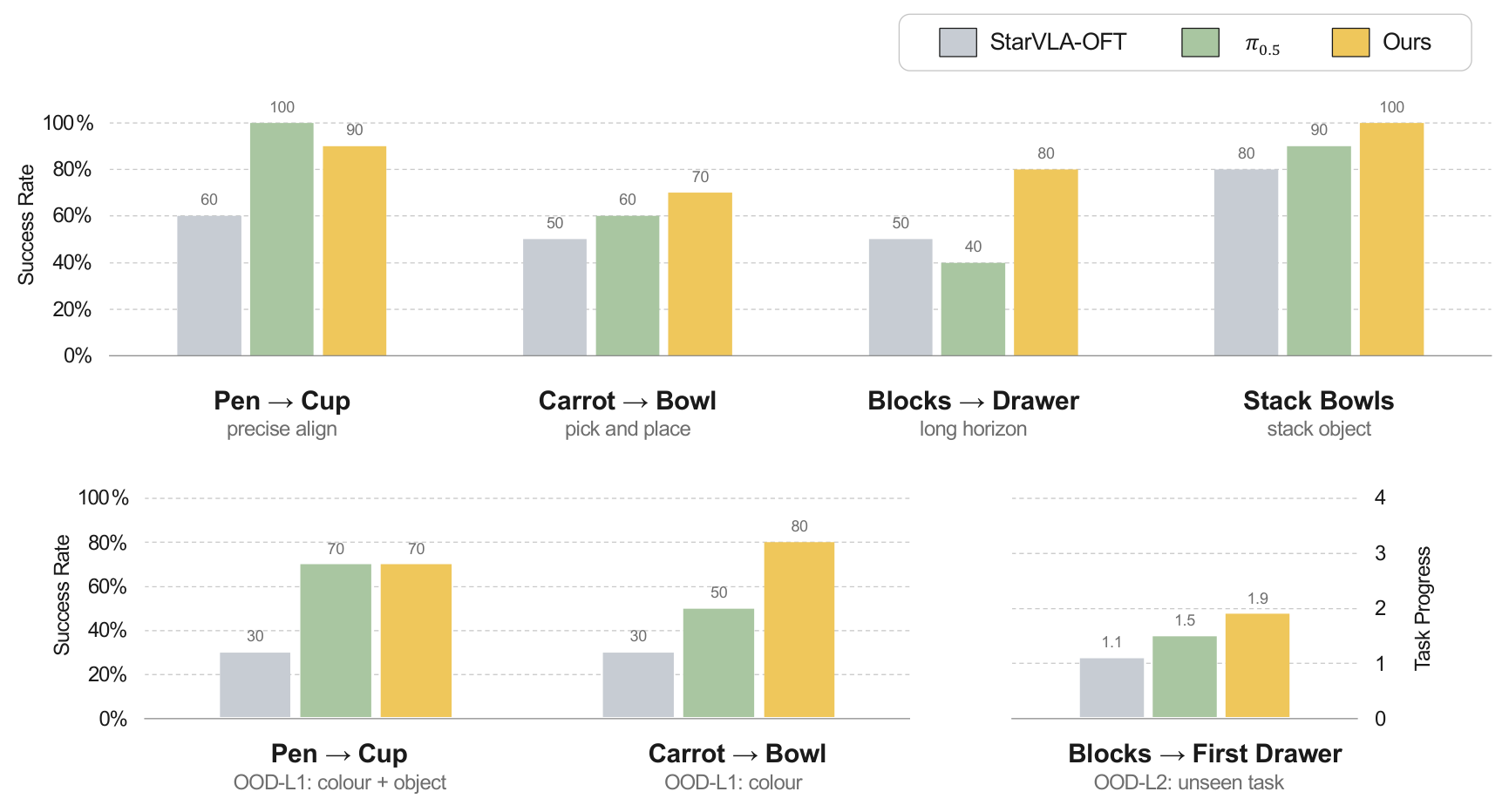
图 4:AgileX Piper 真机评估。上:四个任务的分布内成功率。左下:OOD-L1,扰动物体属性,其难度应在同一任务内比较,而不是跨任务比较。右下:OOD-L2,将积木放入第一层抽屉的未见任务。场景见图 5。
原图注:Real-robot evaluation on the AgileX Piper. Top: in-distribution success rate on the four tasks. Bottom left: OOD-L1, which perturbs object attributes and is comparable within a task rather than across tasks. Bottom right: OOD-L2, an unseen task placing the blocks in the first drawer. Scenes are shown in Figure 5.
图 4 解读
图例区分 StarVLA-OFT、\pi_{0.5} 与本文方法;上排纵轴是成功率,横轴依次为笔到杯、胡萝卜到碗、积木到抽屉、叠碗。本文四项分别为 90%、70%、80%、100%,均值 85%。StarVLA-OFT 为 60%、50%、50%、80%;\pi_{0.5} 为 100%、60%、40%、90%。左下两项扰动中,本文为 70%、80%,平均 75%;StarVLA-OFT 为 30%、30%,\pi_{0.5} 为 70%、50%。本文对应两项分布内均值为 80%,因此下降 5 个百分点。 右下纵轴换成了 0–4 的任务进度,三种方法分别为 1.1、1.5、1.9;不是成功率,所有方法完整成功率为零。每格仅 10 次 rollout,小的单任务差值需谨慎理解。
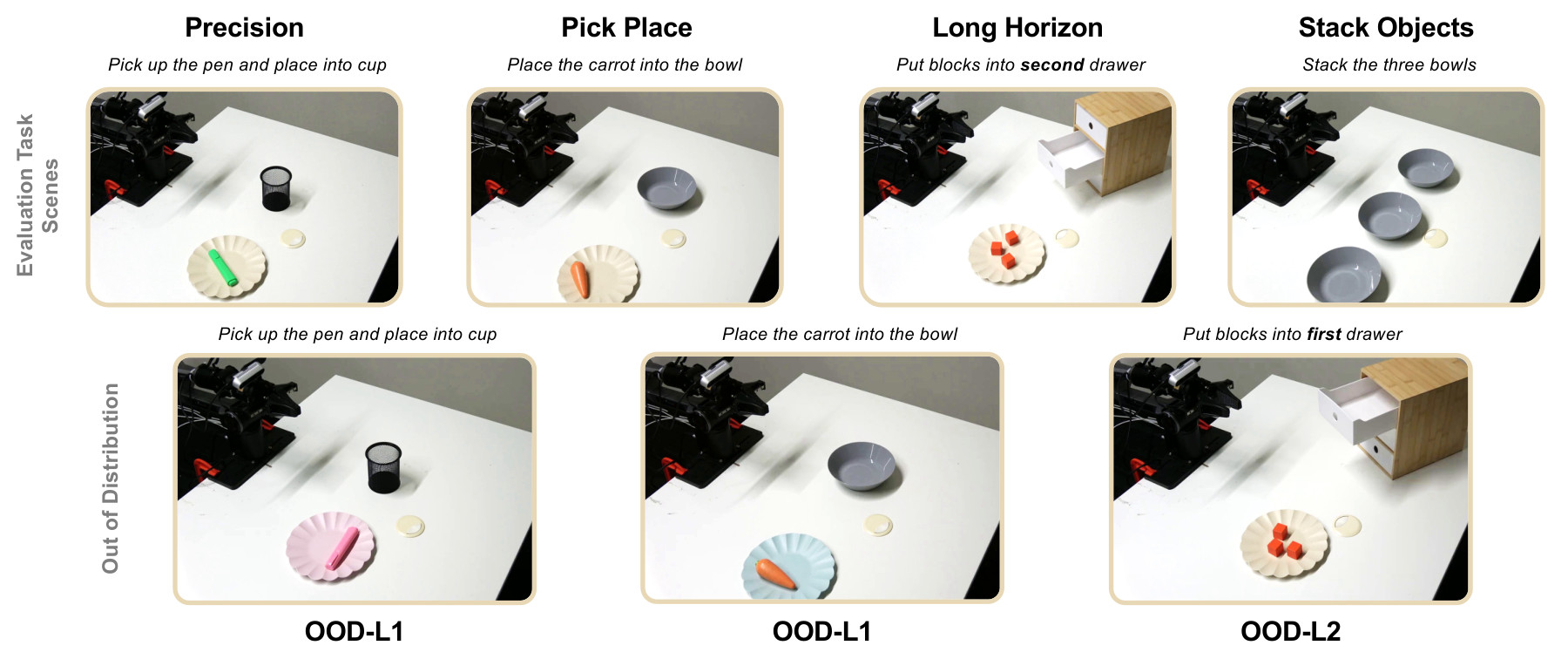
图 5:真机评估场景。上:四个分布内任务。下:相应分布外变体。OOD-L1 在笔到杯任务中同时更换颜色和物体身份,在胡萝卜到碗任务中只改变颜色,因此 L1 应在任务内而非任务间比较;OOD-L2 把积木目标从第二层抽屉改到第一层,该任务没有真机训练回合。
原图注:Real-robot evaluation scenes. Top: the four in-distribution tasks. Bottom: their out-of-distribution variants. OOD-L1 substitutes both colour and object identity for pen\tocup but colour alone for carrot\tobowl, which is why L1 is comparable within a task rather than across tasks; OOD-L2 redirects the blocks from the second drawer to the first, a task for which no real-robot training episode exists.
图 5 解读
上排从左至右对应精密插放、抓放、抽屉长序列、叠放;下排展示三个扰动场景。笔到杯的变化包含颜色和物体替换,胡萝卜到碗只改颜色,两者不能被视作校准过的相同难度。“第二层变第一层”改变了目标位置与操作程序,而非只改变视觉纹理。该图提供图 4 各条件的实体含义,没有成功率坐标;理解它有助于避免把部分进度误读成未见任务已经完成。
原文
Cross-Source Consistency. The mixed-source rollouts above cannot isolate the effect of demonstration provenance, because each cell samples from all three sources. We therefore evaluate a fixed checkpoint on held-out teleoperated episodes while holding the current observation fixed and changing only the retrieved source. We measure the mean L_1 disagreement D(S_1,S_2) between predicted action chunks, normalized by the per-dimension standard deviation \sigma of the ground-truth actions. The paired human and XR-retargeted demonstrations share the same trajectory and timing, so their comparison changes embodiment appearance without changing the demonstrated behavior.
译文
跨来源一致性。前述混合来源 rollout 无法隔离示范来源的作用,因为每格都从三种来源中采样。因此,我们在保留的遥操作回合上评估固定检查点,保持当前观测不变,只改变检索来源。我们度量预测动作块之间的平均 L_1 差异 D(S_1,S_2),按真实动作各维的标准差 \sigma 归一化。成对的人手与 XR 重定向示范具有相同轨迹与时序,所以两者比较改变了本体外观,而不改变演示行为。
解释
S_1,S_2 表示示范来源,例如 human、xr、real;none 表示移除示范。按各维标准差归一化后,可以比较不同量纲的关节与夹爪输出。直觉上 D 衡量“只换参考示范来源,同一帧会让动作改变多少”。这是一项固定观测的离线预测对照,并不是让三种示范各自控制完整任务的闭环成功率对照。
原文
Across 1{,}780 ID and 1{,}719 OOD frames, Table 4 shows that real-robot, human-hand, and XR-retargeted context yield closely matched predictions. Source-to-source disagreement is 0.0014–0.0016\sigma, corresponding to 0.02^\circ–0.03^\circ of joint angle and less than 0.05 mm of gripper width. This supports consistency across the three structured demonstration sources.
译文
在 1,780 个分布内帧与 1,719 个 OOD 帧上,表 4 显示,真实机器人、真人手与 XR 重定向上下文产生非常接近的预测。不同来源之间的差异为 0.0014–0.0016\sigma,对应 0.02^\circ–0.03^\circ 的关节角和小于 0.05 mm 的夹爪宽度。这支持三种结构化示范来源之间的一致性。
解释
这些差异是标准化动作尺度的约 0.14%–0.16%,说明来源切换在所测观测上影响很小。原文把归一化差异写成带 \sigma 的形式;应理解为相对于各维真实动作标准差的尺度。它支持“换外观时预测相近”,却不能单独说明“这份示范是完成任务所必需”。
原文
This test is limited to single-step predictions. Removing the demonstration changes the action by only 0.0041–0.0045\sigma, and small differences may still accumulate in closed-loop execution. The result therefore establishes source consistency under matched observations, not closed-loop invariance or the standalone contribution of context on hardware.
译文
该测试仅限于单步预测。移除示范所引起的动作变化也只有 0.0041–0.0045\sigma,而细小差异仍可能在闭环执行中累积。因此,结果确立的是匹配观测条件下的来源一致性,而不是闭环不变性,也不是上下文在硬件上的独立贡献。
解释
这是重要的证据边界:如果有示范和没示范的动作都很接近,那么不同来源之间更接近,并不能证明它们都提供了很强的指导。另一方面,小角度变化在多步执行后可能导致不同接触或抓取结果,因此离线单步差异也不能证明闭环行为完全相同。需要固定来源、完整运行、多次重复的真机对照来进一步回答。
4.4理解结构化示范
原文
Unless stated otherwise, these analyses use the LIBERO checkpoint and report the four-suite average (AVG) and, where available, the LIBERO-Plus average (LP). Evaluation-time interventions change only the demonstration supplied to a fixed checkpoint.
译文
除非另有说明,这些分析使用 LIBERO 检查点,报告四个套件的平均值(AVG),并在可用时报告 LIBERO-Plus 平均值(LP)。评估时的干预只改变提供给固定检查点的示范。
解释
AVG 是分布内四套件平均成功率,LP 是扰动测试平均成功率。接下来的实验有两种不同操作:在同一检查点上换输入,以及改变训练条件重新训练。表 7 将它们分成上下两个区块,阅读时必须区分。
表 5:评估时改变示范内容。
| Demo | Sp. | Obj. | Goal | Long | AVG |
| Correct | 99.6 | 99.0 | 99.6 | 96.8 | 98.8 |
| None | 72.2 | 94.4 | 24.8 | 58.2 | 62.4 |
| Wrong | 72.6 | 52.0 | 0.0 | 55.0 | 44.9 |
原表注:Changing demonstration content at evaluation.
表 5 解读
Correct、None、Wrong 分别是正确示范、无示范与错误任务示范;Sp./Obj./Goal/Long 是四套件,AVG 为平均。同一检查点的 AVG 为 98.8、62.4、44.9,证明示范内容确实影响动作。Goal 的 99.6/24.8/0.0 对比最强,说明目标歧义依赖示范消解。错误示范比无示范更差,既是有效使用上下文的证据,也是检索失败会误导行为的证据;不等于已验证内部因果推理机制。
原文
Causal Role of the Demonstration. Table 5 evaluates the same trained checkpoint with the correct demonstration, no demonstration, and a demonstration from a different task. Removing the demonstration reduces the average success rate from 98.8 to 62.4, while providing a wrong-task demonstration further lowers it to 44.9. The latter result is particularly informative: if the policy largely ignored the retrieved context, missing and mismatched demonstrations would produce similar outcomes. Instead, the additional degradation shows that StellaVLA actively uses the demonstration to determine the intended task and adjusts its behavior accordingly, even when the supplied context is misleading.
译文
示范的因果作用。表 5 对同一个已训练检查点,分别提供正确示范、无示范和来自不同任务的示范。移除示范使平均成功率从 98.8 降到 62.4,提供错误任务示范则进一步降至 44.9。后一结果尤其有信息量:如果策略基本忽略检索上下文,那么缺失和失配示范应产生相似结果。实际出现的额外退化说明,StellaVLA 主动使用示范确定预期任务,并据此调整行为,即使给出的上下文具有误导性。
解释
正确到无示范下降 36.4 个百分点;无示范到错误示范再下降 17.5 个百分点。这个“错误示范比没有更坏”的现象,有力反驳模型完全忽略示范的解释。它同时揭示检索的风险:模型会被错误程序带偏。响应上下文不等于已证明模仿了专家的内部推理,因为模型也可能使用其中的任务标识、目标说明或步骤约束来改变行为。
原文
The per-suite results further clarify when this contextual specification matters. On Goal, performance falls to 24.8 without a demonstration and to 0.0 with a wrong one, since tasks may involve similar objects and scenes but require different outcomes. The demonstration is therefore critical for disambiguating the intended goal. By contrast, Spatial performs similarly with no and wrong demonstrations (72.2 and 72.6), suggesting that the current observation still provides useful cues about where the interaction should occur. These results provide direct evidence that the retrieved demonstration serves as a task specification rather than being ignored as auxiliary visual context.
译文
逐套件结果进一步说明了上下文指定何时重要。Goal 在无示范时降到 24.8,错误示范时降到 0.0,因为任务可能使用相似物体和场景,却要求不同结果。因此,示范对于消除预期目标的歧义至关重要。相反,Spatial 在无示范与错误示范时相近,分别为 72.2 和 72.6,表明当前观测仍提供了有用线索,帮助确定应在哪里交互。这些结果直接表明,检索示范充当任务说明,而不是被忽略的辅助视觉上下文。
解释
同样看到杯子、盘子和抽屉,并不能从画面判断应把什么放到哪里;正确示范能补充目标与程序。Spatial 仍可依赖当前场景中的空间关系,所以错误示范的额外损害较小。Object 也从无示范 94.4 降到错误示范 52.0,显示错误的物体指代可能直接诱导抓错物体。
原文
Spatial-Language Components. We next isolate the two movement fields in the structured demonstration. Removing the 3D movement lowers AVG from 98.8 to 97.8, whereas removing the 2D gripper path lowers it to 97.3. Although the 2D path is a projection of the same physical motion, it directly anchors that motion in the current image. Its larger effect is consistent with the 2D component providing visual grounding and the 3D component providing workspace-level kinematic information. This experiment does not isolate the semantic subtask label, for which no removal result is available.
译文
空间语言组件。接下来,我们隔离结构化示范中的两个运动字段。移除三维运动使 AVG 从 98.8 降到 97.8,移除二维夹爪路径则降到 97.3。尽管二维路径是同一物理运动的投影,它却直接将运动锚定到当前图像。其较大影响与以下解释一致:二维组件提供视觉锚定,三维组件提供工作空间层面的运动学信息。本实验未隔离语义子任务标签,文中没有提供移除该标签的结果。
解释
去掉三维字段损失 1.0 个百分点,去掉二维字段损失 1.5 个百分点。二者描述同一运动,但与图像 token 的对应便利程度不同,因此可能不完全冗余。差距不大且未报告误差区间,不宜断言二维信息在所有条件下都更重要。没有子任务标签消融,所以无法据此量化语义标签相对运动字段的贡献。
原文
Demonstration Modality. Table 7 examines which part of the demonstration provides the useful context. At evaluation time, text-only demonstrations nearly match the full image+text input, achieving 98.8/84.4 compared with 98.8/85.1 on LIBERO AVG and LIBERO-Plus. In contrast, image-only demonstrations decrease performance to 92.9/75.7, with the largest loss appearing on Long. These results indicate that most of the transferable task information is captured by the structured language representation, including the subgoal sequence and spatial movement, rather than by raw demonstration frames alone. This also supports the use of demonstrations across embodiments, since the structured description abstracts away much of the source-specific visual appearance.
译文
示范模态。表 7 考察示范的哪一部分提供有用上下文。评估时,仅文本示范几乎达到完整图文输入的表现:LIBERO AVG/ LIBERO-Plus 为 98.8/84.4,完整输入为 98.8/85.1。相反,仅图像示范使成绩降为 92.9/75.7,最大损失出现在 Long。这表明,大部分可迁移任务信息由结构化语言表示承载,包括子目标序列和空间运动,而不是单靠原始示范帧。这也支持跨本体使用示范,因为结构化描述抽象掉了来源特有的大量视觉外观。
解释
这里删除的是示范中的图片或文字,不是当前机器人的视觉观测。模型仍然需要当前图像才能控制。“仅文本”保留了子任务、状态和空间数值等丰富结构,不是只留一句任务指令。Long 从 96.8 降至仅图像的 80.4,提示图片难以像文字程序那样明确表达步骤关系。跨本体的解释得到间接支持,尚不能替代闭环来源控制实验。
原文
The training-time block of Table 7 reveals a complementary trade-off. Image-only demonstrations provide slightly higher in-distribution performance than text-only demonstrations (98.4 vs. 97.3), but generalize substantially worse on LIBERO-Plus (78.7 vs. 85.0). A plausible explanation is that visual demonstrations allow the policy to exploit appearance correspondence between the demonstration and the current observation, which is effective in distribution but becomes unreliable under visual perturbations. Structured language removes much of this shortcut and instead encourages the policy to rely on task-level and spatial structure that remains more stable across distribution shifts.
译文
表 7 的训练阶段区块揭示了互补的权衡。仅图像示范的分布内表现略高于仅文本示范,分别为 98.4 和 97.3;但在 LIBERO-Plus 上的泛化明显更差,分别为 78.7 和 85.0。一种合理解释是,视觉示范让策略利用示范与当前观测的外观对应关系,这在分布内有效,却在视觉扰动下变得不可靠。结构化语言消除了这类捷径的大部分影响,促使策略依赖在分布变化下更稳定的任务和空间结构。
解释
这一段比较的是按不同示范模态训练出的模型,并非前一段同一模型临时缺少输入。仅文本训练的 LP 高 6.3 个百分点,分布内却低 1.1 个百分点,说明最适合熟悉环境的表示未必最鲁棒。“外观捷径”是作者提出的可能机制;文中未直接测量注意力或特征因果性,所以译文保留“一种合理解释”的限定。
表 6:空间语言损失权重。
| \lambda | AVG | LP |
| 0 | 97.6 | 86.9 |
| 0.3 | 98.8 | 85.1 |
| 0.6 | 97.5 | 84.0 |
| 1.0 | 97.2 | 81.9 |
原表注:Spatial-language loss weight.
表 6 解读
\lambda 是式(3)语言损失的系数;AVG 为 LIBERO 平均,LP 为 LIBERO-Plus 平均。\lambda=0,0.3,0.6,1.0 时,AVG 为 97.6/98.8/97.5/97.2,LP 为 86.9/85.1/84.0/81.9。分布内最佳和 OOD 最佳并不在同一权重。\lambda=0 仍保留示范,所以表格支持“上下文条件化本身已有强鲁棒性”,也限制了“语言监督提高泛化”的笼统主张。默认权重按分布内性能选择。
表 7:示范模态:上半部分在固定检查点评估时改变,下半部分在训练时改变。图像加文本是默认设置。每个区块中各列最佳结果以粗体标出。
| Demo modality | Sp. | Obj. | Goal | Long | AVG | LP |
| Changed at evaluation (fixed checkpoint) | ||||||
| Image+Text | 99.6 | 99.0 | 99.6 | 96.8 | 98.8 | 85.1 |
| Text-only | 99.0 | 99.8 | 99.8 | 96.6 | 98.8 | 84.4 |
| Image-only | 96.4 | 98.6 | 96.0 | 80.4 | 92.9 | 75.7 |
| Changed at training | ||||||
| Text-only | 98.6 | 98.6 | 99.2 | 92.8 | 97.3 | 85.0 |
| Image-only | 99.4 | 99.4 | 98.8 | 95.8 | 98.4 | 78.7 |
原表注:Demonstration modality, changed at evaluation on a fixed checkpoint (top) and at training (bottom). Image+Text is the default. Best per column within each block in bold.
表 7 解读
Image+Text 为图文示范,Text-only 为仅文字,Image-only 为仅图像;其余列为四个 LIBERO 套件、平均及 LP。上半部分考察输入依赖:仅文本维持 98.8/84.4,接近完整 98.8/85.1;仅图像掉到 92.9/75.7,Long 只有 80.4。下半部分比较训练方案:仅图像的分布内平均 98.4 略高,但 LP 78.7 明显低于仅文本的 85.0。两个区块不能互换比较,当前机器人观测始终包含视觉输入。
原文
Context Granularity. Performance changes by only 0.7 point when the demonstration is reduced from ten to three subgoal keyframes (Table 9 in Appendix C). This saturation suggests that the subgoal sequence, rather than dense trajectory replay, carries the useful context.
译文
上下文粒度。当示范从十个子目标关键帧缩减到三个时,性能只变化 0.7 个百分点(附录 C 的表 9)。这种饱和趋势表明,有用上下文由子目标序列承载,而不是由密集轨迹回放承载。
解释
少量关键帧覆盖任务程序就能接近满配置,提示输入可以做稀疏采样来节省 token 和显存。不过这项实验只测了所给粒度范围内的 LIBERO 平均值,不能推出任意复杂任务三个关键帧都够用,也没有单独证明帧数与子目标数的所有影响。
4.5空间语言监督与部署
原文
Effect of Language-Loss Weight. Table 6 varies the weight \lambda of the spatial-language objective. The in-distribution average follows a shallow inverted-U and peaks at \lambda=0.3 (98.8), whereas LIBERO-Plus robustness decreases from 86.9 at \lambda=0 to 81.9 at \lambda=1.0. Spatial-language supervision therefore improves in-distribution precision at the selected weight but does not monotonically improve OOD robustness; context conditioning alone already provides a strong robustness signal. One possible explanation is that a large language weight overemphasizes the offline annotation schema. We use \lambda=0.3 as the best in-distribution setting.
译文
语言损失权重的影响。表 6 改变空间语言目标的权重 \lambda。分布内平均值呈浅倒 U 形,在 \lambda=0.3 时达到峰值 98.8;LIBERO-Plus 鲁棒性却从 \lambda=0 时的 86.9 下降到 \lambda=1.0 时的 81.9。因此,在所选权重下,空间语言监督提高了分布内精度,但并未单调提高 OOD 鲁棒性;仅靠上下文条件化已经提供很强的鲁棒性信号。一种可能解释是,较大的语言权重过分强调了离线标注规范。我们使用 \lambda=0.3,因为它是分布内表现最好的设置。
解释
这是对“辅助推理必然改善泛化”的直接约束。\lambda=0 仍有检索示范,只是没有语言辅助损失。它在 LP 上为 86.9,比默认配置高 1.8 个百分点;默认配置的分布内成绩则高 1.2 个百分点。可以支持“适量语言监督提高所测分布内表现”,不能支持“语言监督是所有 OOD 增益的必要条件”。语言过拟合标注格式只是解释假设,不是已证实机制。
表 8:推理延迟,单位 ms。
| Configuration | Cache | Latency |
| No demo | — | 64 |
| Image+Text | no | 183 |
| Image+Text | yes | 91 |
| Text-only | — | 109 |
| Paired language decoding | ||
| Action only | yes | 88 |
| + language | yes | 3177 |
原表注:Inference latency (ms).
表 8 解读
Configuration 为配置,Cache 为是否缓存固定前缀,Latency 为延迟。“—”是原表未给缓存状态,并非自动解释为否。无示范 64 ms;图文无缓存 183 ms,有缓存 91 ms;仅文本条目为 109 ms。由于该条目的缓存条件标为“—”,不能只由 109 与 91 推断文字比图像更慢。下半部分是另一组配对语言解码测量:Action only 为 88 ms,加语言输出为 3177 ms,约 36 倍。表格支持去掉自回归解释和缓存前缀能节约时间,但不支持示范本身完全零开销。真机全流水线约 205 ms/动作块,与这里的模型侧时间也不能混为一谈。
原文
Inference Efficiency. Table 8 separates the cost of context encoding from language decoding. A forward pass without a demonstration takes 64 ms. Adding an image+text demonstration raises this to 183 ms without a cache, while caching the immutable prefix reduces the steady-state cost to 91 ms. In a paired measurement, the action-only path takes 88 ms, whereas decoding the 83-token spatial-language output increases latency to 3177 ms, about 36\times slower.
译文
推理效率。表 8 将上下文编码与语言解码成本分开。无示范前向需要 64 ms;加入图文示范且不缓存时升至 183 ms,缓存固定前缀后稳态成本降到 91 ms。在配对测量中,仅动作路径为 88 ms;解码 83 个 token 的空间语言输出使延迟增至 3177 ms,约慢 36 倍。
解释
缓存节省 183-91=92 ms,约减少 50.3% 的该配置延迟;但 91 ms 仍比无示范的 64 ms 多 27 ms。文字解码 3177/88\approx36.1 倍,说明在线生成完整解释确实很昂贵。88 和 91 来自文中区分的两组测量,不应强行当成同一个精确值。实时性的主要来源是并行直接回归与前缀重用。
原文
The 88–91 ms values measure the model-side path; the real-robot pipeline, including observation and control overhead, runs at approximately 205 ms per action chunk (Appendix B). Thus, removing the spatial-language expert avoids autoregressive decoding at deployment, while prefix caching amortizes demonstration encoding across the rollout.
译文
88–91 ms 的数值衡量模型侧路径;包含观测与控制开销的真机流水线约为每动作块 205 ms(附录 B)。因此,移除空间语言专家避免了部署时的自回归解码,而前缀缓存则把示范编码成本分摊到整个 rollout 中。
解释
模型前向时间与完整机器人循环时间的边界不同,不能直接把 88 ms 换算成真机端到端控制频率。30 Hz 是底层动作执行频率,约 205 ms 是每个预测块的流水线延迟;动作块与滚动执行使两者能够衔接。前缀首次构建的成本被摊销,也不意味着新任务开始时没有启动开销。
5结论(Conclusion)
原文
We presented StellaVLA, a framework that improves VLA generalization by converting retrieved expert demonstrations into structured in-context guidance. An automated offline pipeline extracts hierarchical semantic and kinematic rationales from heterogeneous demonstrations, while a parallel dual-training objective jointly learns continuous control and spatial-language reasoning. At inference, the spatial-language expert is removed and the fixed demonstration prefix is KV-cached, allowing the policy to benefit from structured reasoning without autoregressive language-decoding overhead. Experiments on LIBERO, VLA-Arena, LIBERO-Plus, and real-world manipulation show that StellaVLA preserves strong in-distribution performance while substantially improving robustness to task and environment shifts, including when demonstrations originate from different embodiments.
译文
我们提出了 StellaVLA:通过把检索专家示范转换为结构化上下文指导,改善 VLA 泛化的框架。自动化离线流水线从异构示范中提取分层语义与运动学理由,并行双重训练目标则联合学习连续控制与空间语言推理。推理时移除空间语言专家,并对固定示范前缀进行 KV 缓存,使策略能够受益于结构化推理,同时避免自回归语言解码开销。LIBERO、VLA-Arena、LIBERO-Plus 与真实操作实验表明,StellaVLA 保持了较强分布内表现,并显著改善了对任务与环境变化的鲁棒性,包括示范来自不同本体的情况。
解释
结论概括了“结构化示范—并行监督—动作单独执行”的设计。结合消融,最稳妥的理解是:任务程序的结构化表达让模型有效响应示范,辅助语言目标与缓存机制分别影响训练表现和部署效率。完整系统的成绩不等于每个组件都对所有指标有正收益;真机跨本体结果支持单步来源一致性,尚未建立完整闭环不变性,极长任务与未见真机任务也仍未解决。
6作者名单(Author List)
原文
Contributor: Siyu Xu, Yunke Wang, Zijian Wang, Dihao Zhu, Chenghao Xia, Chengbin Du, Daochang Liu, Tao Huang, Chang Xu.
译文
贡献者:Siyu Xu、Yunke Wang、Zijian Wang、Dihao Zhu、Chenghao Xia、Chengbin Du、Daochang Liu、Tao Huang、Chang Xu。
解释
原 PDF 首页以 StellarEdge AI Technical Team 为团队署名,本节列出九名贡献者;姓名按原文保留,不推测其中文写法或具体分工。参考文献列表不另行翻译,见原论文;英文段落中的方括号编号与原论文一致。
A实现细节(Implementation Details)
原文
Optimization. All models are fully fine-tuned from Qwen3-VL-4B-Instruct with AdamW (\beta = 0.9/0.95, weight decay 10^{-8}), a backbone learning rate of 5\times10^{-6} and an action-expert learning rate of 10^{-4} under a cosine schedule (500 warmup steps), gradient clipping 1.0, bf16 mixed precision, and DeepSpeed ZeRO-2, for 30k steps at a global batch size of 128.
译文
优化。所有模型从 Qwen3-VL-4B-Instruct 开始,采用 AdamW 全参数微调:\beta=0.9/0.95,权重衰减 10^{-8};主干学习率 5\times10^{-6},动作专家学习率 10^{-4};使用余弦学习率计划,预热 500 步,梯度裁剪为 1.0,bf16 混合精度及 DeepSpeed ZeRO-2;训练 30k 步,全局批量大小为 128。
解释
两个 \beta 是 AdamW 的一阶和二阶动量系数。动作头学习率是主干的 20 倍,使新动作模块更快适应,同时较温和地更新预训练表征。warmup 逐步升高学习率,之后余弦下降;梯度裁剪抑制异常更新。bf16 减少内存开销,ZeRO-2 将优化器状态和梯度分片到多设备。原文没有在本段给出设备数、总训练时长或完整数据采样策略,因此这些超参数尚不足以独立保证精确复现。
原文
Regularization. Two per-sample dropouts regularize training. A 2D gripper-path dropout (0.5) keeps the 3D steering command usable when the pixel trace is missing. A context-demonstration dropout matches demonstration availability at deployment: 0.0 when a same-task demonstration is always retrievable (LIBERO, LIBERO-Plus) and 0.5 otherwise (VLA-Arena, the real robot).
译文
正则化。两种逐样本丢弃机制对训练进行正则化。二维夹爪路径丢弃率为 0.5,使像素轨迹缺失时三维引导命令仍能使用。上下文示范丢弃率则匹配部署时的示范可用性:同任务示范总能检索时为 0.0(LIBERO、LIBERO-Plus),其他情况为 0.5(VLA-Arena、真机)。
解释
两种 dropout 作用在输入字段上,而不是同一个操作:第一种只去掉二维路径,第二种去掉整个上下文示范。0.5 表示每个训练样本有 50% 概率丢弃对应内容。这样训练出的真机模型能在示范缺失时工作;LIBERO 模型默认总有示范,所以其表 5 的无示范设置同时也是一个未在训练中常规出现的输入条件。
原文
Retrieval. Demonstrations are retrieved by the language embedding of the task instruction alone; no visual features enter the query. In simulation the instruction set is closed, so this reduces to an exact task match, and we condition on the single nearest demonstration (M=1) throughout. Training uses leave-one-out retrieval, which excludes the target episode from the pool.
译文
检索。示范只由任务指令的语言嵌入检索;查询不包含视觉特征。仿真中的指令集合封闭,因此这退化为精确任务匹配,全文始终仅以最近的一条示范为条件,即 M=1。训练使用留一检索,从池中排除目标回合。
解释
M 是检索示范数,不是帧数;一条示范内部还可包含多个关键帧。仅用语言避免了人手和机器人外观相差太大导致视觉检索失败,但也不能自动解决物体布局、相机变化或语义含糊。封闭指令集中的精确匹配是较强条件,开放任务库里自然语言检索错误的影响需额外评估。
原文
Action Expert and Spatial-Language Expert. A set of action-placeholder tokens is appended to the user turn, causally preceding the language-action chain-of-thought. After a single backbone forward, their final-layer hidden states pass through a two-block residual MLP that regresses the action chunk under an L_1 objective. The compact “subtask + 3D/2D steering command” chain-of-thought is retained from a language-action formulation [52] and supervised against offline-generated annotations by cross-entropy; it is not decoded at action inference. The steering command is the target \Phi(A_t) of Eq. 2, that is, the same action chunk the MLP regresses, rendered by the verbaliser \Phi over the chunk span rather than over a whole segment; the subtask is the per-frame label s_t.
译文
动作专家与空间语言专家。用户轮次末尾追加一组动作占位 token,它们在因果顺序上位于语言—动作思维链之前。主干一次前向传播后,这些 token 的末层隐藏状态通过由两个残差块组成的 MLP,在 L_1 目标下回归动作块。紧凑的“子任务 + 3D/2D 引导命令”思维链沿用语言—动作表述,以离线生成标注作为目标进行交叉熵监督;动作推理时不解码它。引导命令就是式(2)的目标 \Phi(A_t),也就是 MLP 所回归的同一个动作块,由文字化算子 \Phi 在动作块而非整个片段的跨度上生成;子任务则为逐帧标签 s_t。
解释
因果注意力使前面的动作 token 无法读取后面解释的真值 token,因此可避免训练时“偷看解释”、推理时却没有解释的依赖不一致。两个残差 MLP 块承担从隐藏状态到连续动作的映射。正文用 h_t 简化表示,实现中这里明确使用一组动作 token 的隐藏状态。紧凑思维链仍是结构化标签,不是自由的长篇思考。原段未进一步给出 token 数和完整 MLP 宽度。
原文
Per-Platform Instantiation. In simulation the policy reads 256\times256 images, predicts end-effector deltas over an action chunk of length 8, and the retrieved demonstration carries up to ten subgoal keyframes. On the real robot it reads 640\times480 images, predicts a 7-dimensional chunk of length 16 (six joint-position deltas relative to the episode start plus an absolute gripper width, all q_{99}-normalized), and the demonstration carries up to eight keyframes. The real-robot state is rendered in language as the end-effector pose together with the joint angles.
译文
各平台的具体设置。在仿真中,策略读取 256\times256 图像,预测长度为 8 的动作块,其内容为末端执行器增量;检索示范最多携带十个子目标关键帧。在真实机器人上,策略读取 640\times480 图像,预测长度为 16、每步 7 维的动作块:六个相对回合起始状态的关节位置增量,以及一个绝对夹爪宽度,均采用 q_{99} 归一化;示范最多携带八个关键帧。真机状态以末端位姿和关节角的语言形式呈现。
解释
仿真 H=8、真机 H=16,不能混用;图像分辨率和关键帧上限也不同。真机的关节增量相对回合起点,不是必然相对上一步逐次累加的增量;夹爪则输出绝对宽度。q_{99} 指基于第 99 百分位的归一化尺度,但原文没有给出完整计算与截断公式,不宜自行补成某种唯一实现。真机更高图像分辨率和不同动作头配置也使模型延迟不能直接跨平台等同。
B真机设置(Real-World Setup)
原文
Control Stack. The AgileX Piper is driven over CAN at 30 Hz without a ROS stack. Each 16-step chunk spans \approx\!0.53 s and is executed in a synchronous receding-horizon loop with a horizon of 8. Joint targets pass through a One Euro filter and a 25^\circ per-step jump guard before reaching the arm. Because the demonstration prefix is fixed for the duration of a rollout, its key–value cache is computed once and reused, and steady-state inference settles at \approx\!205 ms per chunk, comfortably inside the control budget.
译文
控制栈。AgileX Piper 通过 CAN 以 30 Hz 驱动,不使用 ROS 栈。每个 16 步动作块覆盖约 0.53 s,并在 horizon 为 8 的同步滚动时域循环中执行。关节目标在发送到机械臂前,通过 One Euro 滤波器和每步 25^\circ 的跳变保护。由于示范前缀在整个 rollout 中固定,其 KV 缓存只计算一次并复用;稳态推理稳定在约 205 ms/动作块,处于控制时间预算内。
解释
CAN 是机械臂通信总线,ROS 是常见机器人软件中间件。16/30\approx0.533 s 是预测块覆盖时长;horizon 8 可理解为滚动执行的 8 步窗口,约 8/30\approx0.267 s,再利用新观测更新预测。205 ms 小于这个窗口,说明计算上有衔接空间,但原文没有给出每个异步/同步细节的完整时序。One Euro 滤波平衡平滑与响应,跳变保护限制异常大目标变化;它们帮助控制稳定,不是模型推理能力的证据。
原文
Data Collection. The 125 teleoperated episodes (71{,}702 frames) were collected by master–slave teleoperation across the four tasks: pick the pen and put it in the cup, pick the carrot and put it in the bowl, put the blocks into the second drawer and close it, and stack the three bowls on top of each other. They cover precision alignment, free-space pick-and-place, a long-horizon sequence involving an articulated object, and multi-stage stacking respectively.
译文
数据采集。125 个遥操作回合(71,702 帧)通过主从遥操作采集,覆盖四项任务:拿起笔放进杯中、拿起胡萝卜放进碗中、把积木放进第二层抽屉并关闭它以及把三个碗叠放在一起。这些任务分别覆盖精密对齐、自由空间抓放、涉及可动关节物体的长时程序列以及多阶段叠放。
解释
主从遥操作指操作者控制主设备,目标机器人跟随记录动作。这里明确训练中的抽屉任务目标是第二层,之后 OOD-L2 改成第一层,所以并非只换了一种说法。多阶段任务要求多次抓取和放置,早期误差可能影响后续步骤。原文未在本段给出每任务回合数或失败数据比例,不应自行假定均匀分配。
原文
Cross-Source Pool Construction. Twenty-six human-hand takes recorded in XR yield two aligned datasets of 26 episodes and 10{,}996 frames each: one preserving the operator's bare hand, one showing a retargeted Piper arm executing the identical trajectory. The two share episode structure and timing frame for frame, so the appearance of the embodiment is the only variable separating them. The grounding point of the 2D gripper path uses the operator's wrist for the human take and the flange for the retargeted arm, both matched to the real robot's convention, so that a rendered coordinate denotes the same physical quantity regardless of provenance. The three sources are merged by exact task-string match, retrieval excludes the current episode, and the off-embodiment data enters only the retrieval pool: no human or retargeted frame ever supplies an action target, so the policy's motor supervision remains entirely real-robot.
译文
跨来源示范池构建。在 XR 中录制的 26 条真人手示范产生两个对齐数据集,每个包含 26 个回合和 10,996 帧:一个保留操作者裸手,另一个显示重定向 Piper 机械臂执行完全相同的轨迹。两者的回合结构与时序逐帧一致,因此它们之间唯一变化是本体外观。二维夹爪路径的锚定点在人手版本使用操作者手腕,在重定向机器人版本使用法兰,两者都与真实机器人的约定匹配,确保无论来源如何,输出坐标表示相同物理量。三种来源按精确任务字符串匹配合并,检索排除当前回合;异本体数据只进入检索池:任何人手或重定向帧都不会提供动作目标,因此策略的运动监督完全来自真实机器人。
解释
这里的 26 条原始操作生成两种呈现,不应当成 52 条独立行为经验。逐帧对齐让 human 与 xr 对照更接近单独改变外观;但 real 来源通常不与这两者构成完全相同轨迹的三方对照。统一手腕/法兰参考点是在表示层面减少坐标定义差异,仍依赖追踪和标定质量。跨来源检索与跨来源控制监督分离,是本方法跨本体结果最需要保留的限定条件。
原文
Evaluation Conditions. Every reported cell is 10 rollouts scored by a human operator against a fixed success criterion, with object placements re-randomized per rollout and held identical across methods. OOD-L1 severity is not calibrated across tasks: it compounds a colour and an object substitution for pen\tocup but changes only colour for carrot\tobowl, so L1 is comparable within a task rather than across tasks. On OOD-L2 the progress score awards one point for each of the three blocks placed and one for closing the drawer, out of four. Single cells carry roughly 10–15 points of noise at 10 rollouts, so we base conclusions on the per-condition averages, which aggregate 40 rollouts in distribution and 20 under L1, and on paired degradations. Because only pen\tocup and carrot\tobowl have an L1 variant, the degradation quoted in the main text compares each policy against its own score on those two tasks (80.0\% for StellaVLA, 55.0\% for StarVLA-OFT, 80.0\% for \pi_{0.5}) rather than against the four-task in-distribution average. On OOD-L2 the progress scores are 1.9 for StellaVLA, 1.5 for \pi_{0.5} and 1.1 for StarVLA-OFT; the task is absent from real-robot training, so the human take is the only entry in the pool holding a demonstration of it.
译文
评估条件。每个报告单元包含 10 个 rollout,由人工操作者按固定成功标准评分;每次重新随机放置物体,不同方法使用相同摆放。OOD-L1 的严重程度没有跨任务校准:笔到杯任务同时更换颜色和物体,胡萝卜到碗则只改变颜色,因此 L1 适合任务内比较,不适合跨任务比较。OOD-L2 的进度评分为:三个积木每放入一个记一分,关闭抽屉再记一分,满分四分。在只有 10 次 rollout 时,单格约有 10–15 个百分点的噪声,因此我们基于每种条件的平均值与配对退化作结论;分布内平均聚合 40 次 rollout,L1 聚合 20 次。由于只有笔到杯和胡萝卜到碗具有 L1 变体,正文引用的退化比较的是每种策略在这两个任务上的自身成绩(StellaVLA 为 80.0%、StarVLA-OFT 为 55.0%、\pi_{0.5} 为 80.0%),而不是四任务的分布内平均。在 OOD-L2 上,StellaVLA 的进度为 1.9,\pi_{0.5} 为 1.5,StarVLA-OFT 为 1.1;该任务不存在于真机训练中,因此池里只有真人手示范包含该任务的演示。
解释
同一任务的成功/失败是二元结果;在 n=10、成功概率约 0.5 时,二项比例标准误差约为 \sqrt{0.5(1-0.5)/10}\approx15.8 个百分点,可帮助理解小样本的不稳定性,但这不是论文另行报告的置信区间。聚合多任务可降低部分采样噪声,却不等于跨任务难度相同。原文给出固定判据和 L2 计分方式,但未逐项详述每个任务的几何成功阈值。L2 在训练中未见,仍可从人手示范获得程序指导。
原文
Baselines. The matched control is StarVLA-OFT [42], trained on the same real-robot episodes with the same backbone, action expert and action space, and differing only in receiving no demonstration and no auxiliary spatial-language expert. We additionally fine-tune the openpi flow-matching policy \pi_{0.5} [37] on the same episodes; as a separately pretrained model family it places our absolute numbers on an external scale rather than serving as a matched control.
译文
基线。匹配对照为 StarVLA-OFT:用相同真机回合训练,主干、动作专家及动作空间均相同,区别仅在于不接收示范且没有辅助空间语言专家。我们还在相同回合上微调 openpi 的流匹配策略 \pi_{0.5};由于它属于独立预训练的模型家族,作用是为绝对成绩提供外部参照,而非充当匹配对照。
解释
同主干同数据有助于减少预训练能力差异,但 StarVLA-OFT 与本文仍同时相差两个因素,因此其差值是完整方案收益。\pi_{0.5} 可说明本文相对另一种强控制器的实用表现,不能据此单独推断某一模块的效果。对照类型的明确区分有助于设计后续实验:保留示范但关掉语言损失,或反过来分别训练,才能进一步分解贡献。
C补充分析(Additional Analysis)
C.1示范结构
表 9:子目标粒度。最佳结果用粗体标出。
| Subgoal frames | AVG |
| 3 | 98.1 |
| 5 | 98.2 |
| 8 | 98.3 |
| 10 (default) | 98.8 |
原表注:Subgoal granularity. Best in bold.
表 9 解读
第一列是示范中子目标关键帧数量,第二列是四套件平均成功率。3、5、8、10 帧分别为 98.1、98.2、98.3、98.8,十帧为默认值。三帧到十帧只提高 0.7 个百分点,说明这个测试中稀疏示范已承载大部分信息;不能据此把帧数直接等同于子任务数,也不能推广为所有长程序只需三张图。
原文
Subgoal granularity (Table 9) is nearly flat: three keyframes already reach 98.1 AVG, within 0.7 of the full ten (98.8). Denser sampling adds frames but no new sub-goals, and it is the sub-goal decomposition the policy consumes, so returns saturate as soon as the plan is complete rather than as soon as the trajectory is densely covered. This is also what keeps the prefix short enough to cache.
译文
子目标粒度(表 9)的影响几乎是平坦的:三个关键帧已达到 98.1 AVG,与完整十帧的 98.8 只差 0.7。更密集的采样增加了帧,却没有增加新子目标;策略利用的是子目标分解,因此当计划已完整时,收益就会饱和,而不是要等轨迹被密集覆盖后才饱和。这也使前缀能够保持足够短,便于缓存。
解释
三、五、八、十帧分别为 98.1、98.2、98.3、98.8。它支持在所测任务中压缩示范关键帧的可行性,而非证明图像完全无用。作者把平坦曲线解释为完整计划比密集运动回放更重要;还需要更多任务复杂度、关键帧选择方式及随机重复实验,才能推广到任意程序长度。缓存可行性还取决于图像 token 数与设备显存。
D讨论与局限(Discussion and Limitations)
原文
Language as a Cross-Embodiment Bridge. Under matched observations, real-robot, human-hand, and XR-retargeted demonstrations produce closely matched action predictions (Table 4). The hardware results also use demonstrations sampled from the merged three-source pool rather than from the robot source alone. Together, these results indicate that the structured representation reduces sensitivity to source-specific appearance and coordinates. They do not establish closed-loop invariance across pinned sources, which requires a larger source-controlled rollout study.
译文
语言作为跨本体桥梁。在匹配观测下,真实机器人、真人手与 XR 重定向示范产生非常接近的动作预测(表 4)。硬件结果也使用从三来源合并池采样的示范,而不是只来自机器人来源。综合来看,这些结果表明结构化表示降低了对来源特有外观与坐标的敏感性。但它们没有确立固定各来源时的闭环不变性;要验证后者,需要规模更大、控制示范来源的 rollout 研究。
解释
这段主动区分来源鲁棒的单步预测与来源不影响整个执行结果。后者必须把 real、human、xr 各自固定为整回合示范来源,在相同初始状态上反复执行,再比较成功率和轨迹。现有混池真机评估与离线动作一致性只能为这一方向提供支持,不能取代该实验。
原文
Decoupling Reasoning from Latency. Autoregressive language generation is incompatible with the latency budget of real-time control. StellaVLA instead trains the backbone under joint action and spatial-language supervision, then removes the spatial-language expert and caches the demonstration prefix at deployment. Control therefore incurs no autoregressive language-decoding overhead (Table 8).
译文
将推理与延迟解耦。自回归语言生成与实时控制的延迟预算不兼容。StellaVLA 转而用动作和空间语言联合监督训练主干,再在部署时移除空间语言专家并缓存示范前缀。因此,控制不承担自回归语言解码开销(表 8)。
解释
这项设计把解释文本当作训练任务,而不是每次执行前都必须完成的中间产物。表 8 的 88 ms 对 3177 ms 直接支持省去自回归解码能显著缩短延迟。不过“不兼容”在这里针对本文控制预算和实现,不意味着所有机器人任务或所有短文本生成都绝对不能使用。
原文
Limitations and Future Work. Despite its strong performance, our framework has several limitations. Long-horizon compositionality: while StellaVLA substantially improves task-level generalization and robustness, success rates on extremely long-horizon, multi-stage tasks (such as the Long Horizon suite in VLA-Arena) remain low for all evaluated models. The demonstration prefix is fixed for the duration of an episode, so it cannot re-plan once execution has drifted, and in-context conditioning alone therefore does not resolve multi-step error accumulation. Dependence on retrieval quality: the effectiveness of our in-context adaptation relies on retrieving a relevant expert demonstration. As the wrong-demonstration ablation shows, conditioning on a mismatched demonstration degrades performance below the no-demonstration baseline, so more robust retrieval under visual and semantic domain shift is a critical next step. Finally, Coarse kinematic discretization: our textualized kinematic rationale relies on a quantized representation of spatial movements to fit within the VLM's vocabulary. While this quantization suffices to shape the shared representation, it may introduce discretization errors that limit the precision of fine-grained manipulation. Continuous tokenization or hybrid representation schemes could mitigate this.
译文
局限与未来工作。尽管表现较强,我们的框架仍有若干局限。长时程组合性:虽然 StellaVLA 显著改善任务级泛化与鲁棒性,但在极长、多阶段任务上,例如 VLA-Arena 的 Long Horizon 套件,所有被评估模型的成功率仍低。示范前缀在整个回合固定,因此执行偏移后无法重新规划,仅靠上下文条件化无法解决多步误差累积。对检索质量的依赖:上下文适应效果依赖能否检索相关专家示范。错误示范消融表明,失配示范会让性能低于无示范基线,因此视觉与语义领域变化下更鲁棒的检索是关键下一步。最后,粗粒度运动学离散化:文字化运动学理由为适配 VLM 词汇,使用了空间运动的量化表示。虽然这种量化足以塑造共享表征,却可能引入离散化误差,限制精细操作精度。连续 token 化或混合表示方案有望缓解这一问题。
解释
三类限制对应三项后续研究:动态更新任务程序、可靠检索与错误拒绝、兼顾语义及连续精度的运动表示。前两项分别在长时程失败和错误示范退化中有直接现象支持;离散化限制主要是作者指出的潜在机制,文中没有单独量化其误差。不要把这些未来方向当成本文已经实现的功能。针对具身 ICL,这篇工作的主要启发是明确区分“上下文里提供了什么信息”“模型是否受它影响”以及“这种影响能否稳定改善闭环执行”。