StarVLA:像乐高一样搭建
视觉—语言—动作模型的代码库
StarVLA: A Lego-like Codebase for Vision-Language-Action Model Developing
StarVLA Community & Von Neumann Institute, HKUST
Jinhui Ye, Ning Gao, Yilun Chen, Weiyu Guo, Zixuan Wang, Yuxing Chen, Fangjing Wang,
Senqiao Yang, Chengyao Wang, Yuqi Liu, Meng Chu, Changsheng Lu, Pengguang Chen, Shu Liu, Jiaya Jia
arXiv:2604.05014v1 [cs.RO],2026 年 4 月 6 日提交
技术报告封面日期:2026 年 4 月;项目主页:https://starvla.github.io
中文逐段翻译与解释
整理日期:2026 年 11 月 4 日
视觉—语言—动作模型的代码库
StarVLA: A Lego-like Codebase for Vision-Language-Action Model Developing
StarVLA Community & Von Neumann Institute, HKUST
Jinhui Ye, Ning Gao, Yilun Chen, Weiyu Guo, Zixuan Wang, Yuxing Chen, Fangjing Wang,
Senqiao Yang, Chengyao Wang, Yuqi Liu, Meng Chu, Changsheng Lu, Pengguang Chen, Shu Liu, Jiaya Jia
arXiv:2604.05014v1 [cs.RO],2026 年 4 月 6 日提交
技术报告封面日期:2026 年 4 月;项目主页:https://starvla.github.io
中文逐段翻译与解释
整理日期:2026 年 11 月 4 日
解释
阅读方式。沿用本工作区已完成译文的三联框:灰色框保留英文原文,蓝色框给出中文译文,橙色框解释概念、设计动机和结论边界。图片使用原论文源码中的矢量图,表格完整重排,均附原注、译注和绿色解读框。保留原章节、公式和图表编号;正文引用沿用原文的“作者,年份”格式,参考文献列表从略。解释框是本译稿的分析,不属于作者原文。
来源与许可。原论文:https://arxiv.org/abs/2604.05014v1;PDF:https://arxiv.org/pdf/2604.05014v1;代码:https://github.com/starVLA/starVLA(默认分支名为
来源与许可。原论文:https://arxiv.org/abs/2604.05014v1;PDF:https://arxiv.org/pdf/2604.05014v1;代码:https://github.com/starVLA/starVLA(默认分支名为
starVLA)。论文以 CC BY 4.0 发布,许可见 https://creativecommons.org/licenses/by/4.0/。本文件在原作基础上增加中文翻译、解释并调整排版;原作者不因此为译稿背书。英文内容以下载的 v1 源码及 PDF 为依据。 目录
导读摘要(Abstract)1 引言(Introduction)2 VLA 系统的统一框架2.1 背景:面向具身智能的视觉语言基础模型2.2 在视觉语言基础模型上构建 VLA 框架2.3 有代表性的 VLA 实例3 模型训练与测试的统一系统流水线3.1 训练范式3.1.1 面向行为克隆的监督学习3.1.2 面向具身推理的多目标联合训练3.1.3 基于机器人数据混合的跨本体联合训练3.1.4 强化学习微调3.2 评测与部署3.2.1 跨基准的统一服务端—客户端评测3.2.2 真机部署4 多基准集成(Multiple Benchmark Integration)4.1 统一的基准集成接口4.2 已支持的基准套件5 单基准训练示例(Single-Benchmark Training Examples)5.1 LIBERO 上的结果5.2 SimplerEnv 上的结果5.3 RoboCasa-GR1 上的结果5.4 RoboTwin 2.0 上的结果6 多模态联合训练示例(Multimodal Co-Training Examples)6.1 实验设置6.2 多模态联合训练的主要结果7 跨基准训练示例(Cross-Benchmark Training Examples)7.1 实验设置7.2 作为通用模型的主要结果8 计算效率(Computation Efficiency)8.1 单节点训练效率8.2 多节点扩展效率参考文献9 StarVLA v1.0 的作者与贡献者译者附注:原文数字与表述核对汇总导读
这篇报告是什么。StarVLA 不是一个新模型,而是一套开源的 VLA 研究代码库及配套技术报告。它要解决的问题是:VLA 方法的模型结构、数据处理、训练脚本和评测协议各自为政,难以公平比较,也难以把一篇工作的组件拿去和另一篇组合。作者的回答是一个统一抽象:任何 VLA = 视觉语言主干(backbone)+ 可插拔动作头(action head),两部分之间用固定的数据格式衔接,外层再用统一的训练循环、数据加载器和评测服务包起来。全文的逻辑链条。第 2 节先给出理论上的统一视角:策略同时输出动作块和可选的辅助输出,损失写成 \mathcal L=\mathcal L_{\mathrm{action}}+\mathcal L_{\mathrm{aux}},VLM 路线和世界模型路线只是 \mathcal L_{\mathrm{aux}} 不同;然后落到代码层面的两个接口forward 与 predict_action,以及 FAST、OFT、\pi、GR00T 四种动作头。第 3 节讲训练(行为克隆、多模态联合训练、跨本体混合数据)与评测部署(WebSocket 服务端—客户端)。第 4 节介绍接入的基准。第 5–7 节给出单基准、联合训练和跨基准通用模型的结果,第 8 节报告训练吞吐与多机扩展效率。| 概念 | 本文中的具体含义 |
| VLM / VLA | 视觉语言模型理解图文;VLA 在其上增加动作输出,直接控制机器人。 |
| 世界模型(WM)/ WAM | 通过预测未来画面学习物理动态的生成模型;WAM 指同时预测视频和动作的世界—动作模型。本文用 Cosmos-Predict2 作为这类主干的代表。 |
| 主干(backbone) | 读取图像和语言、输出隐藏状态的大模型,例如 Qwen3-VL-4B 或 Cosmos-Predict2-2B。 |
| 动作头(action head) | 把主干隐藏状态变成电机指令的模块。本文实现四种:FAST、OFT、\pi、GR00T。 |
| 动作块(action chunk) | 一次预测未来 k 步连续动作,而不是每步只预测一个动作。 |
| FAST tokenizer | 把连续动作序列压缩成离散 token 的编码器,使语言模型能像生成文字一样逐个生成动作。 |
| 流匹配(flow matching) | 一种生成模型训练方法:学习把噪声逐步“推”向真实动作的速度场,推理时迭代若干步去噪。 |
| DiT | Diffusion Transformer,用 Transformer 做去噪网络。 |
| 联合训练(co-training) | 训练动作的同时混入图文问答、定位等多模态数据,防止主干遗忘原有能力。 |
| 跨本体(cross-embodiment) | 用多种机器人(单臂、双臂、人形)的数据训练同一个模型。 |
| LeRobot 格式 | Hugging Face 推出的机器人数据集格式,本文所有机器人数据都采用它。 |
摘要(Abstract)
原文
Building generalist embodied agents requires integrating perception, language understanding, and action, which are core capabilities addressed by Vision-Language-Action (VLA) approaches based on multimodal foundation models, including recent advances in vision-language models and world models. Despite rapid progress, VLA methods remain fragmented across incompatible architectures, codebases, and evaluation protocols, hindering principled comparison and reproducibility. We present StarVLA, an open-source codebase for VLA research. StarVLA addresses these challenges in three aspects.
译文
构建通用具身智能体,需要把感知、语言理解和动作整合在一起。视觉—语言—动作(Vision-Language-Action,VLA)方法以多模态基础模型为基础(包括视觉语言模型和世界模型的最新进展),处理的正是这些核心能力。尽管进展迅速,VLA 方法仍分散在互不兼容的模型结构、代码库和评测协议中,妨碍了有原则的比较和结果复现。我们提出 StarVLA,一个面向 VLA 研究的开源代码库。StarVLA 从三个方面应对这些挑战。
解释
第一句交代背景:VLA 的“底座”有两类,一类是视觉语言模型(VLM,如 Qwen-VL),一类是世界模型(如 Cosmos 这类视频生成模型)。第二句点出问题:碎片化(fragmentation)。“有原则的比较”指控制变量的比较,即只改一个设计、其余保持一致。整篇报告的卖点不是某个新算法,而是提供这种比较所需的“公共实验台”。
原文
First, it provides a modular backbone–action-head architecture that supports both VLM backbones (e.g., Qwen-VL) and world-model backbones (e.g., Cosmos) alongside four representative action-decoding paradigms, all under a shared abstraction in which backbone and action head can each be swapped independently. Second, it provides reusable training strategies, including cross-embodiment learning and multimodal co-training, that apply consistently across supported paradigms. Third, it integrates major benchmarks, including LIBERO, SimplerEnv, RoboTwin 2.0, RoboCasa-GR1, and BEHAVIOR-1K, through a unified evaluation interface that supports both simulation and real-robot deployment.
译文
第一,它提供模块化的“主干—动作头”结构,既支持 VLM 主干(如 Qwen-VL),也支持世界模型主干(如 Cosmos),并配有四种有代表性的动作解码范式;它们都在同一套共享抽象之下,主干和动作头可以各自独立替换。第二,它提供可复用的训练策略,包括跨本体学习(cross-embodiment learning)和多模态联合训练(multimodal co-training),并能一致地用于所有已支持的范式。第三,它通过统一的评测接口接入了主要基准,包括 LIBERO、SimplerEnv、RoboTwin 2.0、RoboCasa-GR1 和 BEHAVIOR-1K,该接口同时支持仿真评测和真机部署。
解释
三点贡献分别对应碎片化的三个层面:模型层(主干和动作头可拼装)、训练层(训练配方与模型结构解耦)、评测层(所有模型用同一套接口接入各基准)。“独立替换”是全文最核心的性质:换主干时不必改动作头代码,反之亦然。四种动作解码范式在第 2.3 节展开。
原文
StarVLA also ships simple, fully reproducible single-benchmark training recipes that, despite minimal data engineering, already match or surpass prior methods on multiple benchmarks with both VLM and world-model backbones. To our best knowledge, StarVLA is one of the most comprehensive open-source VLA frameworks available, and we expect it to lower the barrier for reproducing existing methods and prototyping new ones. StarVLA is being actively maintained and expanded; we will update this report as the project evolves. The code and documentation are available at github.com/starVLA/starVLA.
译文
StarVLA 还附带简单、完全可复现的单基准训练配方。尽管数据工程极少,这些配方在使用 VLM 主干和世界模型主干时,都已在多个基准上达到或超过此前的方法。据我们所知,StarVLA 是目前最全面的开源 VLA 框架之一,我们希望它能降低复现已有方法和快速验证新想法的门槛。StarVLA 正在积极维护和扩展;我们会随项目进展更新本报告。代码和文档见 github.com/starVLA/starVLA。
解释
“数据工程极少”是理解实验结果的关键前提:不做机器人数据预训练、不做图像增强、不用本体状态。因此第 5 节的成绩代表“框架默认设置能达到的水平”。“达到或超过此前的方法”需要逐表看:例如在 LIBERO 上 StarVLA-OFT(96.6%)略低于 OpenVLA-OFT(97.1%),但训练步数少得多;在 RoboTwin 2.0 上则明显超过 \pi_{0.5}。另外,这是一份会持续更新的技术报告,本译稿依据的是 v1 版本。
1引言(Introduction)
原文
Embodied AI is advancing toward general-purpose agents that integrate perception, language understanding, and action in the physical world, driven in part by recent breakthroughs in large foundation models (OpenAI, 2023; Bai et al., 2025a; Gao et al., 2025). Vision-Language-Action (VLA) models have emerged as a dominant paradigm for this goal, with a diverse range of design choices. Existing approaches can be broadly grouped into two families: VLM-based methods, which repurpose the language model's representational capacity for action decoding, and world-model-based methods, which employ generative architectures to jointly model action distributions and future observations. While both directions have shown strong promise, they are often developed in isolation, with different codebases, interface assumptions, and evaluation protocols, making it challenging to systematically compare them and understand the trade-offs between different design choices.
译文
具身智能正朝着通用智能体发展,这类智能体在物理世界中整合感知、语言理解和动作;推动这一趋势的部分原因是大型基础模型的最新突破(OpenAI, 2023; Bai et al., 2025a; Gao et al., 2025)。视觉—语言—动作(VLA)模型已成为实现这一目标的主导范式,其设计选择多种多样。现有方法大致可分为两类:基于 VLM 的方法,把语言模型的表征能力改用于动作解码;基于世界模型的方法,用生成式结构联合建模动作分布和未来观测。两个方向都显示出很大潜力,但它们常常各自独立发展,代码库、接口假设和评测协议都不相同,因此很难系统地比较两者,也很难理解不同设计选择之间的权衡。
解释
三条引用分别对应 GPT-4、Qwen3-VL 技术报告和 Seedance 1.0 视频生成模型,代表“语言大模型、视觉语言模型、视频生成模型”三条基础模型路线。两类 VLA 的区别可以这样记:VLM 路线借用的是“看懂图并理解指令”的能力,典型如 OpenVLA、\pi_0;世界模型路线借用的是“预测画面接下来会怎样变化”的能力,典型如把视频生成模型改造成策略的 Cosmos Policy。作者认为两者没有在同一条件下比较过,这正是 StarVLA 想补的空白。
原文
Fragmentation hinders systematic exploration. Despite this progress, VLA research remains hindered by fragmentation at multiple levels. At the architecture level, existing approaches (Kim et al., 2025; Brohan et al., 2022, 2023; Bjorck et al., 2025; Black et al., 2024; Intelligence et al., 2025a; Wu et al., 2026; Li et al., 2026) adopt diverse action-decoding designs, from VLM-native methods (autoregressive tokenization, parallel regression) to generative-model-based methods (diffusion, flow matching), making systematic comparison across paradigm families difficult. At the system level, methods are released with tightly coupled assumptions on model architecture, data processing, and training pipelines, limiting component reuse across projects. At the evaluation level, results are reported on disjoint subsets of benchmarks with inconsistent protocols, making fair comparison infeasible.
译文
碎片化阻碍了系统性探索。尽管已有进展,VLA 研究仍在多个层面受到碎片化的阻碍。在结构层面,现有方法(Kim et al., 2025; Brohan et al., 2022, 2023; Bjorck et al., 2025; Black et al., 2024; Intelligence et al., 2025a; Wu et al., 2026; Li et al., 2026)采用多种动作解码设计,从 VLM 原生方法(自回归 token 化、并行回归)到基于生成模型的方法(扩散、流匹配),因此难以在不同范式家族之间做系统比较。在系统层面,各方法发布时对模型结构、数据处理和训练流程做了紧密耦合的假设,限制了组件在不同项目之间复用。在评测层面,结果在互不重叠的基准子集上报告,协议也不一致,使公平比较无法进行。
解释
引用依次是 OpenVLA-OFT、RT-1、RT-2、GR00T N1、\pi_0、\pi_{0.5}、LingBot-VLA 和 LingBot-VA。四种动作解码方式的差别是:自回归 token 化把动作离散成 token、逐个生成;并行回归一次前向直接输出所有连续动作值;扩散和流匹配从噪声出发迭代去噪得到动作。“系统层面紧密耦合”是做过复现的人常见的痛点:例如某方法的数据加载器把图像预处理写死成某个 VLM 的格式,想换主干就得改一大片代码。
原文
Together, these issues create a “Tower of Babel” for VLA research, where ideas are difficult to compare, reproduce, or recombine. We attribute this fragmentation to the lack of a unified abstraction for VLA systems. Existing codebases (Bjorck et al., 2025; Black et al., 2024) are largely method-specific and do not support (i) modular composition across different action-decoding paradigms, (ii) reusable training across heterogeneous data sources, or (iii) standardized evaluation and deployment across benchmarks and embodiments.
译文
这些问题共同使 VLA 研究陷入一座“巴别塔”:想法难以比较、复现或重新组合。我们把这种碎片化归因于缺少一个统一的 VLA 系统抽象。现有代码库(Bjorck et al., 2025; Black et al., 2024)大多只针对特定方法,不支持:(i) 跨不同动作解码范式的模块化组合;(ii) 跨异构数据源的可复用训练;(iii) 跨基准和跨本体的标准化评测与部署。
解释
“巴别塔”比喻各家说着不同的“语言”(接口、格式),彼此无法沟通。这里点名的现有代码库是 NVIDIA 的 Isaac-GR00T 和 Physical Intelligence 的 openpi。(i)(ii)(iii) 三条正好与摘要中的三点贡献一一对应,也对应后文表 1 的各列。
原文
StarVLA: a unified platform for exploring embodied intelligence. We introduce StarVLA, an open-source research platform that brings VLM-based and world-model-based VLA paradigms into a unified modular framework. The core design is a backbone–action-head decomposition, where a shared vision-language backbone encodes the scene and instruction, and a pluggable action head maps the resulting representation to motor commands. This formulation is flexible enough to support a wide range of existing approaches, including autoregressive tokenization, parallel regression, flow-matching denoising, and dual-system reasoning, with re-implementations that match or in some cases exceed reported performance. In practice, StarVLA provides three core capabilities:
译文
StarVLA:一个探索具身智能的统一平台。我们提出 StarVLA,一个开源研究平台,把基于 VLM 和基于世界模型的 VLA 范式纳入统一的模块化框架。其核心设计是主干—动作头分解:共享的视觉语言主干对场景和指令进行编码,可插拔的动作头把得到的表征映射为电机指令。这种表述足够灵活,能支持大量现有方法,包括自回归 token 化、并行回归、流匹配去噪和双系统推理;这些方法的重新实现达到、在某些情况下甚至超过了原文报告的性能。实际使用中,StarVLA 提供三项核心能力:
解释
“主干—动作头分解”可以类比计算机视觉里的“骨干网络 + 任务头”:同一个 ResNet 主干可以接分类头、检测头或分割头。StarVLA 把这个思路搬到 VLA:同一个 Qwen3-VL 主干可以接四种动作头。“双系统推理”指 GR00T 式设计,大模型慢速理解,小模型快速出动作,见 2.3 节。
原文
- Unified VLA frameworks: StarVLA implements four representative paradigms under the shared backbone–action-head abstraction (Section 2): StarVLA-FAST (autoregressive tokenization), StarVLA-OFT (parallel regression), StarVLA-\pi (flow-matching denoising), and StarVLA-GR00T (dual-system reasoning). Crucially, both VLM backbones (e.g., Qwen3-VL) and world-model backbones (e.g., Cosmos-Predict2) are supported as drop-in alternatives, enabling direct comparison between VLM-based and world-model-based research paths under identical training and evaluation conditions. All variants share the same data interface and downstream infrastructure; only the backbone or the action head differs, enabling researchers to isolate the effect of any single design choice while holding all others constant.
译文
- 统一的 VLA 框架:StarVLA 在共享的主干—动作头抽象下实现了四种代表性范式(第 2 节):StarVLA-FAST(自回归 token 化)、StarVLA-OFT(并行回归)、StarVLA-\pi(流匹配去噪)和 StarVLA-GR00T(双系统推理)。关键在于,VLM 主干(如 Qwen3-VL)和世界模型主干(如 Cosmos-Predict2)都可以作为即插即用的替代项,从而能在完全相同的训练和评测条件下,直接比较基于 VLM 与基于世界模型的两条研究路线。所有变体共享同一数据接口和下游基础设施,只有主干或动作头不同,研究者因此可以在其余条件不变的情况下,单独分离出任一设计选择的影响。
解释
四个变体的命名规则是“StarVLA-原方法名”:FAST 来自 \pi_0-FAST,OFT 来自 OpenVLA-OFT,\pi 来自 \pi_0,GR00T 来自 NVIDIA GR00T N1.5。它们是在同一主干上的重新实现,不是直接调用原作者代码,所以和原论文的数字不完全可比(原方法的主干、数据和训练步数都不同)。“即插即用”(drop-in)意味着换主干时只需改配置文件。
原文
- Flexible training recipes: StarVLA treats cross-embodiment learning and multimodal co-training as reusable, paradigm-agnostic configurations rather than method-specific add-ons. The same training infrastructure supports supervised action learning, co-training with web-scale vision-language data to preserve multimodal reasoning, and cross-embodiment pretraining across heterogeneous robot datasets. Every recipe applies uniformly to all supported paradigms, making it straightforward to study how training strategies interact with different architectural choices.
译文
- 灵活的训练配方:StarVLA 把跨本体学习和多模态联合训练视为可复用、与范式无关的配置,而不是某个方法专属的附加功能。同一套训练基础设施支持监督式动作学习、与网络规模视觉语言数据联合训练以保留多模态推理能力,以及在异构机器人数据集上的跨本体预训练。每种配方都统一适用于所有已支持的范式,因此可以方便地研究训练策略如何与不同的结构选择相互作用。
解释
“与范式无关”是这一条的要点:在许多原始代码库里,联合训练只为某一个模型写好,换动作头就不能用了。在 StarVLA 中,“是否联合训练”“用哪些数据集混合”只是 YAML 配置中的开关,于是可以做“训练策略 × 动作头”的交叉实验。具体实现见第 3.1 节。
原文
- Broad benchmark integration: StarVLA integrates five mainstream benchmarks (LIBERO, SimplerEnv, RoboTwin 2.0, RoboCasa-GR1, and BEHAVIOR-1K) through a unified server-client testing interface, enabling controlled comparison across environments and embodiments. For each benchmark, we provide simple, fully reproducible training recipes with minimal data engineering that already achieve competitive or state-of-the-art performance under both VLM and world-model backbones, lowering the barrier for the community to build upon. The same interface supports both simulation evaluation and real-robot deployment without code changes, closing the gap between research exploration and practical deployment.
译文
- 广泛的基准接入:StarVLA 通过统一的服务端—客户端测试接口接入了五个主流基准(LIBERO、SimplerEnv、RoboTwin 2.0、RoboCasa-GR1 和 BEHAVIOR-1K),从而能跨环境、跨本体做受控比较。对每个基准,我们都提供简单、完全可复现、数据工程极少的训练配方,它们在 VLM 和世界模型主干下都已达到有竞争力或最先进的性能,降低了社区在此基础上继续开发的门槛。同一接口无需修改代码即可同时支持仿真评测和真机部署,缩小了研究探索与实际部署之间的距离。
解释
这里说的是“五个”基准,但表 1 中 StarVLA 一栏写的是 7,第 4.2 节又额外介绍了 LIBERO-Plus 和 CALVIN;按第 4.2 节计数正好是 7 个。需要注意,第 5 节实际报告了结果的只有 LIBERO、SimplerEnv、RoboCasa-GR1 和 RoboTwin 2.0 四个,BEHAVIOR-1K、LIBERO-Plus 和 CALVIN 在 v1 报告中没有给出成绩。“服务端—客户端”的含义见第 3.2 节:模型作为网络服务运行,仿真器或机器人通过网络发送观测、接收动作。
原文
To position StarVLA within the existing ecosystem, we compare it with representative open-source VLA systems across key capabilities in Table 1. To the best of our knowledge, StarVLA is the first platform to bring these capabilities together within a unified interface. Leveraging the controlled comparisons enabled by this framework, StarVLA achieves competitive, and in some cases state-of-the-art, performance across multiple benchmarks with both VLM and world-model backbones, demonstrating that the platform serves not only as a research toolkit but also as a provider of strong, easy-to-reproduce baselines.
译文
为了说明 StarVLA 在现有生态中的位置,我们在表 1 中把它与有代表性的开源 VLA 系统在关键能力上进行比较。据我们所知,StarVLA 是第一个在统一接口内汇集这些能力的平台。借助该框架支持的受控比较,StarVLA 在 VLM 和世界模型两类主干下都在多个基准上取得了有竞争力的、在部分情况下最先进的性能,表明该平台不仅是一个研究工具包,也能提供强大且易于复现的基线。
解释
这段把 StarVLA 定位成两种角色:工具(做受控实验)和基线提供者(给后续论文一个可靠的比较对象)。“首个”这一说法是相对于表 1 列出的五个系统而言的,表 1 的列是作者自己选定的维度,读者应当把它理解为功能清单对比,而不是性能比较。
表 1:有代表性的开源 VLA 系统对比。模块化动作头:动作头可在共享主干上即插即用。模块化 VLM:支持替换 VLM 主干。模块化 WA:支持以世界模型作为视觉语言主干。混合数据源:内置面向异构数据源的混合数据加载器。开源多模态联合训练:开源的多模态联合训练支持。开源跨本体联合训练:开源的跨本体联合训练支持。基准数:已接入并带评测代码的仿真基准数量。多基准联合训练:把所有基准合并训练成一个模型。
| 框架 | 模块化 动作头 | 模块化 VLM | 模块化 WA | 混合 数据源 | 开源多模态 联合训练 | 开源跨本体 联合训练 | 基准数 | 多基准 联合训练 |
| OpenPI (Intelligence et al., 2025a) | ✗ | ✗ | ✗ | ✗ | ✗ | ✗ | 2 | ✗ |
| Isaac-GR00T (Bjorck et al., 2025) | ✗ | ✗ | ✗ | ✓ | ✗ | ✓ | 6 | ✗ |
| OpenVLA-OFT (Kim et al., 2025) | ✗ | ✗ | ✗ | ✗ | ✗ | ✓ | 1 | ✗ |
| Dexbotic (Contributors, 2025) | ✗ | ✓ | ✗ | ✗ | ✓ | ✗ | 5 | ✗ |
| X-VLA (Zheng et al., 2025a) | ✗ | ✗ | ✗ | ✓ | ✗ | ✓ | 5 | ✗ |
| StarVLA(本文) | ✓ | ✓ | ✓ | ✓ | ✓ | ✓ | 7 | ✓ |
原表注:Comparison of representative open-source VLA systems. Modular Action Heads: action heads are plug-and-play on a shared backbone. Modular VLM: supports swapping the VLM backbone. Modular WA: supports world model as VL backbone. Mixture DS: built-in mixture dataloader for heterogeneous data sources. Open-Source MM Co-train: open-source multimodal co-training support. Open-Source X-Emb. Co-train: open-source cross-embodiment co-training support. #Sim Bench: number of integrated simulation benchmarks with evaluation code. Multi-Bench Co-train: joint all benchmarks into one model.
表 1 解读
行是五个开源 VLA 系统加 StarVLA;列是八项能力。前三列衡量“可拼装程度”:能否换动作头、换 VLM、换成世界模型主干。只有 StarVLA 三项全勾,Dexbotic 支持换 VLM。中间三列衡量训练能力:混合数据加载、多模态联合训练、跨本体联合训练。Isaac-GR00T 和 X-VLA 有混合数据和跨本体训练,Dexbotic 有多模态联合训练。“基准数”一列中 Isaac-GR00T 为 6,与 StarVLA 的 7 相差不大,StarVLA 的明显优势在前三列的模块化和最后一列的多基准联合训练。 注意两点:原表注称这一列为“#Sim Bench”,表头却写“#Bench”,指同一项;对比维度和勾选都是作者自己给出的,没有说明判定标准(例如“模块化 VLM”是指改配置即可,还是改代码也算),读者引用时宜将其视为作者的定性总结;各系统也在持续更新,表中状态对应 2026 年 4 月。
原文
A generalized VLA perspective. Beyond its engineering utility, StarVLA also suggests a broader perspective on unifying diverse VLA approaches. Empirically, we find that a single backbone–action-head abstraction can accommodate VLM-based decoding, generative-model-based decoding, and dual-system architectures, all within a shared data pipeline, training loop, and evaluation protocol. This observation indicates that VLM-based and world-model-based methods may be better understood not as fundamentally distinct paradigms, but as variations within a common structural framework, differing primarily in the form of auxiliary learning signals (e.g., language-aligned reasoning or future observation prediction). We refer to this as the generalized VLA perspective. Rather than a purely conceptual viewpoint, it arises from the practical unification enabled by StarVLA: when differences in infrastructure are minimized, underlying commonalities become more apparent. We hope this perspective encourages more systematic and cumulative exploration of robotic foundation models.
译文
广义 VLA 视角。除了工程上的用途,StarVLA 还提示了一种统一各类 VLA 方法的更宽视角。我们在实践中发现,单一的主干—动作头抽象就能容纳基于 VLM 的解码、基于生成模型的解码以及双系统结构,并且全部共享同一数据流水线、训练循环和评测协议。这一观察表明,基于 VLM 和基于世界模型的方法也许不应被理解为本质不同的范式,而是同一结构框架中的不同变体,主要区别在于辅助学习信号的形式(例如与语言对齐的推理,或对未来观测的预测)。我们把这称为广义 VLA(generalized VLA)视角。它并非纯概念性的观点,而是来自 StarVLA 所实现的实际统一:当基础设施上的差异被减到最小,内在的共性就更加明显。我们希望这一视角能促进对机器人基础模型更系统、更可累积的探索。
解释
这是全文唯一的“观点性”贡献,第 2 节的公式 (2) 会把它形式化:\mathcal L=\mathcal L_{\mathrm{action}}+\mathcal L_{\mathrm{aux}},VLM 路线的 \mathcal L_{\mathrm{aux}} 是语言类目标,世界模型路线的 \mathcal L_{\mathrm{aux}} 是未来画面预测。需要分清论据的强度:“同一套代码能装下两类方法”证明的是工程上可统一,而“两者没有本质区别”是更强的科学判断,还需要比较不同辅助信号对泛化、数据效率等的影响才能确立。本报告中的世界模型主干实验没有报告使用未来画面预测损失,因此尚不能直接支撑后一判断。
2VLA 系统的统一框架(Unified Framework for VLA Systems)
原文
The rapid evolution of Vision-Language-Action (VLA) models has led to a wide range of heterogeneous designs, with varying preprocessing pipelines, model boundaries, and inference assumptions. While this diversity enables rapid exploration, it often hinders reproducibility and makes fair comparison difficult. To address this, StarVLA adopts a unified framework abstraction at the system level: each method is implemented as a modular component with explicit training and inference interfaces, such that algorithmic differences are isolated to a minimal set of interchangeable modules.
译文
VLA 模型的快速演进带来了大量异构设计,它们的预处理流水线、模型边界和推理假设各不相同。这种多样性虽然有利于快速探索,却常常妨碍复现,也使公平比较变得困难。为此,StarVLA 在系统层面采用统一的框架抽象:每种方法都实现为一个模块化组件,带有明确的训练接口和推理接口,使算法上的差异被隔离到最少的一组可互换模块中。
解释
“模型边界”指哪些计算算模型内部、哪些算数据预处理或后处理。例如图像缩放放在数据加载器里还是放在模型里,不同代码库做法不同;边界不同就很难把一个模型直接搬到另一个代码库。“隔离到最少的可互换模块”是软件工程中的“变化点最小化”:比较两种方法时,代码差异应只出现在真正不同的那个模块里。
原文
Abstraction of VLA systems. Beyond the system-level abstraction, we introduce a unified policy-centric formulation of VLA models. Prior work often distinguishes between VLM-based policies (VLA) and world-model-based approaches (WAM); here, we place them under a common perspective centered on action generation.
译文
VLA 系统的抽象。在系统层面的抽象之外,我们还提出一种统一的、以策略为中心的 VLA 模型表述。以往工作常把基于 VLM 的策略(VLA)与基于世界模型的方法(WAM)区分开;这里我们把两者放在以动作生成为中心的共同视角之下。
解释
WAM 即 World-Action Model(世界—动作模型),指同时预测未来画面和动作的模型。“以策略为中心”的意思是:不管模型内部是否生成视频、是否输出文字,最终都要回答“下一段该做什么动作”,所以统一从“策略 \pi”的角度描述。
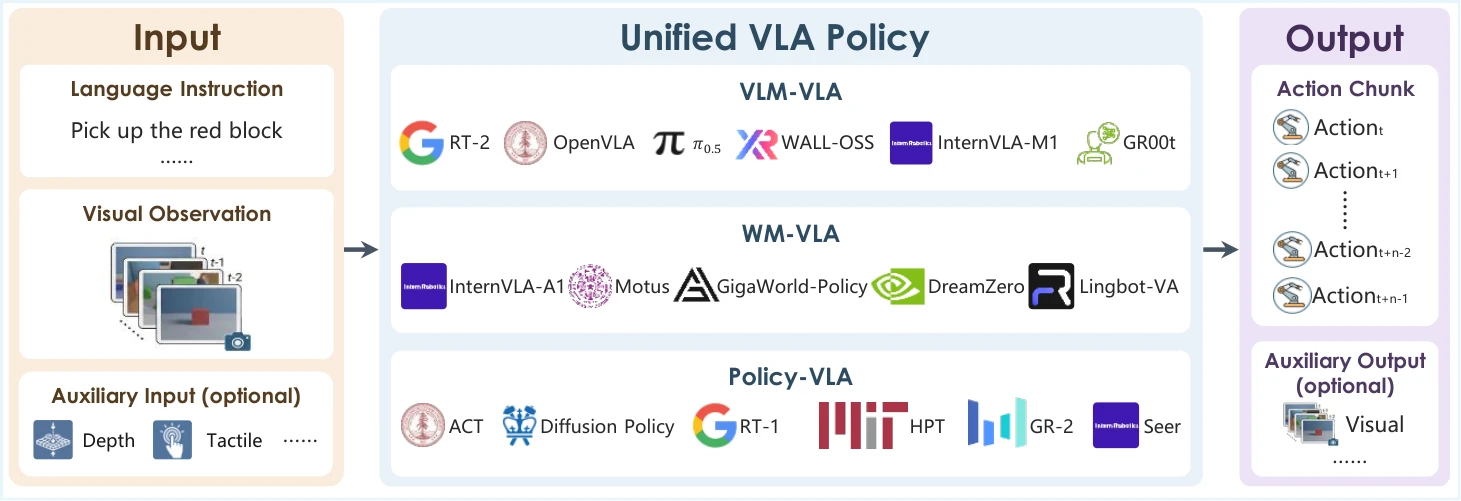
图 1:StarVLA 所采用的统一 VLA 表述的概念图。策略 \pi 把视觉观测和语言指令映射为未来的动作块。训练目标分解为 \mathcal L=\mathcal L_{\mathrm{action}}+\mathcal L_{\mathrm{aux}},不同模型家族对应不同形式的 \mathcal L_{\mathrm{aux}}。
原图注:Conceptual view of the unified VLA formulation adopted in StarVLA. A policy \pi maps visual observations and a language instruction to a future action chunk. The training objective decomposes as \mathcal{L} = \mathcal{L}_{\mathrm{action}} + \mathcal{L}_{\mathrm{aux}}, where different model families correspond to different forms of \mathcal{L}_{\mathrm{aux}}.
图 1 解读
左栏(Input)是策略的输入:语言指令(如 “Pick up the red block”,捡起红色积木)、多帧视觉观测,以及可选的辅助输入(深度、触觉等)。中栏(Unified VLA Policy)把已有方法分为三行:VLM-VLA(RT-2、OpenVLA、\pi_{0.5}、WALL-OSS、InternVLA-M1、GR00T),WM-VLA(InternVLA-A1、Motus、GigaWorld-Policy、DreamZero、LingBot-VA),以及作者归为 Policy-VLA 的一类(ACT、Diffusion Policy、RT-1、HPT、GR-2、Seer,大多是直接在机器人数据上训练的策略模型,对应下文“直接 VLA 建模”)。右栏(Output)是动作块 \mathrm{Action}_t,\ldots,\mathrm{Action}_{t+n-1},以及可选的辅助输出(如预测的未来画面)。 要点:三行方法共用同一个“输入—策略—输出”外壳,差别只在中间如何建模、是否产生辅助输出。图中动作块下标用 n,正文公式用 k,二者都表示动作块长度。
原文
As illustrated in Fig. 1, we model a VLA system as a policy that maps vision-language (VL) inputs to future action (A) sequences and optional auxiliary outputs:
\pi(\mathbf{a}_{t:t+k}, \mathbf{y}_{\mathrm{aux}} \mid \mathbf{x}_{\leq t}, \ell),(1)
where: - \mathbf{x}_{\leq t} = \{o^{\mathrm{vis}}_{\leq t}, o^{\mathrm{depth}}_{\leq t}, o^{\mathrm{tactile}}_{\leq t}, \ldots\} denotes the multimodal observation history up to time t, which may include visual observations, depth maps, tactile feedback, proprioceptive states, or other sensor modalities;
- \ell is the language instruction describing the task;
- \mathbf{a}_{t:t+k} represents the predicted k-step action chunk from time t to t+k;
- \mathbf{y}_{\mathrm{aux}} denotes optional auxiliary outputs over the future horizon, such as predicted future visual observations o^{\mathrm{vis}}_{t+1:t+k}, intermediate language reasoning or sub-goal descriptions \ell_{\mathrm{plan}}, or other modality predictions.
译文
如图 1 所示,我们把 VLA 系统建模为一个策略,它把视觉语言(VL)输入映射为未来的动作(A)序列和可选的辅助输出:
\pi(\mathbf{a}_{t:t+k}, \mathbf{y}_{\mathrm{aux}} \mid \mathbf{x}_{\leq t}, \ell),(1)
其中: - \mathbf{x}_{\leq t} = \{o^{\mathrm{vis}}_{\leq t}, o^{\mathrm{depth}}_{\leq t}, o^{\mathrm{tactile}}_{\leq t}, \ldots\} 表示截至时刻 t 的多模态观测历史,可包括视觉观测、深度图、触觉反馈、本体感知状态或其他传感模态;
- \ell 是描述任务的语言指令;
- \mathbf{a}_{t:t+k} 表示从时刻 t 到 t+k 的预测 k 步动作块;
- \mathbf{y}_{\mathrm{aux}} 表示未来时域上的可选辅助输出,例如预测的未来视觉观测 o^{\mathrm{vis}}_{t+1:t+k}、中间的语言推理或子目标描述 \ell_{\mathrm{plan}},或其他模态的预测。
解释
公式 (1) 是一个条件概率分布:竖线右边是已知条件(历史观测和指令),左边是要预测的量(动作块和辅助输出)。上标 vis/depth/tactile 分别表示视觉、深度、触觉;下标 \le t 表示“到当前时刻为止的全部历史”。动作块的意义:一次预测多步动作,可以降低推理频率,并让动作在时间上更平滑。例如第 5.1 节 LIBERO 实验的动作块长度为 8,即一次输出 8 个连续的末端控制量。严格说 t 到 t+k 若含两端有 k+1 步,原文称“k 步”,是对端点约定不严格,不影响理解。\mathbf y_{\mathrm{aux}} 是可选的:直接策略没有它,VLM 路线可以是文字,世界模型路线可以是未来帧。
原文
This formulation abstracts away intermediate representations and implicitly marginalizes over latent predictions when present, allowing both direct policies and model-based approaches to be expressed within a common interface.The training objective takes the general form
\mathcal{L} \;=\; \mathcal{L}_{\mathrm{action}} \;+\; \mathcal{L}_{\mathrm{aux}},(2)
where \mathcal{L}_{\mathrm{action}} supervises the predicted actions, and \mathcal{L}_{\mathrm{aux}} serves as an inductive bias that shapes the learned representation. Different VLA paradigms can then be interpreted as instantiations of this formulation with distinct learning signals: - Direct VLA Modeling sets \mathcal{L}_{\mathrm{aux}}=0, optimizing actions alone.
- VLM-based VLA introduces language-aligned auxiliary objectives, such as sub-task planning, spatial grounding, or structured reasoning supervision, requiring the model to generate language tokens as auxiliary outputs.
- WM-based VLA incorporates future observation prediction (e.g., images or videos), either as an auxiliary objective or as an implicit latent structure that supports action generation, where the model must predict visual states as auxiliary outputs.
译文
这一表述把中间表征抽象掉,并在存在隐变量预测时对其做隐式边缘化,使直接策略和基于模型的方法都能用同一接口表达。训练目标的一般形式为
\mathcal{L} \;=\; \mathcal{L}_{\mathrm{action}} \;+\; \mathcal{L}_{\mathrm{aux}},(2)
其中 \mathcal{L}_{\mathrm{action}} 监督预测的动作,\mathcal{L}_{\mathrm{aux}} 作为塑造所学表征的归纳偏置。于是,不同的 VLA 范式都可以解释为这一表述在不同学习信号下的实例: - 直接 VLA 建模令 \mathcal{L}_{\mathrm{aux}}=0,只优化动作。
- 基于 VLM 的 VLA引入与语言对齐的辅助目标,例如子任务规划、空间定位(spatial grounding)或结构化推理监督,要求模型生成语言 token 作为辅助输出。
- 基于世界模型的 VLA引入对未来观测(如图像或视频)的预测,它既可以是辅助目标,也可以是支撑动作生成的隐式潜在结构;此时模型必须预测视觉状态作为辅助输出。
解释
“边缘化”是概率论术语:如果模型内部先预测一个中间量 z(例如未来画面),再据此出动作,那么最终的动作分布是对所有可能的 z 求和(积分)后的结果,即 \pi(\mathbf a\mid\mathbf x)=\sum_z p(\mathbf a\mid z,\mathbf x)\,p(z\mid\mathbf x)。公式 (1) 只关心输入和输出,不关心中间怎么算,所以能把各种方法放进同一个框里。公式 (2) 的直觉:\mathcal L_{\mathrm{action}} 是主任务,决定动作准不准;\mathcal L_{\mathrm{aux}} 是“陪练”,不直接决定动作,却迫使共享表征学到有用的东西。归纳偏置(inductive bias)指模型在数据之外被预先引导的倾向:要求模型说出“先抓杯柄”,等于引导它关注任务结构;要求它画出下一帧,等于引导它关注物理动态。三类方法的区别因此被归结为“\mathcal L_{\mathrm{aux}} 是零、是文字还是画面”。原式未写权重,实践中通常会给 \mathcal L_{\mathrm{aux}} 乘一个系数(如第 3.1.2 节的
loss_scale.vlm)。 原文
Under this view, seemingly different paradigms such as VLM-based, world-model-based, and direct policies can be understood as variations of a shared policy formulation with different inductive biases. This perspective simplifies comparison while remaining compatible with both step-wise execution and multi-step open-loop control.
译文
在这一视角下,基于 VLM、基于世界模型以及直接策略这些看似不同的范式,都可以理解为同一策略表述在不同归纳偏置下的变体。这一视角简化了比较,同时兼容逐步执行和多步开环控制两种方式。
解释
逐步执行指每一步都重新观测、重新预测,只执行动作块的第一个动作;多步开环控制指预测出动作块后连续执行多步,期间不看新观测。由于公式 (1) 输出的是动作块,两种执行方式只是部署时如何消费这个动作块的区别,不影响模型表述。
2.1背景:面向具身智能的视觉语言基础模型
原文
Embodied agents interact continuously with the physical world, where vision serves as the primary modality for perceiving scene structure, object identity, spatial relations, and interaction affordances.
译文
具身智能体与物理世界持续交互,视觉是其感知场景结构、物体身份、空间关系和交互可供性(affordance)的主要模态。
解释
可供性指物体“能被怎样操作”,例如杯柄可以抓、抽屉可以拉。本小节是相关工作综述,按三条线展开:视觉语言基础模型本身、把它们用于机器人的 VLA、以及基于视频的世界模型。它为后文“同时支持 VLM 主干和世界模型主干”提供动机。
原文
Vision-language foundation models. This central role of vision has driven advances in visual representation learning, from supervised models such as ResNet (He et al., 2016) and Vision Transformers (Dosovitskiy et al., 2021) to scalable self-supervised approaches (Oquab et al., 2023) and video pretraining that captures temporal structure. Building on these backbones, language-aligned pretraining (Radford et al., 2021; Zhai et al., 2023) enables shared vision–language representations, while promptable systems such as SAM (Kirillov et al., 2023; Liu et al., 2023b) extend open-world perception. Together with instruction-tuned VLMs (Liu et al., 2023a; Chen et al., 2023; Karamcheti et al., 2024; Bai et al., 2025b; OpenAI, 2024; Gemini Team, Google, 2024) and generative video models (Gao et al., 2025; Google DeepMind, 2025), these advances significantly enhance perceptual grounding. However, perception alone is insufficient: embodied agents must also reason over language-conditioned goals and predict environment dynamics under action. Existing models are not inherently designed for action generation or visuomotor control (Zhao et al., 2023; Dhariwal and Nichol, 2021; Ze et al., 2024).
译文
视觉语言基础模型。视觉的这种核心作用推动了视觉表征学习的进步:从 ResNet(He et al., 2016)和 Vision Transformer(Dosovitskiy et al., 2021)等监督模型,到可扩展的自监督方法(Oquab et al., 2023),再到捕捉时间结构的视频预训练。在这些主干之上,与语言对齐的预训练(Radford et al., 2021; Zhai et al., 2023)实现了共享的视觉—语言表征,而 SAM 等可提示系统(Kirillov et al., 2023; Liu et al., 2023b)扩展了开放世界感知。再加上指令微调的 VLM(Liu et al., 2023a; Chen et al., 2023; Karamcheti et al., 2024; Bai et al., 2025b; OpenAI, 2024; Gemini Team, Google, 2024)和生成式视频模型(Gao et al., 2025; Google DeepMind, 2025),这些进展显著增强了感知落地(perceptual grounding)。然而,仅有感知是不够的:具身智能体还必须对语言条件下的目标进行推理,并预测动作作用下的环境动态。现有模型并非天然为动作生成或视觉运动控制而设计(Zhao et al., 2023; Dhariwal and Nichol, 2021; Ze et al., 2024)。
解释
这段按时间线梳理了视觉模型:监督学习(ResNet、ViT)\to 自监督(DINOv2)\to 图文对齐(CLIP、SigLIP)\to 可提示分割与开放词汇检测(SAM、Grounding DINO)\to 指令微调 VLM(LLaVA、PaLI-X、Prismatic、Qwen2.5-VL、GPT-4o、Gemini 1.5)和视频生成模型(Seedance、Veo 3)。转折句是“仅有感知是不够的”:VLA 还需要推理目标和预测动态,前者对应 VLM 路线的优势,后者对应世界模型路线的优势。最后一句的引用是 ACT、扩散模型和 3D Diffusion Policy,用于说明动作生成需要专门设计。
原文
Vision-language modeling for robotic perception and reasoning. Vision-language pretraining grounds perception in language, providing a scalable interface for task specification and high-level reasoning (Radford et al., 2021; Zhai et al., 2023). Extending this paradigm, Vision-Language-Action (VLA) models incorporate action supervision to unify perception, language, and control (Brohan et al., 2022, 2023; Kim et al., 2024; Black et al., 2024; Intelligence et al., 2025b; Bjorck et al., 2025). Early works (Nair et al., 2022; Xiao et al., 2022) show that strong visual priors improve control, while VLA models directly map observations and instructions to actions via behavior cloning or policy learning. By transferring large-scale semantic knowledge into control, they improve instruction following and cross-task generalization, often outperforming prior robotic policies (Zhao et al., 2023; Chi et al., 2024a; Ze et al., 2024). Recent work extends these models to humanoid loco-manipulation (Wei et al., 2026).
译文
面向机器人感知与推理的视觉语言建模。视觉语言预训练把感知落地到语言上,为任务描述和高层推理提供了可扩展的接口(Radford et al., 2021; Zhai et al., 2023)。在这一范式上进一步扩展,视觉—语言—动作(VLA)模型引入动作监督,把感知、语言和控制统一起来(Brohan et al., 2022, 2023; Kim et al., 2024; Black et al., 2024; Intelligence et al., 2025b; Bjorck et al., 2025)。早期工作(Nair et al., 2022; Xiao et al., 2022)表明强视觉先验能改善控制,而 VLA 模型通过行为克隆或策略学习,直接把观测和指令映射为动作。通过把大规模语义知识迁移到控制中,它们改善了指令遵循和跨任务泛化,常常优于此前的机器人策略(Zhao et al., 2023; Chi et al., 2024a; Ze et al., 2024)。近期工作把这些模型扩展到人形机器人的移动操作(Wei et al., 2026)。
解释
VLA 的代表作依次是 RT-1、RT-2、OpenVLA、\pi_0、\pi_{0.5} 和 GR00T N1;早期“视觉先验”工作是 R3M 和 MVP,它们用预训练视觉表征提升机器人控制。行为克隆(behavior cloning)就是监督学习式的模仿:给定专家示范的“观测—动作”对,训练模型复现专家动作。被超越的“此前策略”指 ACT、Diffusion Policy 和 DP3 这类从头训练的策略。\Psi_0(Wei et al., 2026)把 VLA 用于人形机器人的“边走边操作”(loco-manipulation)。
原文
To preserve reasoning capabilities, subsequent approaches explore multimodal co-training (Driess et al., 2025; Ye et al., 2026a; Chen et al., 2025c; Zeng et al., 2024; Yang et al., 2025c; Zhou et al., 2025), while others scale teleoperated datasets (Collaboration et al., 2023; Khazatsky et al., 2024; Wu et al., 2024; AgiBot, 2025; Ebert et al., 2021; Duan et al., 2024). However, these datasets remain limited in task, language, and scene diversity (Shi et al., 2025; Chi et al., 2024b), motivating portable data collection (Generalist AI, 2025; Liu et al., 2024b; Chi et al., 2024b). Meanwhile, tightly coupled pipelines hinder reproducibility, modularity, and scalability, highlighting the need for unified frameworks.
译文
为了保留推理能力,后续方法探索了多模态联合训练(Driess et al., 2025; Ye et al., 2026a; Chen et al., 2025c; Zeng et al., 2024; Yang et al., 2025c; Zhou et al., 2025),另一些方法则扩大遥操作数据集的规模(Collaboration et al., 2023; Khazatsky et al., 2024; Wu et al., 2024; AgiBot, 2025; Ebert et al., 2021; Duan et al., 2024)。然而,这些数据集在任务、语言和场景多样性上仍然有限(Shi et al., 2025; Chi et al., 2024b),这推动了便携式数据采集(Generalist AI, 2025; Liu et al., 2024b; Chi et al., 2024b)。与此同时,紧密耦合的流水线妨碍了复现性、模块化和可扩展性,凸显了对统一框架的需求。
解释
联合训练一线的代表是 \pi_0 的知识隔离(Knowledge Insulating)、ST4VLA、InternVLA-M1、MolmoAct、InstructVLA、ChatVLA,其中 ST4VLA 和 InternVLA-M1 与本文作者团队有关,第 6 节会引用 ST4VLA 的结果。遥操作数据一线包括 Open X-Embodiment(OXE)、DROID、RoboMIND、AgiBot World、BridgeData 等。便携式采集指 UMI 这类手持夹爪设备,不需要真机即可采集示范。段末又落回本文主题:数据和方法越多,越需要统一框架来承载。
原文
Video-based world model for robotic dynamics and interaction. Orthogonal to language-based scaling, video-based world models learn physical dynamics via visual prediction. Video captures motion, contact, and causality more effectively than static data. Early methods augment VLA policies with predictive latent modeling (Zheng et al., 2025b; Bjorck et al., 2025; Ye et al., 2025), while large-scale video pretraining enables planning with minimal robot data (Assran et al., 2025; Jang et al., 2025). Later work treats video as a primary policy substrate, either unifying policy, simulation, and evaluation or decoupling planning from control (Du et al., 2023; Ko et al., 2024; Pai et al., 2025; Chen et al., 2025a).
译文
面向机器人动态与交互的视频世界模型。与基于语言的扩展正交,视频世界模型通过视觉预测来学习物理动态。相比静态数据,视频能更有效地捕捉运动、接触和因果关系。早期方法用预测性的潜在建模来增强 VLA 策略(Zheng et al., 2025b; Bjorck et al., 2025; Ye et al., 2025),而大规模视频预训练使得只用极少机器人数据也能进行规划(Assran et al., 2025; Jang et al., 2025)。后来的工作把视频作为策略的主要载体,要么把策略、仿真和评测统一起来,要么把规划与控制解耦(Du et al., 2023; Ko et al., 2024; Pai et al., 2025; Chen et al., 2025a)。
解释
“正交”意味着两条扩展路线互不替代:语言路线扩展语义知识,视频路线扩展物理知识。代表作:FLARE、GR00T、LAPA 用潜在空间预测增强策略;V-JEPA 2、DreamGen 用大规模视频预训练支持规划;UniPi、AVDC、mimic-video、Large Video Planner 则先生成视频再从视频中提取动作。这一节是“为什么也要支持世界模型主干”的依据。
原文
Action-conditioned world models further support policy evaluation and improvement: imagined rollouts achieve strong performance (Wu et al., 2023), while recent systems enable counterfactual replay and safety evaluation (1X World Model Team, 2025; Team et al., 2025). Other approaches use controllable world models for trajectory generation, reinforcement learning, or scalable data synthesis (Guo et al., 2025; Jiang et al., 2026; GigaWorld Team et al., 2025; GigaBrain Team et al., 2026; Qiu et al., 2026). Recent work emphasizes causal consistency, controllability, and closed-loop efficiency by integrating action and value prediction into pretrained video models or jointly learning dynamics and control (Kim et al., 2026; Li et al., 2026; Cai et al., 2026; Gao et al., 2026; Zhu et al., 2025; Yuan et al., 2025). Some approaches formulate joint video–action prediction as policy learning or analyze gains from test-time imagination versus co-training (Ye et al., 2026b; Yuan et al., 2026). Additionally, human video provides scalable motion priors, with egocentric pipelines enabling transferable behaviors across tasks and embodiments (Hoque et al., 2025; Yang et al., 2025b; Zheng et al., 2026).
译文
动作条件世界模型进一步支持策略的评估和改进:基于想象的推演(imagined rollouts)取得了很强的性能(Wu et al., 2023),近期系统还实现了反事实回放和安全评估(1X World Model Team, 2025; Team et al., 2025)。另一些方法使用可控世界模型来生成轨迹、做强化学习或进行可扩展的数据合成(Guo et al., 2025; Jiang et al., 2026; GigaWorld Team et al., 2025; GigaBrain Team et al., 2026; Qiu et al., 2026)。近期工作强调因果一致性、可控性和闭环效率,做法是把动作和价值预测整合进预训练视频模型,或者联合学习动态与控制(Kim et al., 2026; Li et al., 2026; Cai et al., 2026; Gao et al., 2026; Zhu et al., 2025; Yuan et al., 2025)。有些方法把视频—动作联合预测表述为策略学习,或分析测试时想象与联合训练各自带来的收益(Ye et al., 2026b; Yuan et al., 2026)。此外,人类视频提供了可扩展的运动先验,第一人称(egocentric)数据流水线使行为可以跨任务、跨本体迁移(Hoque et al., 2025; Yang et al., 2025b; Zheng et al., 2026)。
解释
动作条件世界模型:给定当前画面和一段动作,预测执行后的画面,相当于“可学习的模拟器”,可用于 DayDreamer 式的想象训练、1X 世界模型和 Veo 世界模拟器式的策略评估,以及 Ctrl-World、WoVR、GigaWorld-0 等的数据合成与强化学习。第三组引用中最相关的是 Cosmos Policy(Kim et al., 2026):它把 Cosmos 视频模型微调成策略,本文的 Cosmos-Predict2 主干正与此相关。DreamZero 与 Fast-WAM 讨论“世界—动作模型推理时是否必须真的想象未来画面”,这正是本文导读中提到的悬而未决的问题。最后一组 EgoDex、EgoVLA、EgoScale 利用人类第一人称视频学习操作。
引用核对:源码中“Zhu et al., 2025”与“Yuan et al., 2025”对应的参考文献分别是 EMMA(移动操作人类数据)和 MotionTrans(人类 VR 数据),与“把动作和价值预测整合进视频模型”这一描述不完全吻合,可能是引用键使用错误。
引用核对:源码中“Zhu et al., 2025”与“Yuan et al., 2025”对应的参考文献分别是 EMMA(移动操作人类数据)和 MotionTrans(人类 VR 数据),与“把动作和价值预测整合进视频模型”这一描述不完全吻合,可能是引用键使用错误。
原文
Above vision-language pretraining and video-based world modeling scale embodied intelligence along complementary but largely fragmented axes, motivating StarVLA's design choice to separate what should vary across methods from what should remain stable across training, evaluation, and deployment.
译文
上述视觉语言预训练和视频世界建模沿着互补但大体上割裂的方向扩展具身智能,这促使 StarVLA 做出如下设计选择:把应当随方法变化的部分,与在训练、评测和部署中应当保持稳定的部分分离开来。
解释
这句是背景综述的收束,也是整个系统设计的原则:变化的部分是主干和动作头,稳定的部分是数据接口、训练循环、评测服务。下一小节把这个原则具体化为两个代码接口。
2.2在视觉语言基础模型上构建 VLA 框架
原文
While the foundation models surveyed above provide powerful visual-linguistic representations, they are not natively designed for action generation. A key design goal of StarVLA is to make these VL foundation models VLA-ready: we provide a unified I/O interface contract and a compositional architecture that allow diverse action decoding strategies to be flexibly composed on top of the same VL backbone.
译文
上面综述的基础模型虽然提供了强大的视觉—语言表征,但它们并非天然为动作生成而设计。StarVLA 的一个关键设计目标,是让这些视觉语言基础模型具备成为 VLA 的条件(VLA-ready):我们提供统一的输入/输出(I/O)接口约定和一种组合式结构,使多种动作解码策略可以灵活地组合在同一个视觉语言主干之上。
解释
本小节回答“怎么做到可拼装”。答案分两层:外层是整个 VLA 对外的 I/O 接口(原始观测进、动作出);内层是主干与动作头之间的接口(隐藏状态)。两层接口都标准化后,就形成后文所说的“双向模块化”。
原文
Unified I/O Interface. All framework modules in StarVLA inherit from a common base class and expose two methods that share a unified input/output (I/O) interface: both training and inference consume raw, environment-level observations identical to what the robot receives at deployment time.
forward({raw images, str, ...})\rightarrow{raw images, str, ...}: the training entry point. It receives a batch of raw samples, each containing multi-view RGB images, a natural-language instruction, and an action chunk, and returns a loss dictionary.predict_action({raw images, str, ...})\rightarrow{normalized_actions, ...}: the inference entry point. It accepts the same observation format (minus ground-truth actions) and returns predicted action chunks.
译文
统一的 I/O 接口。StarVLA 中所有框架模块都继承自一个共同的基类,并提供两个共享统一输入/输出(I/O)接口的方法:训练和推理都直接使用原始的、环境层面的观测,与机器人在部署时接收到的完全相同。
forward({raw images, str, ...})\rightarrow{raw images, str, ...}:训练入口。它接收一批原始样本,每个样本包含多视角 RGB 图像、一条自然语言指令和一个动作块,并返回一个损失字典。predict_action({raw images, str, ...})\rightarrow{normalized_actions, ...}:推理入口。它接受相同格式的观测(去掉真实动作),返回预测的动作块。
解释
两个方法的输入都是 Python 字典,键包括原始图像(PIL 图像或数组,而非已经归一化、切块的张量)、指令字符串等。
原文小错误:
forward 多一个真实动作字段,用来计算损失;predict_action 输出归一化后的动作(按训练集统计量缩放到固定范围),由评测端适配器读取 dataset_statistics.json 再反归一化成真实物理量(见 3.2.1 节)。原文小错误:
forward 的箭头右侧写的是 {raw images, str, ...},但正文说明它返回损失字典,应理解为 {action_loss, ...}。 原文
By deliberately adopting this unified I/O interface, where training inputs mirror real deployment observations rather than relying on heavily preprocessed dataloader tensors, we minimize train/test distribution mismatch, a common source of silent performance degradation in VLA systems.
译文
我们有意采用这种统一 I/O 接口,让训练输入与真实部署时的观测保持一致,而不是依赖数据加载器中经过大量预处理的张量;这样可以把训练/测试分布不匹配降到最低,而这种不匹配是 VLA 系统中悄无声息地导致性能下降的常见原因。
解释
“悄无声息的性能下降”是一个很实际的坑:训练时数据加载器把图像先裁剪再缩放,部署时评测脚本却先缩放再裁剪;或者训练时图像是 RGB,部署时是 BGR。代码不会报错,但成功率会莫名其妙地掉。把预处理放进模型内部、训练和推理走同一段代码,就从结构上消除了这类不一致。
原文
This design choice reflects a deeper invariant of robotic deployment: regardless of how different VL foundation models are pretrained—what tokenization scheme they adopt, how they resize or partition images, or what auxiliary objectives they optimize during pretraining—at inference time every model must ultimately accept the same raw sensor streams that the physical robot provides and produce executable motor commands. The unified I/O interface codifies this deployment-time invariant as the system's first-class contract, ensuring that any VL model whose inference path can consume raw observations is immediately compatible with StarVLA, without requiring users to reverse-engineer or replicate model-specific preprocessing pipelines. Crucially, this same invariant-driven principle extends naturally to the internal architecture, as we describe next.
译文
这一设计选择反映了机器人部署中一个更深层的不变量:无论不同的视觉语言基础模型如何预训练——采用什么 token 化方案、如何缩放或切分图像、预训练时优化了哪些辅助目标——推理时每个模型最终都必须接受物理机器人提供的同样的原始传感器数据流,并输出可执行的电机指令。统一 I/O 接口把这一部署时不变量写成系统的头等约定,保证任何推理路径能直接处理原始观测的视觉语言模型都能立即与 StarVLA 兼容,用户无需逆向分析或复刻某个模型专属的预处理流程。关键在于,同样的“由不变量驱动”的原则也自然延伸到内部结构,见下文。
解释
“不变量”的思路是:各家模型内部千差万别,但两端是固定的,即一端是相机图像和文字,另一端是电机指令。把接口定在这两个固定端点上,就不会因为某个模型的内部细节而影响整个系统。例如 Qwen-VL 会把图像切成可变数量的图块,Cosmos 用视频 VAE 编码,这些差异都被封装在各自主干内部。
原文
Compositional framework. Applying the same principle internally, we decompose every VLA method into two explicitly separated components connected by a standardized representation contract: a VL backbone (e.g., Qwen2.5-VL, z) that consumes raw multimodal observations and exposes hidden-state representations through a common output specification, and a pluggable action head that reads those representations through a corresponding input specification and converts them into motor commands. Each framework assembles itself through the same two-step composition (first loading the backbone, then attaching an action head), with both components configured declaratively via YAML. Because the outer system boundary (raw observations \to actions) and the inner backbone–head boundary (multimodal inputs \to hidden states \to actions) are both governed by standardized contracts, StarVLA achieves bidirectional modularity: backbone and action head can each be replaced independently without affecting the other or any surrounding infrastructure.
译文
组合式框架。在内部应用同样的原则,我们把每种 VLA 方法分解为两个明确分离、由标准化表征约定连接的组件:一是视觉语言主干(如 Qwen2.5-VL),它处理原始多模态观测,并按统一的输出规范给出隐藏状态表征;二是可插拔的动作头,它按对应的输入规范读取这些表征,并把它们转换为电机指令。每个框架都以同样的两步组合方式搭建(先加载主干,再挂接动作头),两个组件都通过 YAML 声明式配置。由于外层系统边界(原始观测 \to 动作)和内层主干—动作头边界(多模态输入 \to 隐藏状态 \to 动作)都受标准化约定约束,StarVLA 实现了双向模块化:主干和动作头都可以独立替换,既不影响对方,也不影响周围的任何基础设施。
解释
原文“Qwen2.5-VL, z”中的“z”是排版残留,译文已略去。声明式配置的意思是:在 YAML 里写“主干 = Qwen3-VL-4B,动作头 = GR00T”,代码按配置自动组装,而不是在 Python 里手工写死。双向模块化可以用一个 m\times n 网格理解:m 种主干和 n 种动作头可以组合出 m\times n 种模型,而新增一种主干只需写 1 个适配器,不需要写 n 份代码。表 2、表 3 中“Qwen3-VL-4B / Cosmos-Predict2-2B × 多种动作头”的实验正是这个网格的一部分。
原文
This modularity provides flexibility across different stages of VLA development. For researchers, it supports rapid experimentation in multiple directions. New action decoding paradigms can be prototyped by implementing and registering an action-head module, while new vision-language backbones—such as instruction-tuned VLMs (e.g., Qwen2.5-VL (Bai et al., 2025b), InternVL (Cai et al., 2026)) or video-native models (e.g., Cosmos (Kim et al., 2026))—can be integrated through a lightweight adapter that conforms to a shared representation interface. Once integrated, these backbones can be evaluated across different action heads without requiring per-method modification. For training infrastructure, the standardized interfaces allow much of the upstream and downstream stack (e.g., training pipelines, benchmark harnesses, and deployment services) to remain largely backbone- and action-head-agnostic, reducing the need for method-specific code paths as new paradigms or models are introduced. For deployment, switching between different backbones or action paradigms can be handled through configuration changes, without requiring code-level modifications.
译文
这种模块化为 VLA 开发的各个阶段都提供了灵活性。对研究者而言,它支持多个方向的快速实验。新的动作解码范式只需实现并注册一个动作头模块即可快速验证;新的视觉语言主干——例如指令微调的 VLM(如 Qwen2.5-VL(Bai et al., 2025b)、InternVL(Cai et al., 2026))或视频原生模型(如 Cosmos(Kim et al., 2026))——可以通过一个符合共享表征接口的轻量适配器接入。一旦接入,这些主干就可以与不同动作头组合评测,无需针对每种方法修改代码。对训练基础设施而言,标准化接口使上下游的大部分组件(如训练流水线、基准测试框架和部署服务)基本可以与主干和动作头无关,在引入新范式或新模型时减少对方法专属代码路径的需求。对部署而言,在不同主干或动作范式之间切换只需修改配置,无需改动代码。
解释
“注册”(register)是常见的插件机制:动作头类在定义时登记一个名字,YAML 里写这个名字就能找到对应的类。三类受益者分别对应“写新方法的人、维护训练集群的人、做部署的人”。引用核对:InternVL 处引用的 Cai et al. (2026) 实为 InternVLA-A1,Cosmos 处引用的 Kim et al. (2026) 是 Cosmos Policy,均为基于这些模型的 VLA 工作,而非模型本身的原始文献。
2.3有代表性的 VLA 实例
原文
Under this unified abstraction, we implement four paradigms spanning the major action decoding families in the current VLA literature, as illustrated in Fig. 2. All variants share the same VL backbone, the same base class, and the same
forward/predict_action contract, differing only in how they extract actions from the backbone's representations: 译文
在这一统一抽象下,我们实现了四种范式,覆盖当前 VLA 文献中主要的动作解码家族,如图 2 所示。所有变体共享同一个视觉语言主干、同一个基类和同一套
forward/predict_action 约定,区别仅在于如何从主干的表征中提取动作: 解释
这里是全文最“硬核”的部分。读图 2 时可以抓住两个问题:动作是离散 token 还是连续数值?动作头读的是主干的哪一层、哪些位置的隐藏状态?四种方法正好在这两个维度上各不相同。
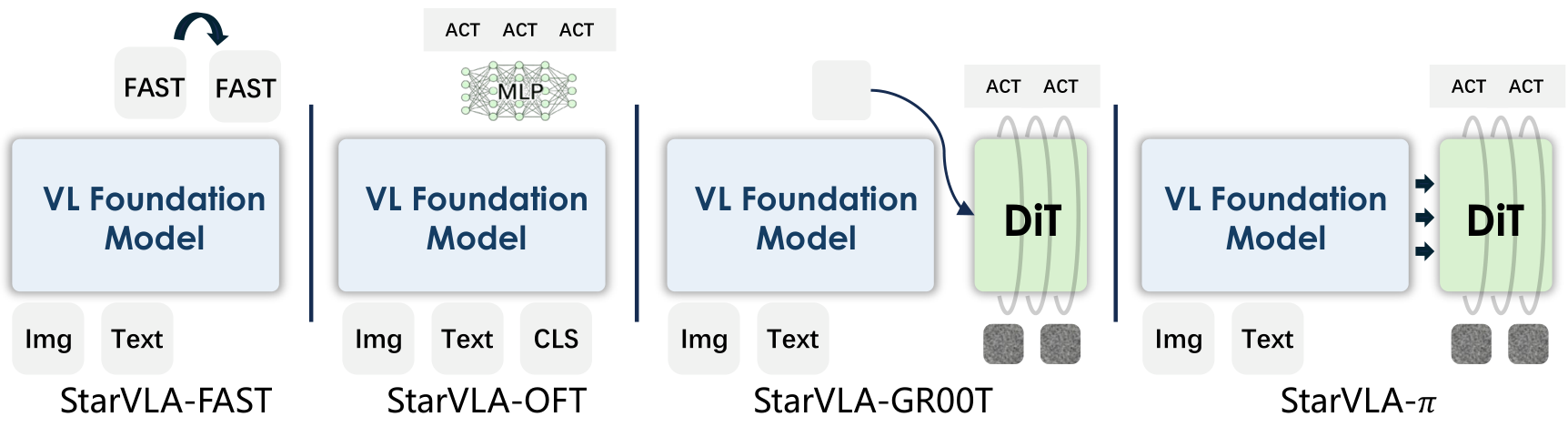
图 2:StarVLA 中把视觉语言模型改造为视觉—语言—动作框架的四种代表性方法(FAST、OFT、\pi 和 GR00T)在统一接口下的总览。
原图注:Overview of four representative approaches for adapting Vision-Language Models into Vision-Language-Action frameworks in StarVLA (FAST, OFT, \pi, and GR00T) under a unified interface.
图 2 解读
四个子图底部都是同一个“VL Foundation Model”(视觉语言基础模型),输入为图像 token(Img)和文本 token(Text),差别全在上方。 StarVLA-FAST(最左):主干直接输出 FAST token,弯箭头表示生成的 token 再喂回模型、逐个生成,即自回归。没有额外的动作网络。 StarVLA-OFT(左二):输入在图文之后多了一组 CLS 位置(可学习的“动作查询” token);读出这些位置最后一层的隐藏状态,经 MLP 一次性输出多个 ACT(连续动作)。 StarVLA-GR00T(右二):主干右侧接一个绿色 DiT,DiT 底部输入是噪声动作(灰色方块),只从主干的最终输出引出一条箭头作为条件,迭代去噪得到 ACT。 StarVLA-\pi(最右):同样是 DiT 去噪,但主干与 DiT 之间有多条箭头,表示 DiT 的每一层都通过交叉注意力读取主干对应层的隐藏状态(逐层条件化)。 要点:从左到右,动作头越来越“重”:FAST 不加网络,OFT 加一个 MLP,GR00T 和 \pi 各加一个 DiT;GR00T 与 \pi 的区别在于条件化取主干一层还是多层。
原文
- StarVLA-FAST (\pi_{\text{fast}}): Appends a FAST tokenizer (Pertsch et al., 2025) to the VL backbone and autoregressively generates discrete action tokens via next-token prediction, using the LLM's own vocabulary space.
- StarVLA-OFT: Attaches a lightweight MLP that reads the hidden states of predefined action tokens and regresses continuous actions in parallel (L1 loss), following OpenVLA-OFT (Kim et al., 2025)—the simplest form of pluggable head.
译文
- StarVLA-FAST(\pi_{\text{fast}}):在视觉语言主干上附加 FAST tokenizer(Pertsch et al., 2025),通过下一 token 预测自回归地生成离散动作 token,使用的是大语言模型自身的词表空间。
- StarVLA-OFT:挂接一个轻量 MLP,读取预定义动作 token 的隐藏状态,并以并行方式回归连续动作(L1 损失),做法沿用 OpenVLA-OFT(Kim et al., 2025)——这是最简单的可插拔动作头形式。
解释
FAST 的原理:先对一段动作序列做离散余弦变换(DCT),把它变成频域系数,再量化并用字节对编码(BPE)压缩成少量 token。这样动作就成了“一种特殊的文字”,语言模型可以用原有的交叉熵损失学习。“使用 LLM 自己的词表”对应仓库里的
OFT 的原理:在输入里放入固定数量的“占位” token,主干一次前向后,把这些位置的隐藏状态送进 MLP,直接输出整个动作块的连续值。损失是 L1(预测值与真实值之差的绝对值之和)。只需一次前向,是四种中推理最快的。
原文此句末尾多了一个字母“i”(“head.i”),属排版残留。
Qwen3-VL-4B-Instruct-Action:在 Qwen 词表中加入了 FAST token。缺点是推理时要逐个生成 token,速度慢,且量化会损失精度。OFT 的原理:在输入里放入固定数量的“占位” token,主干一次前向后,把这些位置的隐藏状态送进 MLP,直接输出整个动作块的连续值。损失是 L1(预测值与真实值之差的绝对值之和)。只需一次前向,是四种中推理最快的。
原文此句末尾多了一个字母“i”(“head.i”),属排版残留。
原文
- StarVLA-\pi (\pi_0): Integrates a layer-wise cross-DiT flow-matching action expert, conditioned on multi-layer VL hidden states via cross-attention, and predicts continuous actions through iterative denoising, following \pi_0 (Black et al., 2024).
- StarVLA-GR00T: Adopts a dual-system design where the VL backbone serves as System 2 (slow reasoning) and a DiT-based flow-matching module serves as System 1 (fast action generation), consistent with GR00T N1.5 (Bjorck et al., 2025). This variant demonstrates that even fundamentally different inference-time compute patterns can coexist under the same interface.
译文
- StarVLA-\pi(\pi_0):集成一个逐层交叉注意力 DiT 流匹配动作专家,通过交叉注意力以多层视觉语言隐藏状态为条件,经迭代去噪预测连续动作,做法沿用 \pi_0(Black et al., 2024)。
- StarVLA-GR00T:采用双系统设计:视觉语言主干充当系统 2(慢速推理),基于 DiT 的流匹配模块充当系统 1(快速动作生成),与 GR00T N1.5(Bjorck et al., 2025)一致。这一变体表明,即使推理时计算模式根本不同,也能在同一接口下共存。
解释
流匹配:训练时取真实动作 \mathbf a 和噪声 \boldsymbol\epsilon,按随机时间 \tau\in[0,1] 插值得到 \mathbf a_\tau=\tau\mathbf a+(1-\tau)\boldsymbol\epsilon,让网络预测“速度” \mathbf a-\boldsymbol\epsilon;推理时从纯噪声出发,按预测的速度走若干步(例如 10 步)得到动作。它能表达多峰分布(例如绕障碍物从左或从右都可以),这是 L1 回归做不到的。
StarVLA-\pi 与 StarVLA-GR00T 的区别:两者都用 DiT 做流匹配,区别在条件化方式。\pi 式是“逐层”的:DiT 第 i 层读取主干第 i 层(或对应层)的隐藏状态,信息交换更细;GR00T 式只读主干某一层的输出,主干和动作专家耦合更松,可以以不同频率运行。“系统 1 / 系统 2”借用自心理学中“快思考 / 慢思考”的说法。
StarVLA-\pi 与 StarVLA-GR00T 的区别:两者都用 DiT 做流匹配,区别在条件化方式。\pi 式是“逐层”的:DiT 第 i 层读取主干第 i 层(或对应层)的隐藏状态,信息交换更细;GR00T 式只读主干某一层的输出,主干和动作专家耦合更松,可以以不同频率运行。“系统 1 / 系统 2”借用自心理学中“快思考 / 慢思考”的说法。
原文
This spectrum, from VLM-native decoding (autoregressive tokenization, parallel regression) to generative-model-based decoding shared with world-model architectures (iterative flow-matching denoising, dual-system reasoning), shows that the proposed compositional architecture and unified interface are broadly applicable. Adding further paradigms requires only implementing and registering a new action head; the backbone, training loop, and evaluation pipeline remain unchanged.
译文
这一谱系从 VLM 原生解码(自回归 token 化、并行回归)延伸到与世界模型结构共享的、基于生成模型的解码(迭代流匹配去噪、双系统推理),表明所提出的组合式结构和统一接口具有广泛的适用性。增加新的范式只需实现并注册一个新的动作头;主干、训练循环和评测流程都保持不变。
解释
可以把四个变体按“与主干的耦合度”排序:FAST 完全在主干内部完成;OFT 只多一个浅层 MLP;\pi 的 DiT 与主干逐层交互;GR00T 的 DiT 相对独立。后文表 2–7 的对比基本就是在这条谱系上做的消融。作者把流匹配类动作头与“世界模型结构”联系起来,是因为视频世界模型多用扩散/流匹配生成画面,同一类生成机制被用来生成动作。
3模型训练与测试的统一系统流水线(Unified System Pipeline for Model Training and Testing)
原文
The StarVLA codebase supports several practical training regimes for VLA policies, ranging from standard supervised fine-tuning (SFT) on downstream robot datasets to multi-objective co-training with vision–language (VLM) web data and cross-embodiment co-training on mixed robot embodiments. All training pipelines are implemented in explicit PyTorch loops built on Accelerate + DeepSpeed for distributed execution, while preserving a unified YAML configuration interface across methods. Figure 3 summarizes the supported training modes and how data streams connect to the unified model framework.
译文
StarVLA 代码库为 VLA 策略支持多种实用的训练方式:从在下游机器人数据集上的标准监督微调(supervised fine-tuning,SFT),到与视觉语言(VLM)网络数据的多目标联合训练,再到在多种机器人本体混合数据上的跨本体联合训练。所有训练流程都实现为显式的 PyTorch 训练循环,基于 Accelerate + DeepSpeed 进行分布式执行,同时在不同方法之间保持统一的 YAML 配置接口。图 3 概括了所支持的训练模式,以及数据流如何连接到统一的模型框架。
解释
显式 PyTorch 循环指训练循环是手写的
for batch in loader: loss.backward(); optimizer.step(),而不是封装在 Hugging Face Trainer 等高层 API 里,好处是容易插入联合训练这类自定义逻辑。Accelerate 是 Hugging Face 的分布式启动库,DeepSpeed 提供 ZeRO 显存优化(第 5 节用 ZeRO-2,即把优化器状态和梯度分片到各卡上)。 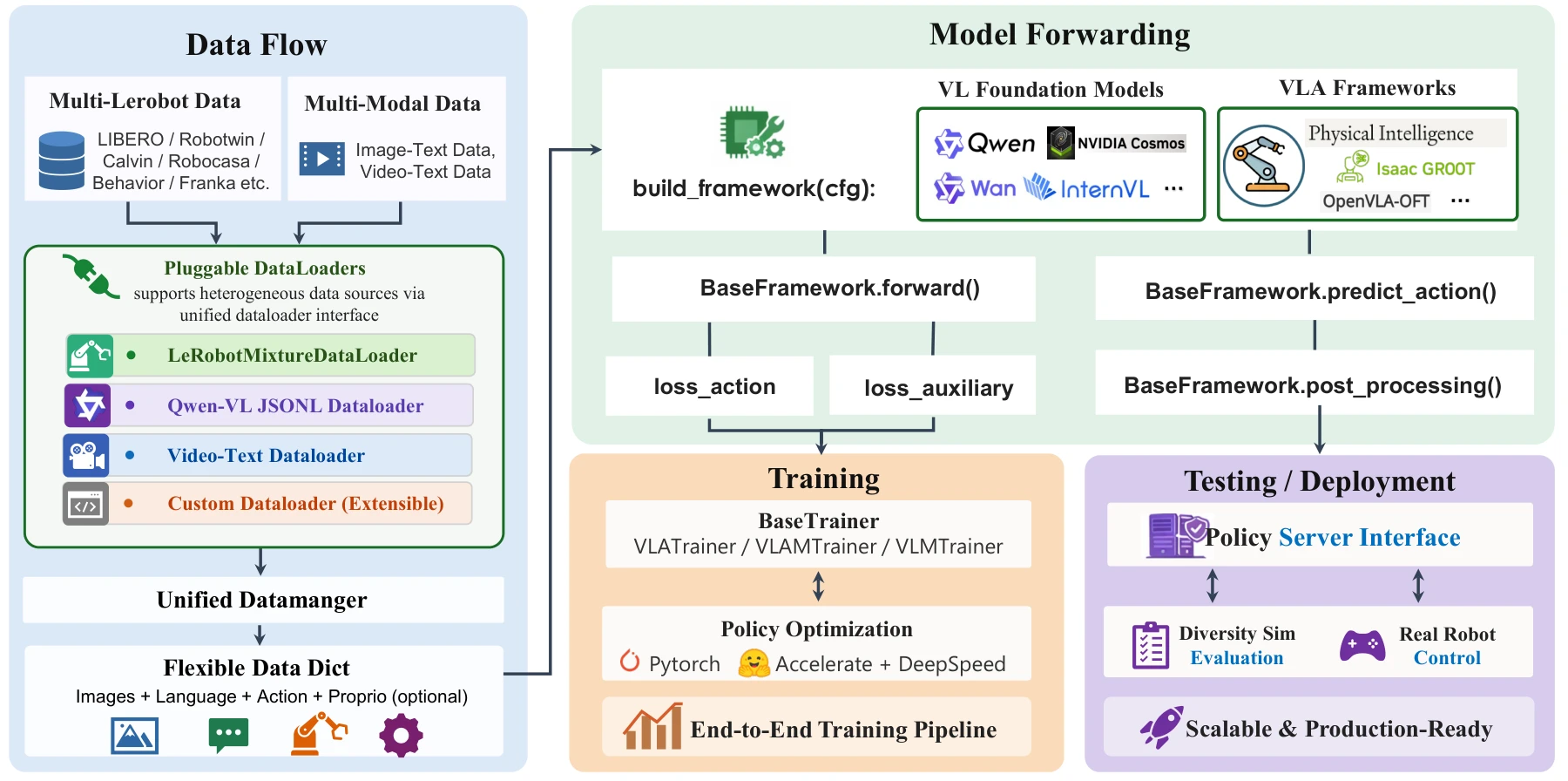
图 3:StarVLA 框架总览。我们给出一个统一的模块化流水线,把异构数据源、可插拔的数据加载器和灵活的数据表示,与标准化的模型前向接口连接起来。该框架支持多种视觉语言基础模型和 VLA 结构,可以端到端地训练和部署。
原图注:Overview of the StarVLA framework. We present a unified and modular pipeline that connects heterogeneous data sources, pluggable dataloaders, and flexible data representations with a standardized model forwarding interface. The framework supports diverse vision-language foundation models and VLA architectures, enabling end-to-end training and deployment.
图 3 解读
图分为四块。左侧 Data Flow(数据流):上方是两类数据源,Multi-LeRobot Data(LIBERO、RoboTwin、CALVIN、RoboCasa、BEHAVIOR、Franka 等机器人数据)和 Multi-Modal Data(图文、视频—文本数据);中间是可插拔的数据加载器(LeRobotMixtureDataLoader、Qwen-VL JSONL 加载器、视频—文本加载器、可扩展的自定义加载器);下方经统一数据管理器(原图拼写为 “Datamanger”)输出“灵活数据字典”,内容为图像 + 语言 + 动作 + 可选本体状态。 右上 Model Forwarding(模型前向):
build_framework(cfg) 按配置组装主干(Qwen、NVIDIA Cosmos、Wan、InternVL 等)和 VLA 框架(Physical Intelligence、Isaac GR00T、OpenVLA-OFT 等);BaseFramework.forward() 输出 loss_action 与 loss_auxiliary,正好对应公式 (2) 的两项;predict_action() 加 post_processing() 用于推理。 右下左 Training(训练):BaseTrainer 派生出 VLATrainer / VLAMTrainer / VLMTrainer,底层是 PyTorch + Accelerate + DeepSpeed。 右下右 Testing / Deployment(测试/部署):经 Policy Server Interface(策略服务接口)连接多种仿真评测和真机控制。 要点:这张图把第 2 节的抽象落到代码模块上,左侧数据和右侧模型之间只通过“数据字典”交互,这就是“原始观测进入模型”的具体实现。 3.1训练范式
3.1.1面向行为克隆的监督学习
原文
The most direct training mode is robot-only supervised learning, where the policy is trained to predict continuous actions from observations and language instructions. In our codebase, this training path is implemented in
starVLA/training/train_starvla.py. The objective is the action modeling loss returned by the framework forward() method (e.g., action_loss in the output dict). 译文
最直接的训练模式是只用机器人数据的监督学习:训练策略根据观测和语言指令预测连续动作。在我们的代码库中,这条训练路径实现于
starVLA/training/train_starvla.py。训练目标是框架 forward() 方法返回的动作建模损失(例如输出字典中的 action_loss)。 解释
这就是公式 (2) 中 \mathcal L_{\mathrm{aux}}=0 的情形。“动作建模损失”随动作头而变:FAST 是 token 交叉熵,OFT 是 L1,\pi 和 GR00T 是流匹配的速度回归误差。训练脚本本身不关心是哪一种,只读取字典里的
action_loss,这正是统一接口的好处。第 5 节所有单基准结果都用这种模式训练。 原文
Optimization setup. We support (i) full-parameter fine-tuning and (ii) selective freezing of submodules via
trainer.freeze_modules (comma-separated module paths). To stabilize training across heterogeneous components, the optimizer can use multiple parameter groups with different learning rates (e.g., separate LR for qwen_vl_interface and the action model) configured by trainer.learning_rate. Training uses bfloat16 autocast, gradient accumulation, gradient clipping, and a cosine schedule with a minimum learning rate. 译文
优化设置。我们支持 (i) 全参数微调,以及 (ii) 通过
trainer.freeze_modules(以逗号分隔的模块路径)选择性冻结子模块。为了在异构组件之间稳定训练,优化器可以使用多个参数组,各自采用不同的学习率(例如为 qwen_vl_interface 和动作模型分别设置学习率),由 trainer.learning_rate 配置。训练使用 bfloat16 自动混合精度、梯度累积、梯度裁剪,以及带最小学习率的余弦学习率调度。 解释
为什么要分组学习率:主干是预训练好的大模型,学习率太大容易“学坏”;动作头通常从零初始化,需要较大学习率才能学得快。例如主干用 1\times10^{-5}、动作头用 1\times10^{-4} 是常见做法(本文第 7.1 节通用模型的学习率为 1\times10^{-4})。bfloat16 是一种 16 位浮点格式,指数位与 32 位浮点相同,因此不易溢出,适合大模型训练。梯度累积:显存放不下大 batch 时,多次前向反向后再更新一次参数。余弦调度:学习率按余弦曲线从峰值下降到设定的最小值。
3.1.2面向具身推理的多目标联合训练
原文
Robot-only SFT can over-specialize the VLM backbone to a narrow instruction distribution. To preserve general-purpose visual reasoning and language grounding while learning action prediction, StarVLA supports a co-training regime that interleaves robot action learning with a VLM loss on multimodal web data. This mode is implemented in
starVLA/training/train_starvla_cotrain.py. 译文
只用机器人数据做 SFT,可能使 VLM 主干过度专门化于狭窄的指令分布。为了在学习动作预测的同时保留通用的视觉推理和语言落地能力,StarVLA 支持一种联合训练方式,把机器人动作学习与多模态网络数据上的 VLM 损失交替进行。该模式实现于
starVLA/training/train_starvla_cotrain.py。 解释
“狭窄的指令分布”:例如 LIBERO 只有 40 条左右的固定指令,模型只需记住这些句子,就不再需要真正理解语言,原有的问答和定位能力会逐渐退化,这就是第 6 节所说的“灾难性遗忘”。联合训练相当于在学新技能时“温习旧功课”。
原文
Dual-loader multi-objective training scheme. Co-training uses two dataloaders (VLA and VLM) and performs two forward/backward passes per optimization step: (i) a VLA forward pass through the framework
forward() to obtain action_loss, and (ii) a VLM forward pass through qwen_vl_interface to obtain the language modeling loss. The VLM loss is scaled by trainer.loss_scale.vlm in config, enabling a controlled trade-off between action learning and VLM capability retention. 译文
双加载器多目标训练方案。联合训练使用两个数据加载器(VLA 和 VLM),每个优化步执行两次前向/反向传播:(i) 经框架
forward() 做一次 VLA 前向,得到 action_loss;(ii) 经 qwen_vl_interface 做一次 VLM 前向,得到语言建模损失。VLM 损失由配置中的 trainer.loss_scale.vlm 缩放,从而在动作学习与保留 VLM 能力之间进行可控的权衡。 解释
用公式写就是:每一步的总梯度来自 \mathcal L=\mathcal L_{\mathrm{action}}+\lambda\,\mathcal L_{\mathrm{VLM}},其中 \lambda 就是
loss_scale.vlm,\mathcal L_{\mathrm{VLM}} 是对图文问答答案的下一 token 交叉熵。两次反向的梯度累加后再做一次参数更新。注意 VLM 前向只经过主干(qwen_vl_interface),不经过动作头,因此只有主干同时受两种损失影响。从模块名也能看出,当前联合训练主要面向 Qwen-VL 系列主干。 3.1.3基于机器人数据混合的跨本体联合训练
原文
To support cross-embodiment generalization, the codebase provides a unified LeRobot mixture dataset interface that allows training on heterogeneous robot datasets with different embodiments, action conventions, and camera setups. In config, users select a named mixture through
datasets.vla_data.data_mix, which maps to a list of (dataset name, sampling weight, robot type) tuples. At runtime, the mixture is materialized as a LeRobotMixtureDataset, which samples trajectories across datasets according to the specified weights and tracks embodiment tags based on robot type. This design makes “cross-embodiment pretraining” an operational configuration choice, rather than a bespoke training script. 译文
为了支持跨本体泛化,代码库提供统一的 LeRobot 混合数据集接口,可以在本体、动作约定和相机配置各不相同的异构机器人数据集上训练。在配置中,用户通过
datasets.vla_data.data_mix 选择一个具名的混合方案,它对应一个由(数据集名称、采样权重、机器人类型)三元组构成的列表。运行时,该混合方案被实例化为 LeRobotMixtureDataset,按指定权重在各数据集之间采样轨迹,并根据机器人类型记录本体标签。这一设计使“跨本体预训练”成为一项可操作的配置选择,而不必为其编写专门的训练脚本。 解释
一个混合方案在概念上类似:
bridge: [("bridge_orig", 1.0, "widowx"), ("fractal", 0.5, "google_robot")],即 Bridge 数据集按权重 1.0、Fractal 按权重 0.5 采样。采样权重决定每个数据集在训练中出现的频率,避免大数据集“淹没”小数据集。本体标签可以让模型知道当前样本来自哪种机器人,以便处理不同的动作维度和相机布局。第 7 节的多基准通用模型就是用这一机制合并 LIBERO、SimplerEnv、RoboTwin 和 RoboCasa 数据训练的。 3.1.4强化学习微调
原文
Beyond supervised and co-training regimes, we plan to support reinforcement learning (RL) fine-tuning as an extension of the same framework abstraction, collaborating with the RLinf project (https://github.com/RLinf/RLinf). At the time of writing, RL fine-tuning is an ongoing integration effort; the current public codebase focuses on supervised and co-training pipelines to build up a strong robotic foundation model.
译文
在监督训练和联合训练之外,我们计划与 RLinf 项目(https://github.com/RLinf/RLinf)合作,把强化学习(RL)微调作为同一框架抽象的扩展加以支持。截至撰写本文时,RL 微调仍在集成中;当前公开的代码库侧重于监督训练和联合训练流程,以构建强大的机器人基础模型。
解释
这是一项未完成的功能,读者不应把它算作 v1 报告已提供的能力。RL 微调的典型做法是在仿真器中让策略自己试错,以任务成功与否作为奖励来改进策略,可以弥补模仿学习只会“照抄示范”的局限。
3.2评测与部署
3.2.1跨基准的统一服务端—客户端评测
原文
StarVLA adopts a thin server–client testing abstraction so that benchmark-side evaluation code remains close to the official implementations, while model-side inference is standardized. In practice, a checkpoint is loaded by
baseframework.from_pretrained() and hosted as a lightweight WebSocket policy server in the StarVLA runtime environment. The benchmark evaluator, which may live in a different conda environment with its own simulator dependencies, interacts with the model through a small client wrapper rather than importing framework code directly. This decoupling is particularly useful for benchmarks such as LIBERO, SimplerEnv, and RoboTwin, whose official evaluators each carry different dependency stacks and control loops. 译文
StarVLA 采用一层很薄的服务端—客户端测试抽象,使基准一侧的评测代码尽量贴近官方实现,而模型一侧的推理则实现标准化。实际做法是:用
baseframework.from_pretrained() 加载检查点,并在 StarVLA 运行环境中把它作为轻量的 WebSocket 策略服务器托管起来。基准评测程序可以位于另一个 conda 环境中,带着自己的仿真器依赖,它通过一个小型客户端封装与模型交互,而不是直接导入框架代码。对于 LIBERO、SimplerEnv 和 RoboTwin 这类官方评测程序各自依赖不同软件栈和控制循环的基准,这种解耦尤其有用。 解释
为什么要拆成两个进程:仿真器常常要求特定版本的 Python、PyTorch、MuJoCo 或 SAPIEN,和大模型训练环境互相冲突。例如 SimplerEnv 依赖较旧的软件栈,而 Qwen3-VL 需要较新的 transformers。拆开后,模型在一个环境里跑,仿真器在另一个环境里跑,两者通过网络通信,互不干扰。WebSocket 是一种保持长连接的网络协议,适合每个控制步都要来回传数据的场景。这一设计与 openpi 的策略服务器思路相同。
原文
Inference interface. All framework variants expose the same inference entry point,
Framework.predict_action(), and the server forwards incoming payload dictionaries to this method with minimal routing logic. The benchmark-side client packages observations into a single dictionary, typically containing image (single- or multi-view RGB observations), lang (task instruction), and optional fields such as state, timestamps, or episode metadata. The payload is serialized with msgpack and sent to the policy server, which returns a dictionary containing model outputs such as normalized_actions. Because the communication contract is action-head-agnostic, switching from OFT to FAST, \pi, or GR00T does not require modifying benchmark code. 译文
推理接口。所有框架变体都提供同一个推理入口
Framework.predict_action(),服务器以极少的路由逻辑把收到的数据字典转发给这个方法。基准一侧的客户端把观测打包成一个字典,通常包含 image(单视角或多视角 RGB 观测)、lang(任务指令),以及 state、时间戳或回合元数据等可选字段。数据用 msgpack 序列化后发送给策略服务器,服务器返回一个包含模型输出(如 normalized_actions)的字典。由于通信约定与动作头无关,从 OFT 切换到 FAST、\pi 或 GR00T 都不需要修改基准代码。 解释
一次请求的数据大致是
{"image": [主视角图, 腕部图], "lang": "put the bowl on the plate"},返回 {"normalized_actions": 形状为 (8, 7) 的数组},即 8 步、每步 7 维(3 维位移 + 3 维旋转 + 1 维夹爪)的动作块,这里以 LIBERO 为例。msgpack 是一种二进制序列化格式,比 JSON 更紧凑、更快,适合传输图像数组。 原文
Benchmark-specific adapters. In StarVLA, benchmark differences are isolated in lightweight interface files such as
model2libero_interface.py, model2simpler_interface.py, and model2robotwin_interface.py. These adapters translate raw environment observations into the common StarVLA example format and post-process returned actions into the benchmark's native control API. Typical responsibilities include resizing images to the training resolution, reading dataset_statistics.json from the checkpoint directory for action unnormalization, converting chunked normalized predictions into executable actions, applying action ensembling, and handling benchmark-specific conventions such as sticky grippers or delta/relative-to-absolute action conversion. This design keeps the core policy server benchmark-agnostic while preserving faithful evaluation under each official protocol. 译文
基准专用适配器。在 StarVLA 中,各基准之间的差异被隔离在轻量的接口文件中,例如
model2libero_interface.py、model2simpler_interface.py 和 model2robotwin_interface.py。这些适配器把原始环境观测转换成 StarVLA 通用的样本格式,并把返回的动作后处理成基准原生的控制 API。典型职责包括:把图像缩放到训练分辨率;从检查点目录读取 dataset_statistics.json 用于动作反归一化;把分块的归一化预测转换为可执行动作;进行动作集成(action ensembling);以及处理基准特有的约定,例如粘滞夹爪(sticky gripper)或从增量/相对动作到绝对动作的转换。这一设计使核心策略服务器与基准无关,同时在各自的官方协议下保持评测的准确性。 解释
适配器做的几件事值得逐一理解:反归一化,模型输出是缩放后的数值,需要用训练集统计量(如各维度的分位数或均值方差)还原成米、弧度等物理单位,这些统计量随检查点一起保存在
值得注意的是,这些后处理选择本身会影响成功率,所以“同一模型在不同代码库中的分数”可能因适配器差异而不同,这也是作者强调统一框架的原因之一。
dataset_statistics.json 中。动作集成,相邻时刻预测的动作块在时间上有重叠,对同一时刻的多个预测加权平均,可使运动更平滑(ACT 中的 temporal ensembling)。粘滞夹爪,SimplerEnv 中常用的技巧:夹爪开合信号需要连续若干步一致才执行,避免夹爪抖动。增量转绝对,有的数据集记录的是“每步移动多少”,有的仿真器要求“移动到哪里”,需要累加换算。值得注意的是,这些后处理选择本身会影响成功率,所以“同一模型在不同代码库中的分数”可能因适配器差异而不同,这也是作者强调统一框架的原因之一。
3.2.2真机部署
原文
The same client-server contract also supports real-robot or hosted-benchmark deployment. In this setting, the robot controller plays the role of the benchmark client: it captures camera observations, assembles the same example dictionary used in simulation, queries the remote policy server, and executes the returned action on hardware. As a result, the control loop, safety logic, and device-specific middleware remain outside the StarVLA model runtime, while the model service remains unchanged.
译文
同样的客户端—服务端约定也支持真机部署或托管式基准部署。在这种情况下,机器人控制器扮演基准客户端的角色:它采集相机观测,组装与仿真中相同的样本字典,向远程策略服务器发出查询,并在硬件上执行返回的动作。这样一来,控制循环、安全逻辑和设备专用中间件都留在 StarVLA 模型运行环境之外,而模型服务本身保持不变。
解释
这意味着从仿真到真机,模型端代码完全不变,只需为真机写一个“客户端”。安全逻辑(如关节限位、急停、碰撞检测)放在机器人一侧更合理,因为它必须在模型出错或网络延迟时依然起作用。代价是每次推理都要经过网络往返,对实时性要求高的任务需要考虑延迟。
原文
Deployment interface. This separation makes deployment much less intrusive. The model stack can stay in a GPU-oriented inference environment, whereas the robot-side process can remain integrated with vendor SDKs, ROS nodes, or hosted evaluation platforms such as RoboChallenge. More importantly, the exact same checkpoint can be reused across simulation and real-robot settings as long as the client provides observations in the agreed dictionary format and applies the appropriate benchmark- or robot-specific post-processing. In this sense, StarVLA treats deployment as a continuation of the same testing paradigm rather than as a separate engineering path.
译文
部署接口。这种分离使部署的侵入性大大降低。模型软件栈可以留在面向 GPU 的推理环境中,而机器人一侧的进程可以继续与厂商 SDK、ROS 节点或 RoboChallenge 等托管评测平台集成。更重要的是,只要客户端按约定的字典格式提供观测,并做相应的基准或机器人专用后处理,同一个检查点就可以在仿真和真机环境中复用。从这个意义上说,StarVLA 把部署视为同一测试范式的延续,而不是一条单独的工程路线。
解释
ROS(Robot Operating System)是机器人领域常用的中间件;RoboChallenge 是一个远程真机评测平台,参赛者提交策略服务,平台方的真机作为客户端调用。需要注意:v1 报告声称支持真机部署,但正文没有给出任何真机实验结果,所有成绩都来自仿真基准。
4多基准集成(Multiple Benchmark Integration)
原文
Recent vision-language-action (VLA) research has made rapid progress across a wide range of benchmarks. However, most existing methods are evaluated on only a limited number of environments, and their implementations often differ substantially in preprocessing pipelines, policy interfaces, and evaluation protocols. These inconsistencies hinder fair cross-paper comparison and weaken reproducibility.
译文
近期视觉—语言—动作(VLA)研究在大量基准上取得了快速进展。然而,大多数现有方法只在少数几个环境中评测,其实现在预处理流程、策略接口和评测协议上往往差异很大。这些不一致妨碍了跨论文的公平比较,也削弱了可复现性。
解释
举例来说,有的论文在 LIBERO 上每个 suite 单独训练一个模型,有的四个 suite 合训一个模型;有的用 50 次试验估计成功率,有的用 500 次。这些差异都会让表格里的数字不能直接比较。本节介绍 StarVLA 如何把各基准纳入同一套流程。
4.1统一的基准集成接口
原文
StarVLA aims to provide simple and reproducible baselines across a diverse benchmark suite by: (i) adhering as closely as possible to the official training and evaluation workflows of each benchmark, with minimal data engineering and environment-specific modifications, and (ii) standardizing the policy-side interface. Concretely, all StarVLA variants expose a unified lightweight WebSocket service, enabling different benchmark runners to interact with a shared inference endpoint. This design facilitates seamless integration and simplifies scaling to additional benchmarks.
译文
StarVLA 力求在多样化的基准套件上提供简单且可复现的基线,做法是:(i) 尽可能贴近各基准官方的训练和评测流程,只做最少的数据工程和针对环境的修改;(ii) 统一策略一侧的接口。具体而言,所有 StarVLA 变体都提供统一的轻量 WebSocket 服务,使不同的基准运行程序都能与同一个推理端点交互。这一设计便于无缝集成,也简化了向更多基准扩展的工作。
解释
(i) 和 (ii) 分别管“基准那一头”和“模型这一头”:基准侧尽量不改官方代码,以保证分数可与他人比较;模型侧统一成一个服务,以保证换基准时不用改模型代码。
原文
To facilitate reproducibility, StarVLA defines a unified integration interface for benchmark onboarding. Specifically, each benchmark integration is structured around three aligned components: (i) a checkpoint package containing the saved
config.yaml and dataset_statistics.json, (ii) a runnable training entry (YAML configuration and launch script under examples/<BENCH>/train_files/), and (iii) a runnable evaluation workflow that launches a policy server and invokes the official benchmark evaluator (typically under examples/<BENCH>/eval_files/). This design ensures that benchmark-specific workflows remain reproducible while maintaining a consistent policy interface across environments. 译文
为了便于复现,StarVLA 为新基准的接入定义了统一的集成接口。具体来说,每个基准的集成都围绕三个相互对应的组成部分展开:(i) 检查点包,包含保存的
config.yaml 和 dataset_statistics.json;(ii) 可运行的训练入口(examples/<BENCH>/train_files/ 下的 YAML 配置和启动脚本);(iii) 可运行的评测流程,它启动策略服务器并调用官方基准评测程序(通常位于 examples/<BENCH>/eval_files/)。这一设计保证各基准专属的流程可以复现,同时在不同环境之间保持一致的策略接口。 解释
这三件套就是复现一个结果所需的全部材料:模型权重和配置(含反归一化统计量)、训练脚本、评测脚本。前文查到的 Hugging Face 上
StarVLA/Qwen3-VL-OFT-LIBERO-4in1 等仓库即对应 (i),GitHub 仓库 examples/ 目录对应 (ii)(iii)。<BENCH> 是占位符,例如 LIBERO、SimplerEnv、Robotwin。 4.2已支持的基准套件
原文
StarVLA integrates a diverse set of manipulation benchmarks spanning different simulators, embodiments, and protocols, including LIBERO, SimplerEnv, RoboTwin 2.0, RoboCasa GR1 Tabletop Tasks, and BEHAVIOR-1K. The experiments section reports detailed results and comparisons under each benchmark's official evaluation protocols.
译文
StarVLA 集成了一组多样化的操作基准,覆盖不同的仿真器、本体和协议,包括 LIBERO、SimplerEnv、RoboTwin 2.0、RoboCasa GR1 桌面任务和 BEHAVIOR-1K。实验部分在各基准官方评测协议下报告了详细结果和比较。
解释
下面逐个介绍七个基准。为方便对照,先给出一张译者整理的速查表(数字均取自原文本节):
| 基准 | 本体 | 规模 | 指标 |
| LIBERO | 单臂 Franka | 4 个 suite,每 suite 10 任务 | 成功率 |
| LIBERO-Plus | 同上 | 10,030 个扰动测试任务 | 成功率(仅测试) |
| SimplerEnv | WidowX / Google Robot | 真实数据训练,仿真测试 | 成功率 |
| RoboCasa-GR1 | GR1 人形双臂 | 24 任务,约 24K 轨迹 | 成功率 |
| RoboTwin 2.0 | 双臂 | 50 任务,约 27.5K 轨迹 | 成功率(clean/random) |
| BEHAVIOR-1K | 移动操作 | 50 任务,10,000 条示范 | 含部分得分的成功率 |
| CALVIN | 单臂 Franka | 34 任务,ABC\toD | 平均完成长度 |
原文
LIBERO. LIBERO (Liu et al., 2024a) is a widely used benchmark for language-conditioned robot manipulation and lifelong robot learning. It contains 130 manipulation tasks organized into four suites: Spatial, Object, Goal, and Long, each targeting a different form of generalization, including spatial variation, object-centric manipulation, goal-conditioned execution, and long-horizon dependencies. A standard training protocol uses 50 demonstrations per task, resulting in approximately 6.5K trajectories in total. LIBERO provides a standardized evaluation protocol and serves as a comprehensive testbed for instruction following, compositional generalization, and multi-task policy learning.
译文
LIBERO。LIBERO(Liu et al., 2024a)是一个广泛使用的基准,面向语言条件下的机器人操作和终身机器人学习。它包含 130 个操作任务,组织为四个 suite:Spatial、Object、Goal 和 Long,分别针对不同形式的泛化,包括空间变化、以物体为中心的操作、目标条件下的执行以及长时程依赖。标准训练协议每个任务使用 50 条示范,总计约 6.5K 条轨迹。LIBERO 提供标准化的评测协议,是指令遵循、组合泛化和多任务策略学习的综合测试平台。
解释
四个 suite 的含义:Spatial 同样的物体放在不同布局中,考空间理解;Object 换不同物体,考物体识别;Goal 同一场景下完成不同目标,考指令理解;Long(即 LIBERO-10)是需要多步完成的长任务,最难。
数字需要澄清:LIBERO 共 130 个任务,是 LIBERO-90、LIBERO-10 以及 Spatial、Object、Goal 三个各 10 任务的 suite 之和;130\times50=6.5K 是全部任务的示范总数。VLA 论文通常只用四个 suite 共 40 个任务训练和测试,对应约 40\times50=2K 条示范(第 5.1 节即如此)。原文把“130 个任务”和“四个 suite”写在一起,容易误解为四个 suite 共有 130 个任务。
数字需要澄清:LIBERO 共 130 个任务,是 LIBERO-90、LIBERO-10 以及 Spatial、Object、Goal 三个各 10 任务的 suite 之和;130\times50=6.5K 是全部任务的示范总数。VLA 论文通常只用四个 suite 共 40 个任务训练和测试,对应约 40\times50=2K 条示范(第 5.1 节即如此)。原文把“130 个任务”和“四个 suite”写在一起,容易误解为四个 suite 共有 130 个任务。
原文
LIBERO-Plus. LIBERO-Plus (Fei et al., 2025) is a robustness-oriented benchmark built on top of LIBERO for systematically evaluating the generalization ability of vision-language-action models under distribution shifts. It expands the original benchmark by introducing perturbations over seven factors, including object layout, camera viewpoints, robot initial states, language instructions, lighting, background textures, and sensor noise. The final benchmark is a test-only evaluation set with 10,030 tasks spanning 7 perturbation factors and 21 low-level components.
译文
LIBERO-Plus。LIBERO-Plus(Fei et al., 2025)是建立在 LIBERO 之上、面向鲁棒性的基准,用于系统评估视觉—语言—动作模型在分布偏移下的泛化能力。它在原基准上引入七类扰动:物体布局、相机视角、机器人初始状态、语言指令、光照、背景纹理和传感器噪声。最终的基准是一个只用于测试的评测集,包含 10,030 个任务,覆盖 7 个扰动因素和 21 个底层扰动成分。
解释
LIBERO 原版成功率已普遍超过 95%,区分度下降;LIBERO-Plus 用扰动来测模型是否真的“看懂”了场景,而不是记住了固定画面。“仅测试”意味着模型仍用原 LIBERO 数据训练,再在扰动环境中测试。v1 报告没有给出 StarVLA 在 LIBERO-Plus 上的成绩,但 Hugging Face 上有
VLAct_Qwen3PI_Libero_Plus_Finetune 权重。 原文
SimplerEnv. SimplerEnv (Li et al., 2024b) is a simulation-based evaluation benchmark designed as a scalable proxy for real-world robot evaluation. It provides standardized simulated environments corresponding to common real-robot platforms, including the WidowX (BridgeData V2) and the Google Robot (RT-series) setups. The benchmark defines fixed evaluation protocols such as Visual Matching and Variant Aggregation, as well as standardized success-rate aggregation rules. Although it does not specify a fixed number of tasks or dataset size, it is widely used to evaluate policies trained on real-world data under reproducible simulated conditions, with prior work showing strong correlation between simulated and real-world performance.
译文
SimplerEnv。SimplerEnv(Li et al., 2024b)是一个基于仿真的评测基准,设计为真实机器人评测的可扩展替代。它提供与常见真机平台相对应的标准化仿真环境,包括 WidowX(BridgeData V2)和 Google Robot(RT 系列)两种配置。该基准规定了固定的评测协议,如视觉匹配(Visual Matching)和变体聚合(Variant Aggregation),以及标准化的成功率汇总规则。虽然它没有规定固定的任务数量或数据集规模,但被广泛用于在可复现的仿真条件下评估用真实数据训练的策略,已有工作表明其仿真成绩与真机成绩高度相关。
解释
SimplerEnv 的特别之处是“真实数据训练、仿真测试”:训练数据是真机采集的 Bridge 和 Fractal(RT-1 数据),测试则在高度还原真实场景的仿真中进行。视觉匹配(VM)让仿真画面尽量贴近真实相机画面;变体聚合(VA)在光照、背景、桌面纹理等方面加入多种变化后取平均,更考验鲁棒性。
原文
RoboCasa-GR1. RoboCasa-GR1 (Nasiriany et al., 2024; Bjorck et al., 2025) is a tabletop manipulation benchmark built on the RoboCasa simulation framework, commonly used to evaluate humanoid-style manipulation policies. Compared with standard single-arm setups, it introduces more complex embodiments and household interaction scenarios involving articulated objects and multi-stage tasks. The benchmark contains 24 tasks, with approximately 1,000 demonstrations per task, resulting in around 24K trajectories in total.
译文
RoboCasa-GR1。RoboCasa-GR1(Nasiriany et al., 2024; Bjorck et al., 2025)是基于 RoboCasa 仿真框架的桌面操作基准,常用于评估人形机器人式的操作策略。与标准单臂设置相比,它引入了更复杂的本体,以及涉及铰接物体和多阶段任务的家居交互场景。该基准包含 24 个任务,每个任务约 1,000 条示范,总计约 24K 条轨迹。
解释
GR1 是傅利叶(Fourier)公司的人形机器人,带灵巧手,动作维度远高于单臂夹爪;这套桌面任务由 NVIDIA 在 GR00T N1 工作中发布。任务名如
PnPCanToDrawerClose(把罐子放进抽屉并关上)所示,多数是“拾取—放置”加开关柜门、微波炉等铰接物体。铰接物体指带转轴或滑轨的物体,如门、抽屉。表 6 列出了全部 24 个任务。 原文
RoboTwin 2.0. RoboTwin 2.0 (Chen et al., 2025b) is a large-scale benchmark for bimanual robotic manipulation, focusing on dual-arm coordination across diverse scenarios. It contains 50 tasks with two evaluation setups: clean and randomized. Each task includes 50 clean demonstrations together with 500 randomized demonstrations, resulting in approximately 550 trajectories per task and 27.5K trajectories in total. The randomized data is generated via structured domain randomization, including variations in scene clutter, backgrounds, table height, and lighting, providing a challenging testbed for both coordination and robustness. For evaluation, each task is tested for 100 episodes under each setup. In total, this results in 50 tasks \times 2 setups \times 100 episodes, equals to 10,000 evaluation trials.
译文
RoboTwin 2.0。RoboTwin 2.0(Chen et al., 2025b)是大规模双臂机器人操作基准,关注多样场景下的双臂协同。它包含 50 个任务和两种评测设置:clean(干净)和 randomized(随机化)。每个任务包含 50 条干净示范和 500 条随机化示范,即每个任务约 550 条轨迹,总计 27.5K 条。随机化数据通过结构化的域随机化生成,包括场景杂物、背景、桌面高度和光照的变化,为协同能力和鲁棒性都提供了有挑战性的测试平台。评测时,每个任务在每种设置下测试 100 个回合,总计 50 个任务 \times 2 种设置 \times 100 个回合 = 10,000 次评测试验。
解释
域随机化(domain randomization)指在仿真中随机改变与任务无关的因素,迫使模型只关注真正重要的信息,从而更容易迁移到新环境或真实世界。算术核对:50\times550=27{,}500;50\times2\times100=10{,}000,都与原文一致。clean 设置的场景干净,random 设置的桌面上有干扰物、背景各异,后者更难,但在表 7 中多数方法两种设置的分数接近,StarVLA-FAST 的 random 分数甚至高于 clean。
原文
BEHAVIOR-1K. BEHAVIOR-1K (Li et al., 2023) is a large-scale benchmark for human-centered embodied AI, built around everyday activities. It defines 1,000 activities across 50 interactive scenes with more than 9,000 objects, covering environments such as homes, offices, and restaurants. Built on OmniGibson, it supports realistic physics for rigid, deformable, and liquid objects, and emphasizes long-horizon interaction requiring perception, navigation, and manipulation. An active evaluation setting is the BEHAVIOR Challenge, which selects 50 household tasks from the activity set and provides 10,000 teleoperated demonstrations (over 1,200 hours), with 200 demonstrations per task released for training. For evaluation, each task includes 20 additional instances with varying initial conditions, of which 10 are used for reporting, and each instance is evaluated once with a fixed timeout. Performance is measured by the average task success rate across all tasks, with partial credit based on goal completion.
译文
BEHAVIOR-1K。BEHAVIOR-1K(Li et al., 2023)是面向以人为中心的具身智能的大规模基准,围绕日常活动构建。它定义了 1,000 种活动,分布在 50 个可交互场景中,包含 9,000 多个物体,覆盖住宅、办公室和餐厅等环境。它基于 OmniGibson 构建,支持刚体、可变形物体和液体的逼真物理模拟,强调需要感知、导航和操作的长时程交互。一个活跃的评测设置是 BEHAVIOR Challenge:它从活动集合中选出 50 个家务任务,提供 10,000 条遥操作示范(超过 1,200 小时),其中每个任务 200 条示范公开用于训练。评测时,每个任务另有 20 个初始条件不同的实例,其中 10 个用于报告成绩,每个实例在固定的超时限制下评测一次。性能以所有任务的平均成功率衡量,并按目标完成情况给予部分得分。
解释
BEHAVIOR-1K 是这些基准中最难的:机器人要在整套房子里移动、开门、取物、整理,一个任务可能持续数分钟。部分得分意味着即使没有完全完成任务,完成了部分子目标也能得分。50\times200=10{,}000 条示范,与原文一致。v1 报告没有给出 BEHAVIOR 的成绩,Hugging Face 上有若干
BEHAVIOR_challenge_QwenDual 权重。 原文
CALVIN. CALVIN (Mees et al., 2022) is a benchmark for long-horizon language-conditioned manipulation, designed to evaluate whether a single policy can execute sequences of natural-language instructions from visual observations. It comprises four environments (A, B, C, and D) and 34 manipulation tasks involving articulated objects and stateful scene elements such as drawers, sliding doors, lights, and switches. The standard evaluation follows the ABC\rightarrowD setting, where policies are trained on A–C and tested on D using 1,000 task sequences of length 5. Performance is reported by the average length of successfully completed subtask sequences.
译文
CALVIN。CALVIN(Mees et al., 2022)是面向长时程、语言条件操作的基准,用于评估单个策略能否根据视觉观测执行一连串自然语言指令。它包含四个环境(A、B、C、D)和 34 个操作任务,涉及铰接物体和带状态的场景元素,如抽屉、滑门、灯和开关。标准评测采用 ABC\rightarrowD 设置:策略在 A–C 上训练,在 D 上用 1,000 个长度为 5 的任务序列测试。性能以连续成功完成的子任务序列的平均长度报告。
解释
平均长度的取值范围是 0–5:每个测试序列有 5 条连续指令,模型完成第 1 条才能进入第 2 条,连续完成的条数即为该序列的得分。ABC\toD 是“换环境”泛化:D 环境的桌面颜色、物体位置与训练环境不同。v1 报告正文没有 CALVIN 结果;GitHub 模型库中有一个社区提供的 D\toD 设置权重,平均长度为 3.786。
5单基准训练示例(Single-Benchmark Training Examples)
原文
In this section, we report single-benchmark SFT results to establish transparent, reproducible reference points under official evaluation protocols. To provide the community with the cleanest possible baselines, we deliberately avoid any VLA-specific pretraining (e.g., large-scale robot pretraining mixtures), data augmentation, or online refinement techniques such as DAgger. Every model is initialized from publicly released VL pretrained weights and fine-tuned exclusively on the benchmark's standard demonstration dataset. These minimal-assumption results serve as reliable anchor points for future research: they make it straightforward to measure the marginal value of additional pretraining data, augmentation strategies, or co-training recipes.
译文
本节报告单基准 SFT 结果,在官方评测协议下建立透明、可复现的参照点。为了给社区提供尽可能“干净”的基线,我们有意不使用任何 VLA 专用预训练(如大规模机器人预训练混合数据)、数据增强,或 DAgger 之类的在线改进技术。每个模型都从公开发布的视觉语言预训练权重初始化,并只在该基准的标准示范数据集上微调。这些假设最少的结果可作为未来研究可靠的锚点:借助它们,可以直接衡量额外预训练数据、增强策略或联合训练配方带来的边际价值。
解释
这段规定了第 5 节所有结果的“游戏规则”,阅读后续表格时必须记住。DAgger(Dataset Aggregation)是一种交互式模仿学习:让策略自己执行,专家在策略出错的状态上补充标注,再重新训练,可以缓解误差累积。“锚点”的意思是:如果你的新方法在同样设置下比这里的数字高,增量就可以归因于你的改动。
与对比方法比较时要注意:\pi_0、\pi_{0.5}、GR00T 等基线都经过大规模机器人预训练,而 StarVLA 的单基准结果没有。所以 StarVLA 分数接近或超过它们,说明框架与训练配方有效;但这不意味着机器人预训练无用。
与对比方法比较时要注意:\pi_0、\pi_{0.5}、GR00T 等基线都经过大规模机器人预训练,而 StarVLA 的单基准结果没有。所以 StarVLA 分数接近或超过它们,说明框架与训练配方有效;但这不意味着机器人预训练无用。
5.1LIBERO 上的结果
原文
LIBERO (Liu et al., 2024a) is a widely used tabletop manipulation benchmark comprising four task suites of increasing difficulty: Spatial, Object, Goal, and Long. We treat it as the first worked example of our single-benchmark pipeline and walk through every step—data loading, training, and evaluation—so that readers can fully reproduce our numbers.
译文
LIBERO(Liu et al., 2024a)是一个广泛使用的桌面操作基准,由难度递增的四个任务 suite 组成:Spatial、Object、Goal 和 Long。我们把它作为单基准流程的第一个完整示例,逐步介绍数据加载、训练和评测的每个环节,以便读者完全复现我们的数字。
解释
LIBERO 是本节中写得最完整的示例,其余基准沿用相同模板(训练设置、评测协议、结果)。对于想动手复现 StarVLA 的读者,这一小节等价于一份入门教程。
原文
Training data format. To maintain a simple and reproducible baseline, we adopt minimal data engineering and follow the benchmark's native schema.
Input: a raw sample dict loaded directly from the LeRobot-format dataset, containing the primary (third-person) RGB view and the wrist-camera RGB view. We do not use proprioceptive state, history stacking, or image augmentation for this baseline.Output: a continuous end-effector (EEF) control action vector following the LIBERO action definition with action chunking=8.
译文
训练数据格式。为了保持基线简单、可复现,我们只做最少的数据工程,并遵循基准原生的数据格式。
- 输入:直接从 LeRobot 格式数据集中加载的原始样本字典,包含主视角(第三人称)RGB 图像和腕部相机 RGB 图像。这一基线不使用本体感知状态、历史帧堆叠或图像增强。
- 输出:按 LIBERO 动作定义的连续末端执行器(end-effector,EEF)控制动作向量,动作块长度为 8。
解释
LIBERO 的动作是 7 维:末端位置增量 (\Delta x,\Delta y,\Delta z)、姿态增量 (\Delta\text{roll},\Delta\text{pitch},\Delta\text{yaw}) 和 1 维夹爪开合。动作块长度 8 意味着每次输出 8\times7=56 个数。不用本体状态这一点值得注意:模型只看两张图和一句话,就要推断机械臂当前在哪里;许多其他方法会额外输入关节角或末端位姿。“历史帧堆叠”指把过去若干帧图像一起输入,这里只用当前帧。
原文
Training setup. We train the LIBERO baseline using distributed training with 8 A100 GPUs (via
accelerate + DeepSpeed ZeRO-2). Unless otherwise specified, the per-device batch size is 16 and training runs for 100K optimization steps. Checkpoints are saved every 10K steps, with periodic logging and evaluation during training. For transparency and exact reproducibility (full command line, YAML configuration, and environment variables), we provide the complete training scripts under examples/LIBERO/train_files/. We train a single policy jointly on four LIBERO suites (Spatial, Object, Goal, and LIBERO-10) using the corresponding LeRobot-format datasets: they are available as a public collection at https://huggingface.co/collections/IPEC-COMMUNITY/libero-benchmark-dataset. 译文
训练设置。我们使用 8 张 A100 GPU 进行分布式训练(通过
accelerate + DeepSpeed ZeRO-2)。除非另有说明,每张卡的 batch size 为 16,训练 100K 个优化步。每 10K 步保存一次检查点,训练期间定期记录日志并进行评测。为了透明和精确复现(完整的命令行、YAML 配置和环境变量),我们在 examples/LIBERO/train_files/ 下提供完整的训练脚本。我们用对应的 LeRobot 格式数据集,在 LIBERO 的四个 suite(Spatial、Object、Goal 和 LIBERO-10)上联合训练一个策略;这些数据集作为公开合集发布于 https://huggingface.co/collections/IPEC-COMMUNITY/libero-benchmark-dataset。 解释
全局 batch size =8\times16=128。训练总共跑 100K 步,但表 2 报告的是 30K 步的检查点,原因见下一段的“最早达到最佳”规则。四个 suite 合训一个模型(Hugging Face 上的仓库名后缀 “4in1” 即此意)比每个 suite 单独训练更难,因为模型要从指令中区分 40 个任务。数据集由 IPEC-COMMUNITY 转换为 LeRobot 格式。
原文
Evaluation protocol. We evaluate on the four suites (Spatial, Object, Goal, and
LIBERO-Long) using the official LIBERO evaluation scripts and report success rate. We periodically evaluate checkpoints (every 10K steps by default) and report the earliest checkpoint that achieves the best average success rate. For each suite, we run 10 tasks with 50 episodes per task (500 trials total) and report the mean success rate over all trials. To ensure reproducibility without modifying benchmark logic, we provide the complete evaluation scripts and launch instructions under examples/LIBERO/eval_files/. 译文
评测协议。我们使用 LIBERO 官方评测脚本在四个 suite(Spatial、Object、Goal 和
LIBERO-Long)上评测并报告成功率。我们定期评测检查点(默认每 10K 步一次),并报告达到最佳平均成功率的最早检查点。每个 suite 运行 10 个任务、每个任务 50 个回合(共 500 次试验),报告全部试验的平均成功率。为了在不修改基准逻辑的前提下保证可复现,我们在 examples/LIBERO/eval_files/ 下提供完整的评测脚本和启动说明。 解释
检查点选择的影响:从 10 个检查点中挑测试成绩最好的一个,相当于用测试集做了模型选择,会使报告分数略偏乐观;这在 LIBERO 社区很常见,但读者应知道它与“固定训练步数后直接测试”不同。500 次试验下,单个 suite 成功率 96% 的 95% 置信区间约为 \pm1.7 个百分点(1.96\sqrt{0.96\times0.04/500}\approx0.017);四个 suite 的平均值基于 2,000 次试验,区间约 \pm0.9 个百分点。因此表 2 中平均分相差不到 1 个点的方法可以视为持平。
原文
Results and analysis. Table 2 summarizes the LIBERO baseline performance. Using only 30K steps (\sim10 epochs), StarVLA already matches or surpasses several strong published baselines. For instance, OpenVLA-OFT trains for 175K steps (223 epochs) to reach 97.1% average, whereas StarVLA-OFT achieves 96.6% (Qwen3-VL) and 95.8% (Cosmos-Predict2-2B) with 6\times fewer steps and 23\times fewer epochs. \pi_0+FAST and GR00T-N1.5 score 85.5% and 86.5% respectively, both considerably below our variants. Notably, replacing the VL backbone from Qwen3-VL-4B to Cosmos-Predict2-2B yields comparable performance (average \geq95.2% across all action heads), demonstrating that StarVLA generalizes well across different VL backbones. These comparisons suggest that the StarVLA pipeline is highly data-efficient on LIBERO.
译文
结果与分析。表 2 汇总了 LIBERO 基线的性能。只训练 30K 步(约 10 个 epoch),StarVLA 就已达到或超过多个已发表的强基线。例如,OpenVLA-OFT 训练 175K 步(223 个 epoch)才达到 97.1% 的平均成功率,而 StarVLA-OFT 以少 6 倍的步数、少 23 倍的 epoch 达到 96.6%(Qwen3-VL)和 95.8%(Cosmos-Predict2-2B)。\pi_0+FAST 和 GR00T-N1.5 的得分分别为 85.5% 和 86.5%,都明显低于我们的各变体。值得注意的是,把视觉语言主干从 Qwen3-VL-4B 换成 Cosmos-Predict2-2B,性能相当(所有动作头的平均成功率都 \geq95.2%),表明 StarVLA 能很好地适配不同的视觉语言主干。这些比较表明,StarVLA 流程在 LIBERO 上具有很高的数据效率。
解释
倍数核对:175/30\approx5.8,约 6 倍;223/9.54\approx23.4,约 23 倍,与原文一致。但“步数”不能直接比较训练量,因为两者的 batch size 不同;“epoch”(遍历数据集的次数)才是可比的训练量指标,因此 23 倍更说明问题。
“数据效率高”的措辞需要斟酌:这里所有方法用的都是同样的 LIBERO 数据,比较的是训练轮数而非数据量,更准确的说法是“收敛快”或“训练效率高”。此外,StarVLA-OFT(96.6%)仍略低于 OpenVLA-OFT(97.1%),差距在置信区间以内。
主干对比是本表最有意思的部分:一个是 4B 参数的图文模型,一个是 2B 参数的视频生成模型,在三个动作头上的平均分都在 95.2–96.6% 之间。由于 LIBERO 接近饱和,这只能说明两类主干都够用,不足以区分谁更好。
“数据效率高”的措辞需要斟酌:这里所有方法用的都是同样的 LIBERO 数据,比较的是训练轮数而非数据量,更准确的说法是“收敛快”或“训练效率高”。此外,StarVLA-OFT(96.6%)仍略低于 OpenVLA-OFT(97.1%),差距在置信区间以内。
主干对比是本表最有意思的部分:一个是 4B 参数的图文模型,一个是 2B 参数的视频生成模型,在三个动作头上的平均分都在 95.2–96.6% 之间。由于 LIBERO 接近饱和,这只能说明两类主干都够用,不足以区分谁更好。
表 2:不同 VLA 模型在 LIBERO 上的比较。我们为全部 4 个 suite 训练一个策略。每个 suite 的分数是 500 次试验(10 个任务 \times 50 个回合)的平均值。
| 模型 | 步数 | Epoch | Spatial | Object | Goal | Long | 平均 |
| \pi_0+FAST (Pertsch et al., 2025) | – | – | 96.4 | 96.8 | 88.6 | 60.2 | 85.5 |
| OpenVLA-OFT (Kim et al., 2025) | 175K | 223 | 97.6 | 98.4 | 97.9 | 94.5 | 97.1 |
| \pi_0 | – | – | 96.8 | 98.8 | 95.8 | 85.2 | 94.1 |
| GR00T-N1.5 (Bjorck et al., 2025) | 20K | 203 | 92.0 | 92.0 | 86.0 | 76.0 | 86.5 |
| VL = Qwen3-VL-4B | |||||||
| StarVLA-FAST | 30K | 9.54 | 97.3 | 97.4 | 96.3 | 90.6 | 95.4 |
| StarVLA-OFT | 30K | 9.54 | 97.8 | 98.6 | 96.2 | 93.8 | 96.6 |
| StarVLA-\pi | 30K | 9.54 | 98.8 | 99.6 | 95.8 | 88.4 | 95.7 |
| StarVLA-GR00T | 30K | 9.54 | 97.8 | 98.8 | 97.4 | 92.0 | 96.5 |
| VL = Cosmos-Predict2-2B | |||||||
| StarVLA-OFT | 30K | 9.54 | 98.6 | 97.6 | 95.0 | 91.8 | 95.8 |
| StarVLA-\pi | 30K | 9.54 | 98.9 | 98.3 | 94.4 | 90.4 | 95.5 |
| StarVLA-GR00T | 30K | 9.54 | 97.4 | 98.0 | 95.1 | 90.4 | 95.2 |
原表注:Comparison of different VLA models on LIBERO. We train one policy for all 4 suites. All scores are averaged over 500 trials for each task suite (10 tasks \times 50 episodes).
表 2 解读
列:步数和 epoch 表示训练量;Spatial / Object / Goal / Long 是四个 suite 的成功率(%);平均为四者的算术平均。行分三组:上组是四个外部基线(数字取自各自论文,“–”表示原文未给出);中组是 Qwen3-VL-4B 主干上的四种动作头;下组是 Cosmos-Predict2-2B 主干上的三种动作头(没有 FAST。原文未说明原因,合理的推测是:FAST 需要在语言模型词表中逐个生成 token,而视频生成模型没有这样的文本解码头)。 读法:前三列(Spatial、Object、Goal)各方法都在 95% 以上,差异主要体现在 Long 一列:\pi_0+FAST 只有 60.2%,StarVLA-FAST 为 90.6%,StarVLA-OFT 最高 93.8%,StarVLA-\pi 反而只有 88.4%。可见同样是离散 token 方法,在同一框架下重新实现的 FAST 远好于原版 \pi_0+FAST 的结果,提示原基线的数字可能受其训练设置影响较大。 算术核对:各行平均值均与四列之和除以 4 一致(如 StarVLA-OFT:(97.8+98.6+96.2+93.8)/4=96.6)。 需要留意:GR00T-N1.5 一行写着 20K 步却对应 203 个 epoch,而 StarVLA 30K 步只有 9.54 个 epoch,说明两者的 batch size 或 epoch 计数方式差异很大,原文没有说明。
5.2SimplerEnv 上的结果
原文
Training setup. All models are trained with full-parameter fine-tuning using distributed training on 16 A100 GPUs. Unless otherwise specified, the per-device batch size is 16 and training runs for 100K optimization steps. Checkpoints are saved every 10K steps, with periodic logging and evaluation during training. For transparency and exact reproducibility (full command line, YAML configuration, and environment variables), we provide the complete training scripts under
examples/SimplerEnv/train_files/. We train SimplerEnv baselines on a merged mixture of Bridge and Fractal datasets in LeRobot format: https://huggingface.co/datasets/IPEC-COMMUNITY/bridge_orig_lerobot and https://huggingface.co/datasets/IPEC-COMMUNITY/fractal20220817_data_lerobot. 译文
训练设置。所有模型都在 16 张 A100 GPU 上以分布式方式进行全参数微调。除非另有说明,每张卡的 batch size 为 16,训练 100K 个优化步。每 10K 步保存一次检查点,训练期间定期记录日志并评测。为了透明和精确复现(完整的命令行、YAML 配置和环境变量),我们在
examples/SimplerEnv/train_files/ 下提供完整的训练脚本。SimplerEnv 基线在 Bridge 与 Fractal 两个 LeRobot 格式数据集合并后的混合数据上训练:https://huggingface.co/datasets/IPEC-COMMUNITY/bridge_orig_lerobot 和 https://huggingface.co/datasets/IPEC-COMMUNITY/fractal20220817_data_lerobot。 解释
全局 batch size =16\times16=256。Bridge(BridgeData V2)是用 WidowX 低成本机械臂在真实厨房玩具场景中采集的约 6 万条轨迹;Fractal 是 Google 用 RT-1 机器人采集的约 8.7 万条轨迹。两者都来自 Open X-Embodiment。合训一个模型后分别在 WidowX 和 Google Robot 的仿真场景中测试,因此这本身已是一个小规模的跨本体训练。Hugging Face 上的
Qwen3VL-GR00T-Bridge-RT-1 等权重即对应这一设置。 原文
Evaluation protocol. We evaluate using the official SimplerEnv evaluation workflow and report the task success rate. We present detailed per-task results under two standard SimplerEnv settings: (i) WidowX robot with Visual Matching (VM) in Table 3, and (ii) Google Robot in Table 4. We strictly follow the official protocol for per-task repeats/episodes and success-rate aggregation without modifying benchmark logic. Since SimplerEnv evaluation can exhibit non-trivial variance, we run each reported setting five times (each time rerunning the full official evaluation) and report the mean success rate. To ensure reproducibility without modifying benchmark logic, we provide the complete evaluation scripts and launch instructions under
examples/SimplerEnv/eval_files/. 译文
评测协议。我们使用 SimplerEnv 官方评测流程,报告任务成功率。我们在两种标准 SimplerEnv 设置下给出逐任务的详细结果:(i) WidowX 机器人的视觉匹配(VM)设置,见表 3;(ii) Google Robot,见表 4。我们严格遵循官方协议中每个任务的重复次数/回合数和成功率汇总方式,不修改基准逻辑。由于 SimplerEnv 评测的方差不可忽视,我们把每个报告的设置运行五次(每次都重新运行完整的官方评测),报告平均成功率。为了在不修改基准逻辑的前提下保证可复现,我们在
examples/SimplerEnv/eval_files/ 下提供完整的评测脚本和启动说明。 解释
SimplerEnv 的 WidowX 每个任务只有 24 个回合,单次评测中一个回合的成败就相当于约 4 个百分点,因此方差很大。跑五次取平均是负责任的做法,但多数外部基线的数字只跑了一次,这一点在比较时要考虑。
原文
Results. Tables 3 and 4 summarize the SimplerEnv performance. On WidowX (VM), StarVLA with Qwen3-VL-4B achieves a strong average success rate (up to 65.3%), while the Cosmos-Predict2-2B backbone also delivers competitive results (up to 61.6%), confirming that StarVLA generalizes across different VL backbones. Both configurations show consistently high performance on the most structured task and a remaining gap on object placement tasks. On Google Robot, StarVLA is competitive with or better than strong recent baselines under the Visual Matching setting, and remains comparable under Variant Aggregation, suggesting that the policy transfers robustly across standardized simulation evaluation settings.
译文
结果。表 3 和表 4 汇总了 SimplerEnv 上的性能。在 WidowX(VM)上,使用 Qwen3-VL-4B 的 StarVLA 取得了很高的平均成功率(最高 65.3%),Cosmos-Predict2-2B 主干也取得了有竞争力的结果(最高 61.6%),证实 StarVLA 能适配不同的视觉语言主干。两种配置都在结构最明确的任务上表现稳定地好,而在物体放置类任务上仍有差距。在 Google Robot 上,StarVLA 在视觉匹配设置下与近期强基线相当或更好,在变体聚合设置下也保持相当水平,表明该策略能稳健地迁移到不同的标准化仿真评测设置。
解释
“结构最明确的任务”指“把茄子放进黄色篮子”:篮子大、目标明确,多个变体达到 100%。“物体放置类任务”的差距主要体现在“把绿色积木叠到黄色积木上”,需要精确对齐,所有 StarVLA 变体都只有 18.8–30.2%。“最高”二字值得注意:65.3% 是四种动作头中最好的一个(GR00T),而 StarVLA-FAST 只有 31.6%,与原版 \pi_0-FAST 的四项均值(约 32.1%)相近。
表 3:SimplerEnv WidowX 基准(视觉匹配)的详细结果。步数为优化步数;所有数字均为成功率(%)。
| 方法 | 步数 | 勺子放到毛巾上 Put Spoon on Towel | 胡萝卜放到盘子上 Put Carrot on Plate | 绿积木叠到黄积木上 Stack Green on Yellow | 茄子放进黄篮子 Eggplant in Basket | 平均 |
| RT-1-X (Brohan et al., 2022) | – | 0.0 | 4.2 | 0.0 | 0.0 | 1.1 |
| Octo-Base (Octo Model Team et al., 2024) | – | 15.8 | 12.5 | 0.0 | 41.7 | 17.5 |
| Octo-Small (Octo Model Team et al., 2024) | – | 41.7 | 8.2 | 0.0 | 56.7 | 26.7 |
| OpenVLA (Kim et al., 2024) | – | 4.2 | 0.0 | 0.0 | 12.5 | 4.2 |
| CogACT (Li et al., 2024a) | – | 71.7 | 50.8 | 15.0 | 67.5 | 51.3 |
| SpatialVLA (Qu et al., 2025) | – | 16.7 | 25.0 | 29.2 | 100.0 | 42.7 |
| \pi_0 (Black et al., 2024) | – | 29.1 | 0.0 | 16.6 | 62.5 | 27.1 |
| \pi_0-FAST (Pertsch et al., 2025) | – | 29.1 | 21.9 | 10.8 | 66.6 | 48.3 |
| GR00T N1.5 (Bjorck et al., 2025) | – | 75.3 | 54.3 | 57.0 | 61.3 | 61.9 |
| Magma (Yang et al., 2025a) | – | 37.5 | 31.0 | 12.7 | 60.5 | 35.8 |
| VL = Qwen3-VL-4B | ||||||
| StarVLA-FAST | 15K | 18.8 | 31.3 | 4.2 | 71.9 | 31.6 |
| StarVLA-OFT | 65K | 90.3 | 38.5 | 29.7 | 100.0 | 64.6 |
| StarVLA-\pi | 40K | 78.1 | 46.9 | 30.2 | 88.5 | 60.9 |
| StarVLA-GR00T | 20K | 83.0 | 59.4 | 18.8 | 100.0 | 65.3 |
| VL = Cosmos-Predict2-2B | ||||||
| StarVLA-OFT | 30K | 66.8 | 62.6 | 25.3 | 90.2 | 61.2 |
| StarVLA-\pi | 30K | 81.4 | 55.2 | 25.1 | 73.0 | 58.7 |
| StarVLA-GR00T | 30K | 80.4 | 65.4 | 20.0 | 80.6 | 61.6 |
原表注:Detailed results on the SimplerEnv WidowX benchmark (Visual Matching). Steps denote optimization steps; all numbers are success rates (%).(原表最左侧还有一列合并单元格“WidowX Robot: SIMPLERENV Visual Matching”,译表省略。)
表 3 解读
列是 WidowX 的四个任务和平均值;“步数”是所选检查点的训练步数。行分三组:十个外部基线、Qwen3-VL-4B 上的四种动作头、Cosmos-Predict2-2B 上的三种动作头。 关键数字:StarVLA-GR00T(65.3%)和 StarVLA-OFT(64.6%)是整张表的前两名,略高于 GR00T N1.5(61.9%),明显高于 CogACT(51.3%)和 \pi_0(27.1%)。StarVLA-OFT 在“勺子放到毛巾上”达到 90.3%,为全表最高。离散的 StarVLA-FAST 只有 31.6%,在“叠积木”上仅 4.2%,说明在需要精细定位的任务上,离散化动作明显吃亏。Cosmos 主干的三个变体都在 58.7–61.6% 之间,与 Qwen 主干的连续动作头差距约 3–4 个点,且在“胡萝卜放到盘子上”反而更好(62.6%、65.4%)。 各变体所选步数不同(15K–65K),这是按“最早达到最佳”规则挑出的检查点,意味着各自的最佳成绩出现在不同训练阶段。 原表数字错误:\pi_0-FAST 一行四项为 29.1、21.9、10.8、66.6,平均应为 (29.1+21.9+10.8+66.6)/4=32.1,原表写作 48.3;Magma 一行四项平均应为 35.4,原表写作 35.8。其余各行平均值与四项一致。按正确值计算,\pi_0-FAST 与 StarVLA-FAST(31.6%)几乎相同。
表 4:SimplerEnv Google Robot 基准的详细结果。除标注 * 的为我们的重新实现外,数字均为官方报告值。由于该平台评测成本高,我们以 Qwen3-VL-4B 上的 StarVLA-OFT 作为代表性配置报告。
| 设置 | 模型 | 拿起可乐罐 Pick Coke Can | 移近 Move Near | 开/关抽屉 Open/Close Drawer | 开顶层抽屉并放入苹果 Open Top Drawer & Place Apple | 平均 |
| 视觉匹配 Visual Matching | RT-1 (Brohan et al., 2022) | 85.7 | 44.2 | 73.0 | 6.5 | 52.4 |
| RT-1-X (Collaboration et al., 2023) | 56.7 | 31.7 | 59.7 | 21.3 | 42.4 | |
| RT-2-X (Brohan et al., 2023) | 78.7 | 77.9 | 25.0 | 3.7 | 46.3 | |
| OpenVLA (Kim et al., 2024) | 18.0 | 56.3 | 63.0 | 0.0 | 34.3 | |
| CogACT (Li et al., 2024a) | 91.3 | 85.0 | 71.8 | 50.9 | 74.8 | |
| SpatialVLA (Qu et al., 2025) | 86.0 | 77.9 | 57.4 | – | 75.1 | |
| \pi_0 (Black et al., 2024) | 72.7 | 65.3 | 38.3 | – | 58.8 | |
| \pi_0-FAST (Pertsch et al., 2025) | 75.3 | 67.5 | 42.9 | – | 61.9 | |
| GR00T N1.5^* (Bjorck et al., 2025) | 51.7 | 54.0 | 27.8 | 7.4 | 35.2 | |
| Magma (Yang et al., 2025a) | 83.7 | 65.4 | 56.0 | 6.4 | 52.9 | |
| StarVLA-OFT | 95.3 | 75.0 | 68.8 | 66.1 | 76.0 | |
| 变体聚合 Variant Aggregation | RT-1 (Brohan et al., 2022) | 89.8 | 50.0 | 32.3 | 2.6 | 43.7 |
| RT-1-X (Collaboration et al., 2023) | 49.0 | 32.3 | 29.4 | 10.1 | 30.2 | |
| RT-2-X (Brohan et al., 2023) | 82.3 | 79.2 | 35.3 | 20.6 | 54.4 | |
| OpenVLA (Kim et al., 2024) | 60.8 | 67.7 | 28.8 | 0.0 | 39.3 | |
| CogACT (Li et al., 2024a) | 89.6 | 80.8 | 28.3 | 46.6 | 61.3 | |
| SpatialVLA (Qu et al., 2025) | 88.0 | 82.5 | 41.8 | – | 70.7 | |
| \pi_0 (Black et al., 2024) | 75.2 | 63.7 | 25.6 | – | 54.8 | |
| \pi_0-FAST (Pertsch et al., 2025) | 77.6 | 68.2 | 31.3 | – | 59.0 | |
| GR00T N1.5 (Bjorck et al., 2025) | 69.3 | 68.7 | 35.8 | 4.0 | 44.5 | |
| Magma (Yang et al., 2025a) | 68.8 | 65.7 | 53.4 | 18.5 | 51.6 | |
| StarVLA-OFT | 91.3 | 75.1 | 55.0 | 59.4 | 70.2 |
原表注:Detailed results on the SimplerEnv Google Robot benchmark. Numbers are officially reported unless marked with *, which denotes our reimplementation. We report StarVLA-OFT with Qwen3-VL-4B as a representative configuration due to the high evaluation cost on this platform.
表 4 解读
上半部分是视觉匹配(VM),下半部分是变体聚合(VA),每部分十个基线加 StarVLA-OFT。四个任务难度递增,最后一项“打开顶层抽屉并放入苹果”是两阶段长任务,多数旧方法低于 25%。 关键数字:VM 下 StarVLA-OFT 平均 76.0%,为全表最高,“拿起可乐罐”95.3% 也是最高;第四项达到 66.1%,比 CogACT(50.9%)高 15 个点。VA 下为 70.2%,与 SpatialVLA(70.7%)相近、高于 CogACT(61.3%)。 比较时要注意平均值的口径:SpatialVLA、\pi_0、\pi_0-FAST 缺少最难的第四项(“–”),它们的平均值只是三项的平均,会比四项平均偏高,不能和其他行直接比较。若按三项平均,StarVLA-OFT 在 VM 下为 (95.3+75.0+68.8)/3=79.7,在 VA 下为 (91.3+75.1+55.0)/3=73.8,仍高于这三种方法。 原表数字核对:StarVLA-OFT 的 VM 四项平均按原表数字应为 76.3,原表写作 76.0;SpatialVLA 的 VM 三项平均应为 73.8,原表写作 75.1。GR00T N1.5 的 VM 一行是作者的重新实现(*),只有 35.2%,远低于其 VA 成绩(44.5%),可能与复现设置有关。
5.3RoboCasa-GR1 上的结果
原文
Training setup. We train the RoboCasa-GR1 baselines with distributed full-parameter fine-tuning on 16 A100 GPUs. Unless otherwise specified, the per-device batch size is 16 and training runs for up to 100K optimization steps. Checkpoints are saved every 10K steps, with periodic logging and evaluation during training. For the specialist setting, we use the official RoboCasa-GR1 tabletop release and train one model jointly across all 24 tasks from this benchmark only. This keeps the policy architecture fixed while treating RoboCasa as a multi-task humanoid-style manipulation suite rather than 24 separate single-task runs.
译文
训练设置。我们在 16 张 A100 GPU 上以分布式全参数微调训练 RoboCasa-GR1 基线。除非另有说明,每张卡的 batch size 为 16,最多训练 100K 个优化步。每 10K 步保存一次检查点,训练期间定期记录日志并评测。在专精(specialist)设置下,我们使用官方发布的 RoboCasa-GR1 桌面任务数据,只用该基准的数据在全部 24 个任务上联合训练一个模型。这样在保持策略结构不变的同时,把 RoboCasa 作为一个多任务的人形机器人式操作套件来处理,而不是 24 次独立的单任务训练。
解释
专精(specialist)与第 7 节的通用(generalist)相对:前者只用本基准的数据训练,后者把多个基准的数据合在一起训练一个模型。这里的“专精”仍然是 24 个任务合训一个模型,只是不混入其他基准的数据。
原文
Evaluation protocol. We follow the official RoboCasa-GR1 evaluation workflow and report average success rate over the 24 tasks. For the architecture comparison in this section, each model is evaluated with 50 rollouts per task. Table 6 further reports the task-level success rates for representative baselines and StarVLA variants.
译文
评测协议。我们遵循 RoboCasa-GR1 官方评测流程,报告 24 个任务的平均成功率。本节的结构比较中,每个模型在每个任务上评测 50 次推演(rollout)。表 6 进一步给出代表性基线和各 StarVLA 变体的逐任务成功率。
解释
每个任务 50 次、共 24\times50=1{,}200 次推演。单个任务 50 次试验的 95% 置信区间约为 \pm14 个百分点(成功率 50% 时 1.96\sqrt{0.25/50}\approx0.139),所以表 6 中单个任务上相差十几个点的差异大多不显著;24 个任务的平均值基于 1,200 次试验,区间约 \pm2.8 个点。
原文
Results. Table 5 summarizes the average RoboCasa-GR1 performance for the single-benchmark setting. This benchmark is noticeably harder than LIBERO and SimplerEnv, and the choice of action head matters more: the discrete StarVLA-FAST baseline reaches 39.0%, while the continuous-action variants improve to 43.9–48.8%. Among the StarVLA variants, StarVLA-OFT performs best with a 48.8% average success rate, slightly exceeding StarVLA-GR00T (47.8%) and outperforming \pi_{0.5} by 11.8 points. Detailed task-level results are reported in Table 6. We defer cross-benchmark generalist results to Sec. 7.
译文
结果。表 5 汇总了单基准设置下 RoboCasa-GR1 的平均性能。这个基准明显比 LIBERO 和 SimplerEnv 难,动作头的选择也更重要:离散的 StarVLA-FAST 基线为 39.0%,而连续动作变体提高到 43.9–48.8%。在各 StarVLA 变体中,StarVLA-OFT 表现最好,平均成功率 48.8%,略高于 StarVLA-GR00T(47.8%),比 \pi_{0.5} 高 11.8 个百分点。逐任务的详细结果见表 6。跨基准的通用模型结果留到第 7 节。
解释
最值得注意的结论:在这个高维动作(人形双臂加灵巧手)的困难基准上,最简单的 OFT(MLP 回归)仍是最好的,流匹配类的 StarVLA-\pi 反而只有 43.9%。这与“扩散/流匹配更适合复杂动作分布”的常见直觉不符,可能与训练步数、动作块长度等超参数有关,报告没有进一步分析。48.8-37.0=11.8,与原文一致。StarVLA-GR00T(47.8%)与 NVIDIA 官方的 GR00T-N1.6(47.6%)几乎相同,说明重新实现是可信的。
表 5:单基准训练设置下 RoboCasa-GR1(24 个任务)的平均成功率。
| 方法 | 平均(%) | 方法 | 平均(%) |
| \pi_{0.5} (Intelligence et al., 2025a) | 37.0 | GR00T-N1.6 (Bjorck et al., 2025) | 47.6 |
| StarVLA-FAST | 39.0 | StarVLA-\pi | 43.9 |
| StarVLA-GR00T | 47.8 | StarVLA-OFT | 48.8 |
原表注:Average success rate on RoboCasa-GR1 (24 tasks) under the single-benchmark training setting.
表 5 解读
这是一张按两列排布的小表,共六个方法:两个外部基线(\pi_{0.5} 和 GR00T-N1.6)与四个 StarVLA 变体。排序为 StarVLA-OFT 48.8 > StarVLA-GR00T 47.8 \approx GR00T-N1.6 47.6 > StarVLA-\pi 43.9 > StarVLA-FAST 39.0 > \pi_{0.5} 37.0。前三名相差在 1.2 个点以内,处于约 \pm2.8 个点的置信区间内,可以视为持平;真正拉开差距的是离散的 FAST 和 \pi_{0.5}。 与第 7 节的矛盾:表 9 中“专精”设置下 StarVLA-\pi、StarVLA-GR00T、StarVLA-OFT 在 RoboCasa-GR1 上分别为 48.9、52.8、53.8,比本表的 43.9、47.8、48.8 恰好各高 5.0 个点,而两处都称为单基准训练。报告没有说明两组数字的来历,可能来自不同的检查点或评测轮次。
表 6:RoboCasa GR1 桌面任务评测结果。所有 24 个任务共用一个模型训练。结果基于每个任务 50 次推演(原注:250 次推演的平均成功率为 48.97%)。粗体为译者按每行最大值重新标注。
| 任务 | GR00T-N1.6 | StarVLA-GR00T | StarVLA-\pi | StarVLA-OFT | StarVLA-FAST |
PnPBottleToCabinetClose | 51.5 | 46.0 | 26.0 | 30.0 | 38.0 |
PnPCanToDrawerClose | 13.0 | 80.0 | 62.0 | 76.0 | 44.0 |
PnPCupToDrawerClose | 8.5 | 54.0 | 42.0 | 44.0 | 56.0 |
PnPMilkToMicrowaveClose | 14.0 | 48.0 | 50.0 | 44.0 | 44.0 |
PnPPotatoToMicrowaveClose | 41.5 | 28.0 | 42.0 | 32.0 | 14.0 |
PnPWineToCabinetClose | 16.5 | 46.0 | 32.0 | 36.0 | 14.0 |
PnPNovelFromCuttingboardToBasket | 58.0 | 48.0 | 40.0 | 50.0 | 54.0 |
PnPNovelFromCuttingboardToCardboardbox | 46.5 | 40.0 | 46.0 | 40.0 | 42.0 |
PnPNovelFromCuttingboardToPan | 68.5 | 68.0 | 70.0 | 70.0 | 58.0 |
PnPNovelFromCuttingboardToPot | 65.0 | 52.0 | 40.0 | 54.0 | 58.0 |
PnPNovelFromCuttingboardToTieredbasket | 46.5 | 56.0 | 44.0 | 38.0 | 40.0 |
PnPNovelFromPlacematToBasket | 58.5 | 42.0 | 44.0 | 32.0 | 36.0 |
PnPNovelFromPlacematToBowl | 57.5 | 44.0 | 52.0 | 58.0 | 38.0 |
PnPNovelFromPlacematToPlate | 63.0 | 48.0 | 50.0 | 52.0 | 42.0 |
PnPNovelFromPlacematToTieredshelf | 28.5 | 18.0 | 28.0 | 24.0 | 18.0 |
PnPNovelFromPlateToBowl | 57.0 | 60.0 | 52.0 | 60.0 | 52.0 |
PnPNovelFromPlateToCardboardbox | 43.5 | 50.0 | 40.0 | 50.0 | 30.0 |
PnPNovelFromPlateToPan | 51.0 | 54.0 | 36.0 | 66.0 | 48.0 |
PnPNovelFromPlateToPlate | 78.7 | 70.0 | 48.0 | 68.0 | 50.0 |
PnPNovelFromTrayToCardboardbox | 51.5 | 38.0 | 34.0 | 44.0 | 28.0 |
PnPNovelFromTrayToPlate | 71.0 | 56.0 | 64.0 | 56.0 | 34.0 |
PnPNovelFromTrayToPot | 64.5 | 50.0 | 44.0 | 62.0 | 46.0 |
PnPNovelFromTrayToTieredbasket | 57.0 | 36.0 | 50.0 | 54.0 | 36.0 |
PnPNovelFromTrayToTieredshelf | 31.5 | 16.0 | 28.0 | 30.0 | 16.0 |
| 平均(原表) | 47.6 | 47.8 | 43.9 | 48.8 | 39.0 |
原表注:RoboCasa GR1 Tabletop Tasks Evaluation Results. A single model was trained for all 24 tasks. Results are reported over 50 rollouts per task (average success rate with 250 rollouts: 48.97%).(原表的粗体标注不统一,有的行加粗了非最大值,译表改为按行最大值加粗。)
表 6 解读
行是 24 个任务,按原表分为四组:第一组 6 个以 “Close” 结尾,要求把物体放进柜子、抽屉或微波炉并关上;后三组都是 “PnPNovelFromAToB”,即把一个新物体从 A(砧板、餐垫、盘子、托盘)拿到 B(篮子、纸箱、锅、碗、多层架等)。列是 NVIDIA 官方 GR00T-N1.6 和四个 StarVLA 变体。 分组看更清楚(译者据原表计算):在 6 个“放入并关闭”任务上,GR00T-N1.6 平均只有 24.2%,StarVLA-GR00T 为 50.3%,StarVLA-OFT 为 43.7%;例如
PnPCanToDrawerClose 一项,GR00T-N1.6 为 13.0%,StarVLA-GR00T 为 80.0%。在 18 个“新物体拾放”任务上则反过来,GR00T-N1.6 平均 55.4%,高于 StarVLA-OFT(50.4%)和 StarVLA-GR00T(47.0%)。两组差异相互抵消,才得到表 5 中几乎相同的总平均。这说明两种实现各有擅长的任务类型,只看总平均会掩盖这些差异。 最难的任务是放到多层架(Tieredshelf)上,所有方法都低于 32%,需要把物体精确放到较高的层上。 数字核对:按逐任务数据计算,StarVLA-\pi 的平均为 44.3%,原表写作 43.9%;其余四列与原表平均一致。原注中“250 次推演平均 48.97%”未说明对应哪个模型,推测是 StarVLA-OFT 换用更多推演次数后的复测值。 5.4RoboTwin 2.0 上的结果
原文
Training setup. We train the RoboTwin 2.0 baseline using distributed training with 48 A100 GPUs (via
accelerate + DeepSpeed ZeRO-2). Unless otherwise specified, the per-device batch size is 4 and training runs for 150K optimization steps. Checkpoints are saved every 10K steps, with periodic logging and evaluation during training. For transparency and exact reproducibility (full command line, YAML configuration, and environment variables), we provide the complete training scripts under examples/Robotwin/train_files/. We train RoboTwin 2.0 baselines on official clean and randomized datasets in LeRobot format: https://huggingface.co/datasets/StarVLA/RoboTwin-Clean and https://huggingface.co/datasets/StarVLA/RoboTwin-Randomized. 译文
训练设置。我们使用 48 张 A100 GPU(通过
accelerate + DeepSpeed ZeRO-2)以分布式方式训练 RoboTwin 2.0 基线。除非另有说明,每张卡的 batch size 为 4,训练 150K 个优化步。每 10K 步保存一次检查点,训练期间定期记录日志并评测。为了透明和精确复现(完整的命令行、YAML 配置和环境变量),我们在 examples/Robotwin/train_files/ 下提供完整的训练脚本。RoboTwin 2.0 基线在官方的 clean 与 randomized 数据集(LeRobot 格式)上训练:https://huggingface.co/datasets/StarVLA/RoboTwin-Clean 和 https://huggingface.co/datasets/StarVLA/RoboTwin-Randomized。 解释
全局 batch size =48\times4=192,训练 150K 步,即约 2{,}880 万个样本,是第 5 节中训练量最大的一个。每卡 batch 只有 4,可能是因为双臂任务有三路相机(头部加两个腕部),图像 token 多、显存占用大。数据集由 StarVLA 团队转换为 LeRobot 格式并发布。
原文
Evaluation protocol. We evaluate on the 50 tasks using the official RoboTwin 2.0 evaluation scripts and report success rate. We periodically evaluate checkpoints (every 10K steps by default) and report the earliest checkpoint that achieves the best average success rate. For each suite, we run 50 tasks with 100 episodes per task under clean and randomized condition (10000 trials total) and report the mean success rate over all trials. To ensure reproducibility without modifying benchmark logic, we provide the complete evaluation scripts and launch instructions under
examples/Robotwin/eval_files/. 译文
评测协议。我们使用 RoboTwin 2.0 官方评测脚本在 50 个任务上评测并报告成功率。我们定期评测检查点(默认每 10K 步一次),并报告达到最佳平均成功率的最早检查点。在 clean 和 randomized 两种条件下,我们对 50 个任务各运行 100 个回合(共 10,000 次试验),报告全部试验的平均成功率。为了在不修改基准逻辑的前提下保证可复现,我们在
examples/Robotwin/eval_files/ 下提供完整的评测脚本和启动说明。 解释
与 LIBERO 相同,这里也采用“最早达到最佳”的检查点选择规则。每种条件 5,000 次试验,平均成功率的统计误差很小(88% 时约 \pm0.9 个点),因此表 7 中 88.0–88.8 的差异可以视为持平。
原文
Results. Table 7 summarizes the RoboTwin baseline performance. Under Qwen3-VL-4B backbones, all four StarVLA variants achieve strong average success rates when trained as a single unified policy over 50 tasks, demonstrating that our end-to-end baseline pipeline (data \to training \to evaluation) is reliable and reproducible.
译文
结果。表 7 汇总了 RoboTwin 基线的性能。在 Qwen3-VL-4B 主干下,四个 StarVLA 变体作为覆盖 50 个任务的单一统一策略训练时,都取得了很高的平均成功率,说明我们端到端的基线流程(数据 \to 训练 \to 评测)可靠且可复现。
解释
这段结论较为克制,但数字本身很突出:三种连续动作头都在 88% 左右,比 \pi_{0.5}(82.7/76.8)高 5–12 个点,与 LingBot-VLA(88.6/86.7)持平或略高,而后者经过大规模真实双臂数据预训练。
表 7:RoboTwin 2.0 基准的详细结果。我们报告该平台上不同的 StarVLA 模型结构。
| 方法 | Clean | Random | 方法 | Clean | Random |
| \pi_0 (Black et al., 2024) | 65.9 | 58.4 | \pi_{0.5} (Intelligence et al., 2025a) | 82.7 | 76.8 |
| X-VLA (Zheng et al., 2025a) | 72.9 | 72.8 | LingBot-VLA (Wu et al., 2026) | 88.6 | 86.7 |
| StarVLA-FAST | 72.5 | 83.2 | StarVLA-OFT | 88.2 | 88.3 |
| StarVLA-GR00T | 88.0 | 88.5 | StarVLA-\pi | 88.1 | 88.8 |
原表注:Detailed results on the RoboTwin 2.0 benchmark. We report different StarVLA model architecture on this platform.
表 7 解读
表按两栏排布,每栏是“方法、Clean 成功率、Random 成功率”。上两行是四个外部基线,下两行是四个 StarVLA 变体。 关键数字:StarVLA-OFT、-GR00T、-\pi 三者 Clean 都在 88.0–88.2%,Random 都在 88.3–88.8%,几乎没有差别;StarVLA-\pi 的 Random 成绩 88.8% 为全表最高。StarVLA-FAST 的 Clean 只有 72.5%,明显落后。 两个反常之处:其一,StarVLA 各变体的 Random 成绩不低于甚至高于 Clean,而外部基线普遍是 Random 低于 Clean;StarVLA-FAST 的差距尤其大(83.2 对 72.5)。一个可能的解释是训练数据中随机化示范(每任务 500 条)远多于干净示范(50 条),模型更熟悉随机化场景,但报告没有讨论。其二,表 9 中 RoboTwin 2.0 有 “clean” 与 “clean^*、random^*” 三列,StarVLA 专精模型的 clean 列为 48.8–53.4,与这里的 88 相差很大,报告没有解释星号含义,推测是不同训练数据(只用 clean 数据或用 clean+random 数据)下的结果。
6多模态联合训练示例(Multimodal Co-Training Examples)
原文
Beyond single-benchmark supervised fine-tuning, StarVLA natively supports multimodal co-training, in which the VLM backbone is jointly optimized on both robot action data and auxiliary vision-language tasks (e.g., spatial grounding, visual question answering, and captioning). The motivation is twofold: (i) action-only fine-tuning can rapidly degrade the pre-trained multimodal representations, undermining instruction comprehension and spatial reasoning; and (ii) co-training with carefully curated auxiliary data can align the optimization dynamics of perception and control, leading to better-performing policies.
译文
在单基准监督微调之外,StarVLA 原生支持多模态联合训练:VLM 主干同时在机器人动作数据和辅助视觉语言任务(如空间定位、视觉问答和图像描述)上联合优化。动机有两点:(i) 只用动作数据微调会迅速破坏预训练得到的多模态表征,损害指令理解和空间推理;(ii) 用精心挑选的辅助数据联合训练,可以使感知与控制的优化动态相互对齐,从而得到性能更好的策略。
解释
这里的辅助任务正是公式 (2) 中“VLM 路线的 \mathcal L_{\mathrm{aux}}”。空间定位(spatial grounding)指根据文字描述在图中框出物体,例如“左边的红杯子”;视觉问答是根据图片回答问题;图像描述是为图片生成文字说明。动机 (ii) 中的“优化动态对齐”在下文图 4(c) 中用梯度子空间相似度来量化。
原文
When a pre-trained VLM is fine-tuned exclusively on action prediction, it tends to “forget” pre-trained visual and linguistic capabilities within thousands of steps. This manifests as degraded object grounding, instruction following, and scene understanding, all of which are prerequisites for robust manipulation. Co-training with multimodal grounding data counteracts this forgetting by maintaining the gradient flow through perception-relevant pathways.
译文
当预训练 VLM 只在动作预测上微调时,它往往会在数千步之内“遗忘”预训练获得的视觉和语言能力,表现为物体定位、指令遵循和场景理解能力的退化,而这些都是稳健操作的前提。用多模态定位数据联合训练,可以让梯度持续流经与感知相关的通路,从而抵消这种遗忘。
解释
这种现象称为灾难性遗忘(catastrophic forgetting):新任务的梯度会改写对旧任务重要的参数。“保持梯度流经感知通路”的直觉是:如果某些参数只对定位任务重要,动作训练不会再“照顾”它们;联合训练让定位损失持续产生梯度,等于不断提醒模型“这部分能力还要用”。
6.1实验设置
原文
Co-training setup. StarVLA provides built-in support for mixing heterogeneous data sources during training. Users can specify arbitrary combinations of action datasets and VLM-style QA datasets in a single configuration file; the framework handles tokenization, loss masking, and gradient accumulation transparently across data types. This makes it straightforward to reproduce co-training recipes, for instance, mixing OXE action data with RefCOCO spatial grounding or LLaVA-style visual QA data, without modifying the training loop.
译文
联合训练设置。StarVLA 内置了训练时混合异构数据源的功能。用户可以在同一个配置文件中指定动作数据集与 VLM 式问答数据集的任意组合;框架会在不同数据类型之间透明地处理 token 化、损失掩码和梯度累积。这样就可以很方便地复现各种联合训练配方,例如把 OXE 动作数据与 RefCOCO 空间定位数据或 LLaVA 式视觉问答数据混合,而无需修改训练循环。
解释
损失掩码(loss masking):在问答数据中,只对“答案”部分的 token 计算损失,问题和图像部分不计入,否则模型会去学习预测问题本身。RefCOCO 是经典的指代表达定位数据集(给一句描述,框出对应物体);LLaVA 式数据是 GPT 生成的图文指令对话。OXE 即 Open X-Embodiment 机器人数据集合。
原文
Evaluation and baselines. To illustrate the effect, we summarize a spatially guided co-training study built on the StarVLA codebase (Ye et al., 2026a). This study compares three training strategies: (1) Vanilla VLA, which fine-tunes only on action data, (2) Vanilla co-training VLA, which jointly optimizes on spatial grounding and action data, and (3) Spatially guided training VLA, which additionally incorporates spatial pre-training and spatial prompting during co-training.
译文
评测与基线。为说明联合训练的效果,我们总结一项基于 StarVLA 代码库的空间引导联合训练研究(Ye et al., 2026a)。该研究比较了三种训练策略:(1) 普通 VLA,只在动作数据上微调;(2) 普通联合训练 VLA,在空间定位数据和动作数据上联合优化;(3) 空间引导训练 VLA,在联合训练中额外加入空间预训练和空间提示(spatial prompting)。
解释
重要前提:本节的图 4 和表 8 都转引自 ST4VLA 论文,不是本报告新做的实验,作用是展示“用 StarVLA 能做出什么样的研究”。ST4VLA 与 StarVLA 作者团队有重叠。空间提示指在指令中加入空间信息(例如先让模型输出目标物体的框,再据此出动作);空间预训练指在动作训练前先在大量空间定位数据上训练主干。
6.2多模态联合训练的主要结果
原文
Figure 4 visualizes the interaction between spatial perception (measured by IoU@0.5 on RefCOCO-g) and manipulation performance (WidowX success rate) across training steps. Vanilla VLA suffers rapid perception degradation: RefCOCO-g performance drops to near-random levels within 20K steps. Vanilla co-training partially preserves perception but exhibits unstable oscillations. The spatially guided StarVLA (ST4VLA (Ye et al., 2026a)) variant achieves the best balance, maintaining {\sim}70\% of original grounding performance while reaching strong manipulation success.
译文
图 4 展示了训练过程中空间感知(以 RefCOCO-g 上的 IoU@0.5 衡量)与操作性能(WidowX 成功率)之间的相互作用。普通 VLA 的感知能力迅速退化:RefCOCO-g 成绩在 20K 步内降到接近随机的水平。普通联合训练部分保留了感知能力,但表现出不稳定的振荡。空间引导的 StarVLA 变体(ST4VLA(Ye et al., 2026a))取得了最好的平衡,在保持约 70% 原有定位性能的同时,达到了很强的操作成功率。
解释
IoU@0.5:模型预测的框与真实框的交并比(交集面积除以并集面积)大于 0.5 就算定位正确,指标是正确的比例。“接近随机”在图中表现为 IoU@0.5 掉到 0。
与图不符之处:图 4(a) 中 ST4VLA 的定位成绩从起点约 55 上升到约 71,并没有下降;正文说“保持约 70% 原有定位性能”,更可能是指 IoU@0.5 约为 70(表 8 中为 71.2),而不是“原有水平的 70%”。
与图不符之处:图 4(a) 中 ST4VLA 的定位成绩从起点约 55 上升到约 71,并没有下降;正文说“保持约 70% 原有定位性能”,更可能是指 IoU@0.5 约为 70(表 8 中为 71.2),而不是“原有水平的 70%”。
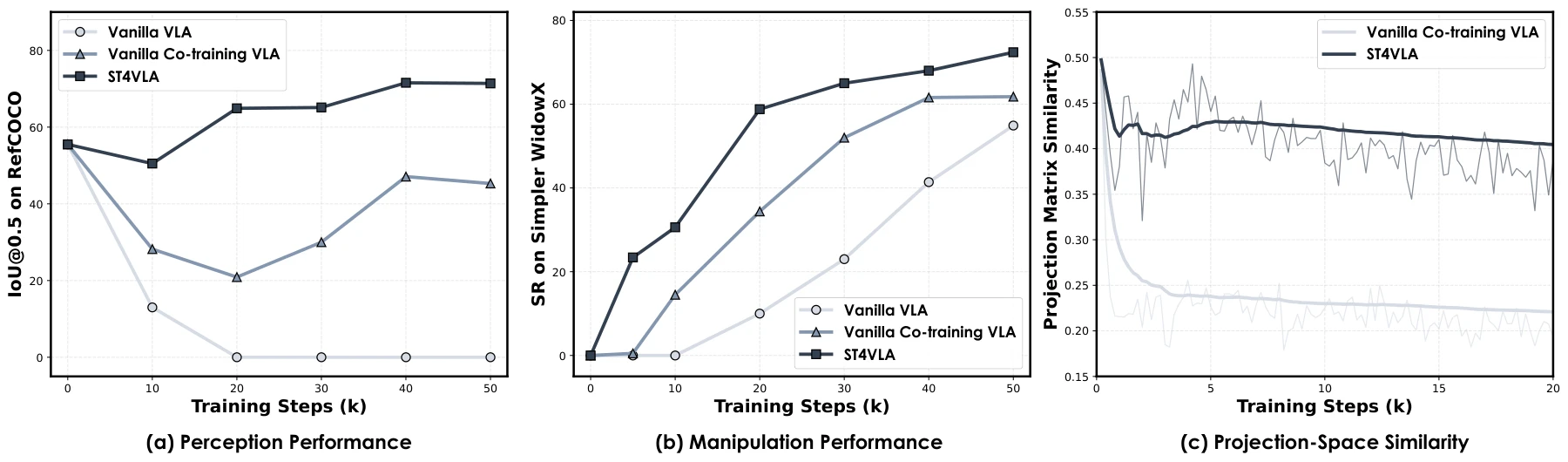
图 4:不同联合训练策略下感知—动作的协同优化动态(转引自基于 StarVLA 的空间引导联合训练研究 ST4VLA(Ye et al., 2026a))。从左到右:(a) 空间定位性能(RefCOCO-g 上的 IoU@0.5);(b) 操作成功率(WidowX);(c) 普通联合训练与空间引导联合训练下,空间定位目标与动作目标之间的梯度子空间对齐程度(PSS)。
原图注:Perception–action co-optimization dynamics under different co-training strategies (reproduced from a StarVLA-based spatially guided co-training study ST4VLA (Ye et al., 2026a)). From left to right: (a) spatial grounding performance (IoU@0.5 on RefCOCO-g); (b) manipulation success rate (WidowX); (c) gradient subspace alignment (PSS) between spatial grounding and action objectives under vanilla co-training vs. spatially guided co-training.
图 4 解读
三幅子图的横轴都是训练步数(单位千步)。(a) 感知性能:纵轴为 RefCOCO-g 的 IoU@0.5。三条线从同一起点(约 55,即主干训练前的定位能力)出发:普通 VLA(空心圆)10K 步时跌到约 13,20K 步起为 0;普通联合训练(三角)先跌到约 20,再回升到 45–48,起伏明显;ST4VLA(实心方块)10K 步时略降到约 50,随后升到约 71 并保持。 (b) 操作性能:纵轴为 SimplerEnv WidowX 成功率。三条线都从 0 开始上升;ST4VLA 最快,20K 步时约 58,50K 步时约 72;普通联合训练最终约 62;普通 VLA 上升最慢,50K 步时约 55。这说明保住感知能力并没有拖慢动作学习,反而让它更快。 (c) 投影空间相似度:纵轴为 PSS(Projection Matrix Similarity),衡量定位损失和动作损失的梯度是否落在相近的子空间里,越高表示两个目标“往同一个方向推”参数。普通联合训练(浅色线)很快降到约 0.22,说明两个目标的梯度方向几乎不相关;ST4VLA(深色线)保持在约 0.41–0.44。作者据此解释空间引导为什么有效:它让感知目标和动作目标的优化方向更一致,从而减少相互干扰。
原文
Table 8 further quantifies the impact of co-training on multimodal understanding, spatial grounding, and robotic manipulation. Compared to the vanilla VLA, vanilla co-training already improves manipulation performance (+4.1% Google Robot VM, +6.4% WidowX) while recovering multimodal capabilities. The spatially guided StarVLA variant pushes the results further, achieving 84.6%/75.9% on Google Robot VM/VA and 73.2% on WidowX, while simultaneously preserving strong spatial grounding (71.2 IoU@0.5 on RefCOCO-g).
译文
表 8 进一步量化了联合训练对多模态理解、空间定位和机器人操作的影响。与普通 VLA 相比,普通联合训练已经提升了操作性能(Google Robot VM 提高 4.1 个百分点,WidowX 提高 6.4 个百分点),同时恢复了多模态能力。空间引导的 StarVLA 变体进一步提升了结果,在 Google Robot VM/VA 上达到 84.6%/75.9%,在 WidowX 上达到 73.2%,同时保持了很强的空间定位能力(RefCOCO-g 上 IoU@0.5 为 71.2)。
解释
增量核对:70.2-66.1=4.1,61.1-54.7=6.4,与原文一致。正文引用的 84.6/75.9、73.2 和 71.2 来自表 8 最后一行“+ 空间预训练”,即在空间引导的基础上再加空间预训练的完整配置。对比第 5 节:单基准设置下 StarVLA-OFT 在 Google Robot VM 上为 76.0%、WidowX 上为 64.6%,联合训练的完整配置分别高出约 8.6 和 8.6 个点,但两者的主干、数据和训练步数是否相同,报告没有说明。
表 8:联合训练策略对多模态理解、空间定位和机器人操作的影响(转引自基于 StarVLA 的空间引导联合训练研究 Ye et al. (2026a))。
| 多模态理解 | 空间定位 | 机器人操作 | ||||||
| 训练策略 | MME | MMVet | TextVQA | POPE Acc | RefCOCO-g IoU@0.5 | RoboRefIt Acc@0.5 | Google Robot VM / VA | WidowX VM |
| 普通 VLA(Vanilla VLA) | – | – | – | – | – | – | 66.1 / 63.5 | 54.7 |
| + 联合训练(Co-training) | 1106 | 19.2 | 20.5 | 78.0 | 47.1 | 66.7 | 70.2 / 66.5 | 61.1 |
| + 空间引导(Spatially guided) | 1374 | 23.0 | 28.4 | 84.6 | 68.1 | 72.5 | 78.8 / 70.0 | 67.4 |
| + 空间预训练(Spatially pretrained) | 1411 | 23.3 | 28.6 | 86.2 | 71.2 | 74.3 | 84.6 / 75.9 | 73.2 |
原表注:Effect of co-training strategies on multimodal understanding, spatial grounding, and robotic manipulation (from a StarVLA-based spatially guided co-training study Ye et al. (2026a)).
表 8 解读
列分三组。多模态理解:MME(感知与认知综合评测,满分约 2800)、MMVet(综合能力问答)、TextVQA(图中文字问答)、POPE(物体幻觉检测,问“图中有没有某物体”的准确率)。空间定位:RefCOCO-g 和 RoboRefIt(机器人场景中的指代定位)。机器人操作:SimplerEnv 的 Google Robot(VM / VA)和 WidowX(VM)成功率。 行是逐步叠加的四种配置,每行都在上一行基础上增加一项。 读法:普通 VLA 的多模态和定位列全是“–”,表示能力已经丧失、无法评测(对应图 4(a) 中降到 0)。加入联合训练后这些能力恢复到可用水平,操作成功率也随之提高;空间引导和空间预训练使三组指标同时进一步提升。最后一行在所有列上都是最好的。由此可以得出本节的核心结论:感知能力和操作能力并不是此消彼长的关系,合适的联合训练可以让两者一起提高。 注意:正文说比较“三种策略”,表中却有四行。“空间引导训练 VLA”在正文中被描述为“加入空间预训练和空间提示”,对应表中最后两行的累积效果。
原文
Takeaways. These results demonstrate that StarVLA's co-training infrastructure enables significant gains over action-only fine-tuning. By preserving multimodal understanding during policy learning, co-training yields more generalizable agents. For a comprehensive treatment of spatially guided co-training, including the full training recipe, gradient alignment analysis, and extensive real-world experiments, we refer readers to the ST4VLA (Ye et al., 2026a), a study paper based on StarVLA.
译文
要点。这些结果表明,StarVLA 的联合训练基础设施相比只用动作数据微调能带来显著提升。通过在策略学习过程中保留多模态理解能力,联合训练得到的智能体泛化能力更强。关于空间引导联合训练的全面论述,包括完整训练配方、梯度对齐分析和大量真机实验,请读者参阅基于 StarVLA 的研究论文 ST4VLA(Ye et al., 2026a)。
解释
“泛化能力更强”在本节中的直接证据是 SimplerEnv 的 VA 设置(光照、背景变化)成绩提升,以及多模态基准分数的恢复;更大范围的泛化证据需要去看 ST4VLA 原文。对 StarVLA 而言,这一节证明的是框架能支撑这类研究,而不是 StarVLA 本身提出了空间引导方法。
7跨基准训练示例(Cross-Benchmark Training Examples)
原文
Building on the benchmark-wise specialist baselines in Sec. 5, we next evaluate a stricter setting for embodied generalization: one model jointly trained across benchmarks and robot embodiments. StarVLA natively supports co-training on heterogeneous datasets under a unified framework, which makes this all-in-one setting a natural case study for generalist VLA training.
译文
在第 5 节逐基准的专精基线基础上,我们接下来评估一个对具身泛化要求更严格的设置:跨基准、跨机器人本体联合训练的单一模型。StarVLA 在统一框架下原生支持异构数据集的联合训练,这使得这种“全合一”设置成为通用 VLA 训练的一个自然案例。
解释
“更严格”体现在:一个模型要同时控制单臂 Franka(LIBERO)、WidowX 和 Google Robot(SimplerEnv)、双臂机器人(RoboTwin)和 GR1 人形机器人(RoboCasa),它们的相机数量、动作维度和控制方式都不同。这一节用到的就是第 3.1.3 节介绍的
LeRobotMixtureDataset。 原文
Existing evaluation patterns. The Embodied AI community shares a common ambition: to develop a generalist agent that can seamlessly operate across diverse tasks, environments, and robots. In practice, however, the research landscape remains fragmented. Many state-of-the-art systems are tuned for specific benchmarks, and their performance can drop substantially when transferred to different environments or embodiments. This makes it difficult to measure true generalization ability.
译文
现有的评测模式。具身智能社区有一个共同的愿景:开发能在多样任务、环境和机器人之间无缝工作的通用智能体。然而在实践中,研究格局仍然是碎片化的。许多最先进的系统都针对特定基准调优,迁移到不同的环境或本体时性能可能大幅下降。这使得衡量真正的泛化能力变得困难。
解释
这是对现状的批评:表格里的“最先进”往往是在每个基准上单独微调出来的,等于每个基准一个专家模型。要衡量“通用”,应当只训练一个模型、在所有基准上直接测试。
7.1实验设置
原文
Training setup. In this setting, we jointly train one model on the merged training sets from LIBERO, SimplerEnv, RoboTwin 2.0, and RoboCasa-GR1, and then directly evaluate on each benchmark under its official protocol. No additional benchmark-specific fine-tuning is applied. We set the learning rate to 1\times10^{-4}, the total batch size to 256, and train jointly on the merged benchmark datasets. To handle action-space differences across embodiments, we avoid task-specific action heads and apply a simple unified padding strategy that expands lower-DoF actions to a shared 32-dimensional action vector.
译文
训练设置。在这一设置下,我们在 LIBERO、SimplerEnv、RoboTwin 2.0 和 RoboCasa-GR1 的训练集合并后的数据上联合训练一个模型,然后直接在各基准上按官方协议评测,不做任何额外的基准专属微调。我们把学习率设为 1\times10^{-4},总 batch size 设为 256,在合并后的基准数据集上联合训练。为了处理不同本体之间动作空间的差异,我们不使用任务专属的动作头,而是采用一种简单的统一填充策略,把自由度较低的动作扩展到共享的 32 维动作向量。
解释
32 维填充:LIBERO 和 SimplerEnv 的动作是 7 维,RoboTwin 双臂是 14 维,GR1 人形加灵巧手维度更高;统一补零到 32 维后,所有样本可以用同一个动作头输出。训练时补零部分的损失通常会被屏蔽或固定为零,推理时只取前若干维。这比“每种机器人一个动作头”简单,但不同本体的同一维度含义不同(例如第 1 维对单臂是 \Delta x,对双臂可能是左臂关节角),需要模型从图像和指令中判断当前是哪种机器人。
报告没有给出训练步数、各数据集的采样权重和所用的动作头,表 9 中的“通用 StarVLA”具体是哪一种动作头也没有说明,这些信息对复现很关键。
报告没有给出训练步数、各数据集的采样权重和所用的动作头,表 9 中的“通用 StarVLA”具体是哪一种动作头也没有说明,这些信息对复现很关键。
原文
Evaluation protocol as a generalist. A practical way to test generalization is to require one model to handle diverse benchmarks simultaneously. Following this principle, we evaluate StarVLA under a unified multi-benchmark setting, where a single policy is trained once and evaluated across suites without benchmark-specific fine-tuning.Baselines. To further demonstrate the effectiveness of our method and the proposed setting, we report both specialist results, where models are trained only on individual datasets, and results from the generalist training setting. In addition to comparing with our model, we also evaluate several state-of-the-art methods, such as \pi_{0.5} and GR00T-N1.6.
译文
作为通用模型的评测协议。检验泛化的一个实用方法,是要求一个模型同时应对多个不同的基准。按照这一原则,我们在统一的多基准设置下评测 StarVLA:单一策略只训练一次,在各个套件上评测,不做基准专属微调。基线。为了进一步说明我们方法和所提设置的有效性,我们同时报告专精结果(模型只在各自的数据集上训练)和通用训练设置下的结果。除了与我们自己的模型比较,我们还评测了若干最先进的方法,如 \pi_{0.5} 和 GR00T-N1.6。
解释
对照设计:同一套代码下的“专精 StarVLA(每个基准一个模型)”与“通用 StarVLA(一个模型)”是最干净的比较,能直接回答“合训会不会互相干扰”。\pi_{0.5} 和 GR00T-N1.6 作为外部参照,它们在表 9 中都是专精设置。
表 9:通用与专精设置的性能比较。专精(Specialist)指在各基准专属数据集上分别训练的多个模型;通用(Generalist)指在全部数据集上联合训练的单个模型。
| 设置 | 方法 | LIBERO | SimplerEnv | RoboTwin 2.0 | RoboCasa-GR1 | ||||||||
| Spatial | Object | Goal | Long | avg | WidowX | Google VA | Google VM | clean | clean^* | random^* | (24 任务平均) | ||
| 专精 | \pi_{0.5} | 98.8 | 98.2 | 98.0 | 92.4 | 96.9 | 46.9 | 68.4 | 72.7 | 60.2 | 82.7 | 76.8 | 37.0 |
| GR00T-N1.6 | 97.5 | 98.5 | 97.5 | 94.4 | 94.1 | 67.8 | 41.5 | 35.2 | – | – | – | 47.6 | |
| StarVLA-\pi | 98.0 | 99.2 | 98.2 | 93.6 | 98.1 | 65.9 | 72.8 | 76.6 | 50.8 | 88.1 | 88.8 | 48.9 | |
| StarVLA-GR00T | 98.9 | 99.6 | 98.4 | 95.3 | 98.7 | 65.3 | 70.7 | 75.3 | 48.8 | 88.0 | 88.5 | 52.8 | |
| StarVLA-OFT | 99.0 | 99.8 | 98.5 | 94.1 | 98.8 | 64.6 | 70.2 | 76.0 | 53.4 | 88.2 | 88.3 | 53.8 | |
| 通用 | StarVLA | 98.7 | 99.7 | 98.6 | 94.2 | 97.8 | 70.2 | 73.8 | 79.3 | – | 88.7 | 87.8 | 57.3 |
原表注:Performance comparison between generalist and specialist settings. Specialist represents multiple models trained separately on each benchmark-specific dataset, while Generalist represents a single model jointly trained across all datasets.
表 9 解读
列按基准分组:LIBERO 四个 suite 及平均;SimplerEnv 的 WidowX、Google Robot VA 和 VM;RoboTwin 2.0 的 clean、clean^*、random^* 三列(星号含义原文未说明,clean^*/random^* 与表 7 数字一致);RoboCasa-GR1 的 24 任务平均。行上半部分是五个专精模型(两个外部方法、三个 StarVLA 变体),下半部分是一个通用 StarVLA 模型。 通用模型的表现(与最好的 StarVLA 专精模型比):SimplerEnv 三列全面更好,WidowX 70.2 对 65.9,Google VA 73.8 对 72.8,Google VM 79.3 对 76.6;RoboCasa-GR1 为 57.3 对 53.8;LIBERO 和 RoboTwin 基本持平(逐 suite 相差都不超过 1.1 个点)。也就是说,把多个基准的数据合在一起训练,没有出现明显的相互干扰,在 SimplerEnv 和 RoboCasa 上还有正迁移。 表内数字需谨慎对待:
(1) LIBERO 平均列与四个 suite 不一致。按四项计算,GR00T-N1.6 应为 97.0(原表 94.1),StarVLA-\pi 应为 97.3(原表 98.1),StarVLA-GR00T 应为 98.1(原表 98.7),StarVLA-OFT 应为 97.9(原表 98.8);只有 \pi_{0.5} 和通用模型一致。按正确值,通用模型的 LIBERO 平均(97.8)与专精模型(97.3–98.1)相当。
(2) StarVLA 专精模型的数字与第 5 节不同:LIBERO 的 StarVLA-OFT 在表 2 中各 suite 为 97.8/98.6/96.2/93.8,这里为 99.0/99.8/98.5/94.1;WidowX 的 StarVLA-\pi 在表 3 中为 60.9,这里为 65.9;RoboCasa 三个变体比表 5 各高 5.0 个点。报告没有说明这里的专精模型是否训练更久或换了配置。
(3) GR00T-N1.6 的 Google VM 为 35.2,与表 4 中作者复现的 GR00T N1.5 完全相同,可能是沿用了同一个数字。
(1) LIBERO 平均列与四个 suite 不一致。按四项计算,GR00T-N1.6 应为 97.0(原表 94.1),StarVLA-\pi 应为 97.3(原表 98.1),StarVLA-GR00T 应为 98.1(原表 98.7),StarVLA-OFT 应为 97.9(原表 98.8);只有 \pi_{0.5} 和通用模型一致。按正确值,通用模型的 LIBERO 平均(97.8)与专精模型(97.3–98.1)相当。
(2) StarVLA 专精模型的数字与第 5 节不同:LIBERO 的 StarVLA-OFT 在表 2 中各 suite 为 97.8/98.6/96.2/93.8,这里为 99.0/99.8/98.5/94.1;WidowX 的 StarVLA-\pi 在表 3 中为 60.9,这里为 65.9;RoboCasa 三个变体比表 5 各高 5.0 个点。报告没有说明这里的专精模型是否训练更久或换了配置。
(3) GR00T-N1.6 的 Google VM 为 35.2,与表 4 中作者复现的 GR00T N1.5 完全相同,可能是沿用了同一个数字。
7.2作为通用模型的主要结果
原文
As shown in Table 9, we compare our generalist model (jointly trained across datasets) with specialist models trained per benchmark. The generalist model remains competitive across most benchmarks and improves RoboCasa-GR1 from the best specialist average of 48.8% to 57.3% on the 24-task average. These results support the feasibility of a single policy that transfers across tasks and embodiments under a unified training/evaluation setting.
译文
如表 9 所示,我们把通用模型(跨数据集联合训练)与逐基准训练的专精模型进行比较。通用模型在大多数基准上保持了竞争力,并把 RoboCasa-GR1 的 24 任务平均成功率从最佳专精模型的 48.8% 提高到 57.3%。这些结果支持了在统一训练/评测设置下,单一策略跨任务、跨本体迁移的可行性。
解释
数字口径不一致:这里的 48.8% 是表 5 中 StarVLA-OFT 的专精成绩,但表 9 本身列出的最佳专精成绩是 53.8%。按表 9 计算提升为 3.5 个点,按表 5 计算为 8.5 个点。无论按哪个口径,通用模型在 RoboCasa 上都更好,但幅度应以同一张表内的比较(+3.5)更为稳妥。
为什么合训对 RoboCasa 有帮助:RoboCasa-GR1 的任务大多是拾取—放置,与 LIBERO、SimplerEnv、RoboTwin 中的大量拾放数据在技能上相通;合训等于增加了“抓取和放置”这一通用技能的训练数据。这是一种合理的解释,报告本身没有做消融验证。
为什么合训对 RoboCasa 有帮助:RoboCasa-GR1 的任务大多是拾取—放置,与 LIBERO、SimplerEnv、RoboTwin 中的大量拾放数据在技能上相通;合训等于增加了“抓取和放置”这一通用技能的训练数据。这是一种合理的解释,报告本身没有做消融验证。
原文
Takeaways. This section focuses on a direct capability demonstration rather than ablation analysis: StarVLA can jointly train on heterogeneous, cross-embodiment benchmark datasets and produce a single model that remains competitive across diverse evaluation suites. We view this as evidence that all-in-one multi-benchmark training is a practical path toward large-scale cross-embodiment pretraining for future generalist VLA systems.
译文
要点。本节侧重于直接展示能力,而不是消融分析:StarVLA 能够在异构的、跨本体的基准数据集上联合训练,得到一个在多种评测套件上都保持竞争力的单一模型。我们认为这证明了全合一的多基准训练是通向未来通用 VLA 系统大规模跨本体预训练的一条可行路径。
解释
作者明确说本节是能力展示而非消融:没有分析哪些数据集对哪些基准有帮助,也没有比较不同的采样权重或动作空间处理方式。从研究角度看,这些正是后续值得做的实验。需要提醒的是,四个基准都是仿真数据,规模也远小于 OXE 等真实数据集,“通向大规模跨本体预训练”是作者的展望,本节只提供了初步证据。
8计算效率(Computation Efficiency)
原文
This section reports the training efficiency of StarVLA using the public profiling measurements collected in issue https://github.com/starVLA/starVLA/issues/158. Our goal is to provide actionable scaling guidance for practitioners, while keeping the reported metrics aligned with common distributed-training bottlenecks (compute and communication).
译文
本节使用 GitHub issue https://github.com/starVLA/starVLA/issues/158 中收集的公开性能测量数据,报告 StarVLA 的训练效率。我们的目标是为实践者提供可操作的扩展指导,同时使报告的指标与分布式训练中常见的瓶颈(计算与通信)保持对应。
解释
这一节回答两个实际问题:一台 8 卡机器上 batch size 怎么设,以及加机器能快多少。数据来自社区在 GitHub issue 中公开的测量,属于工程报告,而非受控的论文实验。
原文
Experimental setup. Unless otherwise specified, the measurements use StarVLA-GR00T with a Qwen3-VL-4B backbone trained on the RoboCasa-GR1 dataset on A100 80GB GPUs. We report wall-clock time per 100K optimization steps, which includes distributed communication and system overhead.Efficiency metrics. We distinguish two throughput notions: (i) step throughput (lower seconds/step is better), and (ii) sample throughput (higher samples/s is better), where samples/s is computed as \text{global batch} / (\text{seconds per step}). This distinction is important because distributed scaling often decreases step throughput (due to synchronization) while increasing sample throughput (due to larger global batch).
译文
实验设置。除非另有说明,测量均使用以 Qwen3-VL-4B 为主干的 StarVLA-GR00T,在 A100 80GB GPU 上用 RoboCasa-GR1 数据集训练。我们报告每 100K 个优化步的实际耗时(wall-clock time),其中包含分布式通信和系统开销。效率指标。我们区分两种吞吐量:(i) 步吞吐量(每步秒数越低越好);(ii) 样本吞吐量(每秒样本数越高越好),计算方式为 \text{全局 batch} / \text{每步秒数}。这一区分很重要,因为分布式扩展往往会降低步吞吐量(由于同步开销),同时提高样本吞吐量(由于全局 batch 更大)。
解释
举例:8 卡、每卡 batch 8 时全局 batch 为 64,每步 0.735 秒,样本吞吐量 =64/0.735\approx87 个/秒。换成 256 卡后全局 batch 为 2048,每步变慢到 0.931 秒,但每秒能处理 2048/0.931\approx2200 个样本。“训练固定步数”与“训练固定数据量”的区别由此而来:如果配置写死 100K 步,加卡不会让训练更快结束,只会让每步看到更多数据。
表 10:单节点训练效率(8 \times A100)。样本吞吐量由每 100K 步的实测时间和全局 batch size 推算。
| 每卡 batch | 全局 batch | 每 100K 步耗时 | 每步秒数 | 样本数/秒 | GPU 利用率 |
| 2 | 16 | 19:32:17 | 0.703 | 22.7 | 74% |
| 4 | 32 | 24:35:59 | 0.886 | 36.1 | 89% |
| 8 | 64 | 31:25:38 | 1.131 | 56.6 | 92% |
| 16 | 128 | 49:15:53 | 1.774 | 72.2 | 91% |
| 24 | 192 | 66:47:02 | 2.404 | 79.9 | 96% |
原表注:Single-node training efficiency (8 \times A100). Sample throughput is derived from the measured time per 100K steps and the global batch size.
表 10 解读
列:每卡 batch 和全局 batch(=8\times每卡 batch);每 100K 步耗时(时:分:秒);每步秒数 = 耗时 /100{,}000;样本数/秒 = 全局 batch / 每步秒数;GPU 利用率。 核对:19:32:17 即 70,337 秒,除以 100K 得 0.703 秒/步;16/0.703=22.8。各行均可按此验算,与原表一致。 读法:每卡 batch 从 2 增到 24(12 倍),每步时间只增加到 3.4 倍,所以样本吞吐量从 22.7 升到 79.9(约 3.5 倍)。但边际收益递减:从 16 到 24,吞吐量只多了 7.7 个/秒。GPU 利用率在 batch 4 以上就接近饱和(89–96%)。按这张表,以每卡 batch 16 训练 100K 步约需 49 小时;第 5 节 LIBERO 设置(8 卡、每卡 16)的时间成本可以此为参考,但该测量用的是 RoboCasa-GR1 数据和 GR00T 动作头,不同基准的图像路数不同,实际耗时会有差别。
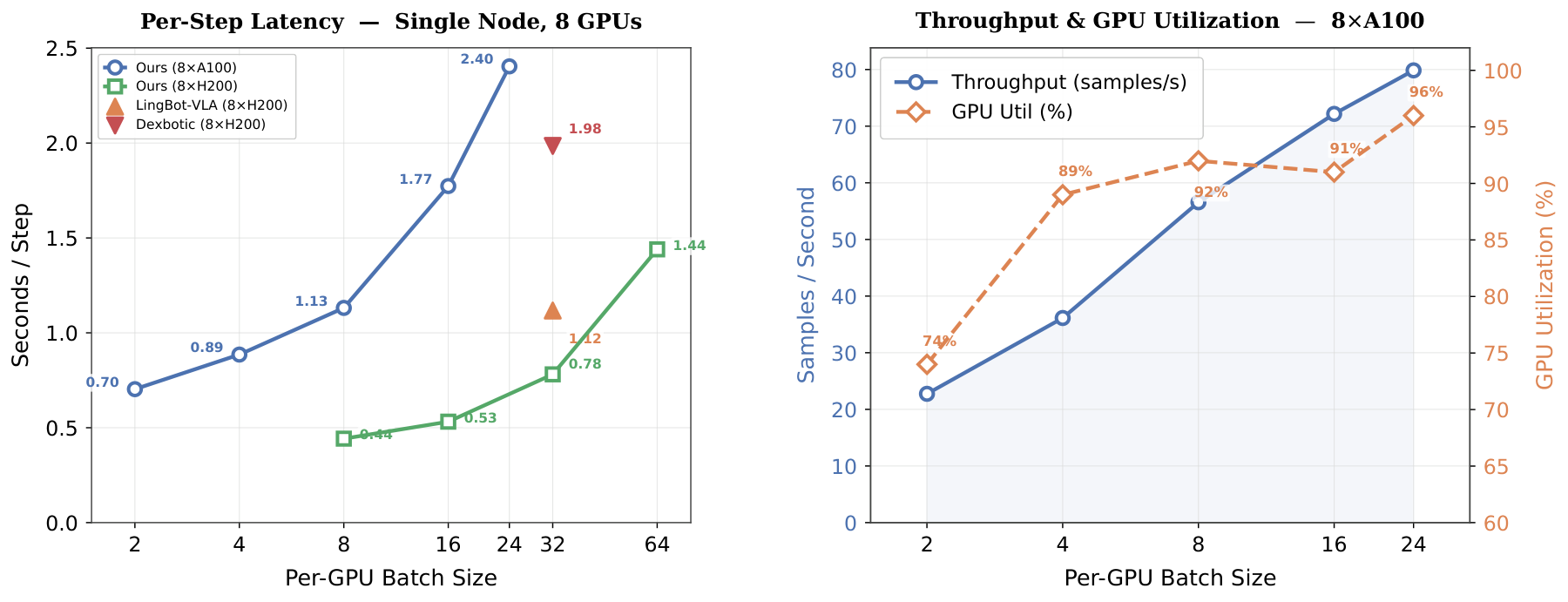
图 5:单个 8 卡节点上的单步延迟和吞吐量。左:单步延迟随每卡 batch size 的变化,包括我们的方法在 A100 和 H200 上的结果,以及 LingBot-VLA 和 Dexbotic(均为 8\timesH200)的对比。右:8\timesA100 上不同 batch size 下的训练吞吐量和 GPU 利用率。
原图注:Per-step latency and throughput on a single 8-GPU node. Left: step latency as a function of per-GPU batch size for our method on A100 and H200, compared with LingBot-VLA and Dexbotic (both on 8×H200). Right: training throughput and GPU utilization on 8×A100 across batch sizes.
图 5 解读
左图:横轴为每卡 batch size(对数刻度,2–64),纵轴为每步秒数。蓝色圆点是 StarVLA 在 8\timesA100 上的测量(即表 10,0.70 到 2.40);绿色方块是 StarVLA 在 8\timesH200 上的测量(batch 8、16、32、64 分别为 0.44、0.53、0.78、1.44 秒);橙色正三角是 LingBot-VLA(batch 32 时 1.12 秒),红色倒三角是 Dexbotic(batch 32 时 1.98 秒)。在同为 H200、batch 32 的条件下,StarVLA 为 0.78 秒,比 LingBot-VLA 快约 30%,比 Dexbotic 快约 60%。 右图:横轴为每卡 batch size,左纵轴(蓝色实线)为样本吞吐量,右纵轴(橙色虚线)为 GPU 利用率,数值即表 10。 注意:正文没有讨论与 LingBot-VLA、Dexbotic 的对比,也没有说明三者所用的模型和数据是否相同;若模型参数量或图像分辨率不同,单步时间不能直接比较。
8.1单节点训练效率
原文
Table 10 summarizes a single-node sweep that varies the per-GPU batch size. We omit derived “24-hour” projections and focus on directly measured quantities and the implied sample throughput.Figure 5 visualizes the main trade-off. Smaller per-GPU batches yield faster steps (e.g., 0.703 s/step at batch 2 vs. 2.404 s/step at batch 24), while larger per-GPU batches improve sample throughput (from 22.7 to 79.9 samples/s) at the cost of sharply increased step latency.
译文
表 10 汇总了改变每卡 batch size 的单节点扫描实验。我们省略了推算出的“24 小时”预估值,只关注直接测量的量以及由此得出的样本吞吐量。图 5 展示了主要的权衡。每卡 batch 越小,每步越快(例如 batch 2 时每步 0.703 秒,batch 24 时每步 2.404 秒);每卡 batch 越大,样本吞吐量越高(从 22.7 提高到 79.9 个/秒),代价是单步延迟急剧增加。
解释
“24 小时预估”大概是 GitHub issue 中原有的“一天能跑多少步”之类的换算,作者认为它是推算值而非测量值,所以没有采用。实际选择时要看训练目标:如果按步数训练(如第 5 节的 30K–150K 步),小 batch 更快结束;如果按数据量(epoch)训练,大 batch 更省时间。
8.2多节点扩展效率
原文
We next fix per-GPU batch size to 8 and scale the number of GPUs. As shown in Table 11, the time per step rises from 0.735 s (8 GPUs) to 0.899 s (32 GPUs) due to inter-node communication overhead, then plateaus at {\sim}0.93 s up to 256 GPUs. Despite this overhead, sample throughput scales from 87.0 to 2200.0 samples/s, which is the relevant metric when the training objective is to process a fixed amount of data quickly.
译文
接下来我们把每卡 batch size 固定为 8,增加 GPU 数量。如表 11 所示,由于节点间通信开销,每步时间从 0.735 秒(8 卡)上升到 0.899 秒(32 卡),之后稳定在约 0.93 秒,一直到 256 卡。尽管存在这一开销,样本吞吐量仍从 87.0 个/秒扩展到 2200.0 个/秒;当训练目标是尽快处理固定数量的数据时,这才是相关的指标。
解释
这是弱扩展(weak scaling)实验:每卡负载固定,总负载随卡数增长。与之相对的强扩展是总 batch 固定、卡越多每卡越少。弱扩展更符合大规模预训练的实际用法。从 8 卡到 256 卡,卡数增加 32 倍,吞吐量增加 2200/87\approx25.3 倍。
表 11:多节点训练效率(每卡 batch =8)。“理想”扩展假设样本吞吐量从 8 卡基线开始线性增长。
| GPU 数 | 全局 batch | 每 100K 步耗时 | 每步秒数 | 样本数/秒 | 扩展效率 |
| 8 | 64 | 20:25:48 | 0.735 | 87.0 | 100% |
| 16 | 128 | 23:36:00 | 0.850 | 150.7 | 86.7% |
| 32 | 256 | 24:58:45 | 0.899 | 284.7 | 81.9% |
| 64 | 512 | 25:40:59 | 0.925 | 553.8 | 79.6% |
| 128 | 1024 | 25:35:26 | 0.921 | 1111.5 | 79.9% |
| 256 | 2048 | 25:51:41 | 0.931 | 2200.0 | 79.1% |
原表注:Multi-node training efficiency (per-GPU batch = 8). “Ideal” scaling assumes linear growth of samples/s from the 8-GPU baseline.
表 11 解读
扩展效率 = 实测样本吞吐量 /(8 卡吞吐量 \times GPU 数 /8)。例如 16 卡:150.7/(87.0\times2)=86.6\%;256 卡:2200/(87.0\times32)=79.0\%,与原表一致。 读法:8 卡是单机,16 卡起跨机。从 8 到 32 卡,每步时间从 0.735 秒涨到 0.899 秒,这是跨机通信带来的开销;32 卡之后每步时间基本稳定在 0.92–0.93 秒,扩展效率稳定在约 79–80%。 与表 10 的矛盾:同样是 8 张 A100、每卡 batch 8,表 10 为每步 1.131 秒(56.6 个/秒),表 11 为每步 0.735 秒(87.0 个/秒),相差约 54%。报告没有说明两组测量的差别(可能是不同的软件版本、数据加载设置或机器)。这意味着表 10 和表 11 不能混在一起推算。
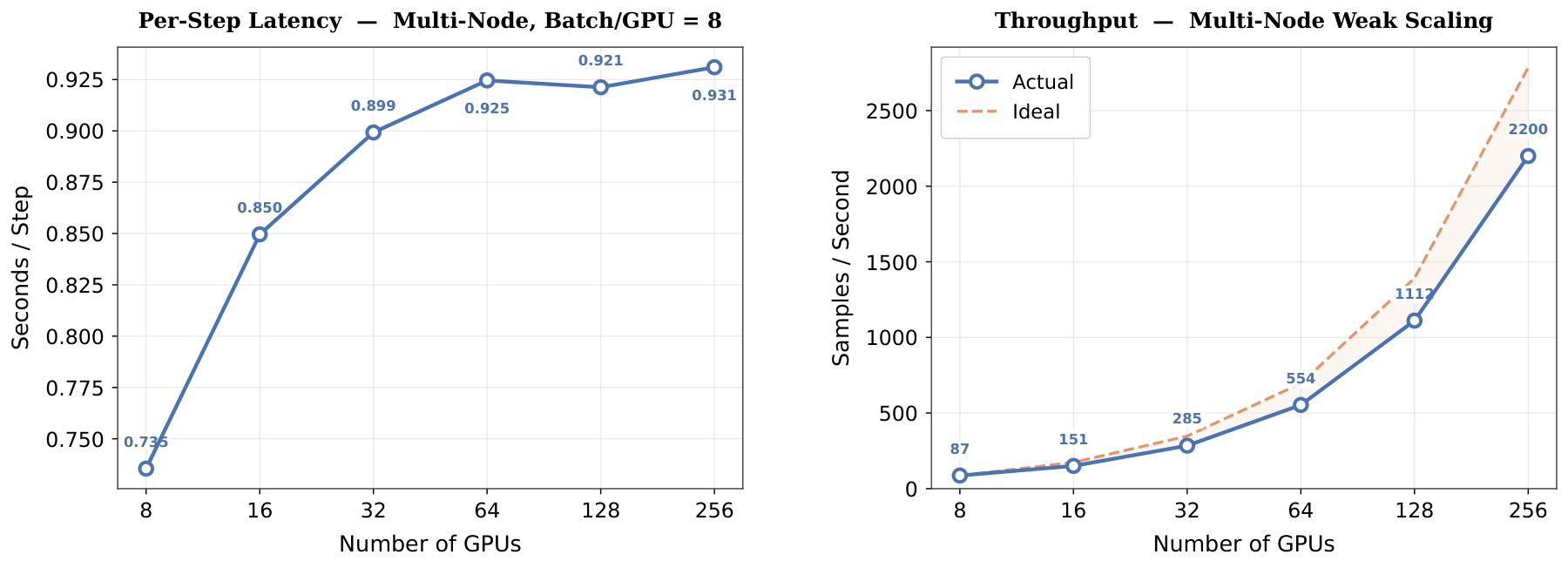
图 6:多节点扩展效率。左:由于节点间通信开销,单步延迟从 8 卡到 32 卡明显上升,之后在 64 到 256 卡之间趋于平稳。右:实测样本吞吐量与理想线性扩展的对比;超过 32 卡后并行效率稳定在约 79–80%。
原图注:Multi-node scaling efficiency. Left: per-step latency rises noticeably from 8 to 32 GPUs due to inter-node communication overhead, then plateaus between 64 and 256 GPUs. Right: measured sample throughput versus ideal linear scaling; parallel efficiency stabilizes around 79–80% beyond 32 GPUs.
图 6 解读
左图:横轴为 GPU 数(8–256,对数刻度),纵轴为每步秒数,纵轴范围只有 0.75–0.93,所以曲线看起来上升很陡,实际只增加了约 0.2 秒。右图:纵轴为样本吞吐量,蓝色实线是实测值(87、151、285、554、1112、2200),橙色虚线是理想线性扩展(从 87 按卡数等比放大,256 卡时约 2784),两线之间的阴影就是通信造成的损失,256 卡时约 21%。 要点:损失主要发生在“单机变多机”的那一步(8\to32 卡),之后不再继续变差,因此扩展到数百卡是可行的。
原文
Figure 6 plots both step latency and sample throughput against GPU count, together with the ideal linear reference line. The results highlight a practical guideline: scaling out is most beneficial for data-volume-driven training, while fixed-step training does not become faster with more GPUs.
译文
图 6 绘制了单步延迟和样本吞吐量随 GPU 数量的变化,并给出理想线性扩展的参考线。结果给出了一条实用准则:横向扩展对以数据量为目标的训练最有益,而以固定步数为目标的训练并不会因为 GPU 增多而变快。
解释
换成具体决策:若计划“把 OXE 全部数据过 5 遍”,多加卡可以近似线性地缩短训练时间;若沿用“训练 100K 步”的配置,加卡只会让每步看到更多样本(相当于增大 batch),总时间反而略增。此时通常还需要相应调大学习率。
原文
Takeaways. First, inter-node communication introduces a one-time latency overhead (0.735\to0.93 s/step), but sample throughput still scales near-linearly via larger global batch. Second, on a single node, a moderate per-GPU batch (e.g., 8) often provides the best balance between step latency and GPU utilization; very large batches (e.g., 24) maximize utilization (96%) but inflate step latency by 3.4\times. Third, for large-scale training, once the system scales beyond 8 nodes (64 GPUs), the communication burden no longer grows further, maintaining a stable scaling efficiency of 79–80%. This indicates that practitioners can confidently scale to hundreds of GPUs without incurring additional parallel efficiency degradation.
译文
要点。第一,节点间通信带来一次性的延迟开销(每步 0.735\to0.93 秒),但借助更大的全局 batch,样本吞吐量仍近似线性扩展。第二,在单节点上,中等的每卡 batch(如 8)往往在单步延迟和 GPU 利用率之间取得最好的平衡;非常大的 batch(如 24)能使利用率最高(96%),但单步延迟会增加到 3.4 倍。第三,对大规模训练而言,一旦系统扩展到 8 个节点(64 卡)以上,通信负担不再继续增长,扩展效率稳定在 79–80%。这表明实践者可以放心地扩展到数百张 GPU,而不会带来额外的并行效率下降。
解释
第二点的“3.4 倍”是相对于 batch 2 的 0.703 秒(2.404/0.703\approx3.42),而非相对于推荐的 batch 8;相对 batch 8 只增加到约 2.1 倍。第三点的“通信负担不再增长”只在 64–256 卡的测量范围内成立,更大规模(上千卡)的行为报告没有测量。整体来看,79% 的弱扩展效率对 4B 级模型的数据并行训练属于正常水平,说明 StarVLA 的分布式实现没有明显短板。
参考文献
参考文献从略,见原文第 20–24 页。正文引用沿用原文的“作者,年份”格式,可据此在原文参考文献表中查找。原文第 19 页为英文目录,本译稿以中文目录代替。9StarVLA v1.0 的作者与贡献者(Authors and Contributors for StarVLA v1.0)
原文
StarVLA thrives on the synergy between its dedicated core team and a vibrant open-source community. To accurately reflect the nature of involvement, we list contributors in two categories: Authors and Community Contributors. We extend our deepest gratitude to everyone who has helped shape and scale StarVLA.Authors. Jinhui Ye, Ning Gao, Yilun Chen^\dagger, Weiyu Guo, Zixuan Wang, Yuxing Chen, Fangjing Wang, Senqiao Yang, Chengyao Wang, Yuqi Liu, Meng Chu, Changsheng Lu, Pengguang Chen, Shu Liu^\dagger, Jiaya Jia^{\dagger *}Community Contributors. Junqiu Yu, Shuang Zeng, Shijie Lian, Hanwen Wan, Changjiu Zhang, Zhijie Song, Mingsheng Li, Qiuyue Wang, Sicheng Xie, Jinliang Zheng, Deyu Zhou, Jiaming Zhou, Lu Dai, Xiaorui ZhaoContributor Policy. Authors constitute the core team of StarVLA. This group is responsible for continuously iterating on core features, maintaining the foundational framework, and providing ongoing, long-term support for the project. Researchers and developers who are interested in making sustained, structural contributions and wish to join the core author team are highly encouraged to contact us. Community Contributors are the vital force behind the project's broader ecosystem. We continuously receive invaluable support from the open-source community—ranging from new feature implementations (pull requests) and bug fixes to constructive feedback. We deeply appreciate these efforts, which allow StarVLA to evolve rapidly. The full and actively updated contributor history is maintained at starvla.github.io/contributors.^\daggerCorresponding authors. * Von Neumann Institute, HKUST
译文
StarVLA 的发展得益于专注的核心团队与活跃的开源社区之间的协作。为准确反映参与的性质,我们把贡献者分为两类:作者和社区贡献者。我们向所有帮助塑造和扩展 StarVLA 的人致以最深的谢意。作者与社区贡献者名单见左侧原文,姓名不译。贡献者政策。作者构成 StarVLA 的核心团队,负责持续迭代核心功能、维护基础框架,并提供长期支持。有意做出持续性、结构性贡献并希望加入核心作者团队的研究者和开发者,欢迎与我们联系。社区贡献者是项目更广泛生态的重要力量。我们不断从开源社区获得宝贵支持,包括新功能实现(pull request)、缺陷修复和建设性反馈。我们非常感谢这些努力,它们使 StarVLA 得以快速发展。完整且持续更新的贡献者历史见 starvla.github.io/contributors。^\dagger通讯作者。* 香港科技大学冯诺依曼研究院。
解释
核心作者 15 人、社区贡献者 14 人;通讯作者为 Yilun Chen、Shu Liu 和贾佳亚(Jiaya Jia)。第一作者 Jinhui Ye 也是第 6 节引用的 ST4VLA 的第一作者。作为持续更新的开源项目,作者名单会随版本变化。
译者附注:原文数字与表述核对汇总
以下问题已在正文对应位置的解释框中说明,这里集中列出,便于引用原文数字时查对。“应为”一栏是按原文自身数据计算的结果。| 位置 | 原文 | 核对结果 |
| 第 2.2 节 | forward 返回 {raw images, str, ...} | 正文说明返回损失字典,箭头右侧写法有误 |
| 第 2.2、2.3 节 | “Qwen2.5-VL, z”“head.i” | 排版残留字符 |
| 第 2.1、2.2 节 | 若干引用键 | InternVL 引的是 InternVLA-A1,Cosmos 引的是 Cosmos Policy;EMMA、MotionTrans 与所述内容不符 |
| 引言 / 表 1 | “五个主流基准”与表 1 中的 7 | 按第 4.2 节计为 7 个;v1 只报告了其中 4 个的成绩 |
| 第 4.2 节 | LIBERO “130 个任务分为四个 suite,约 6.5K 轨迹” | 130 个任务含 LIBERO-90;常用四个 suite 共 40 个任务、约 2K 条示范 |
| 表 3 | \pi_0-FAST 平均 48.3;Magma 平均 35.8 | 应为 32.1;35.4 |
| 表 4 | StarVLA-OFT(VM)平均 76.0;SpatialVLA(VM)75.1 | 应为 76.3;三项平均 73.8 |
| 表 4 | 部分方法只有三项任务 | 三项平均不能与四项平均直接比较 |
| 表 6 | StarVLA-\pi 平均 43.9 | 逐任务平均为 44.3 |
| 表 5 与表 9 | RoboCasa 专精成绩 43.9/47.8/48.8 | 表 9 中为 48.9/52.8/53.8,各高 5.0 |
| 表 2 与表 9 | LIBERO、WidowX 专精成绩 | 两表数字不同,未说明原因 |
| 表 9 | LIBERO 平均列 | GR00T-N1.6 应为 97.0,StarVLA-\pi 97.3,-GR00T 98.1,-OFT 97.9 |
| 第 7.2 节 | RoboCasa 从最佳专精 48.8 提升到 57.3 | 表 9 内最佳专精为 53.8,提升 3.5 个点 |
| 表 9 | RoboTwin clean / clean^* / random^* | 星号含义未说明 |
| 图 4 正文 | ST4VLA“保持约 70% 原有定位性能” | 图中定位成绩从约 55 升到约 71,应指 IoU 约 70 |
| 表 10 与表 11 | 8\timesA100、每卡 batch 8 | 每步 1.131 秒与 0.735 秒,两组测量不一致 |